
The most profitable trade in U.S. energy this year just met its first real test. The threat did not come from oil falling. It came from the possibility that a war might end.
Shares of Valero Energy Corp. (NYSE:VLO) fell 8.4% in afternoon trading Tuesday, their steepest decline since early April 2025, when markets were absorbing President Donald Trump‘s “Liberation Day” tariffs.
Marathon Petroleum Corp. (NYSE:MPC) dropped 6.7%, its worst session since April 10, 2025. Phillips 66 (NYSE:PSX) lost 6.5%, the most since Dec. 16.
The VanEck Oil Refiners ETF (NYSE:CRAK) slid 3.3%, cushioned by its international holdings. The fund is still up nearly 65% in 2026, compared with a 12% gain for the SPDR S&P 500 ETF Trust (NYSE:SPY).
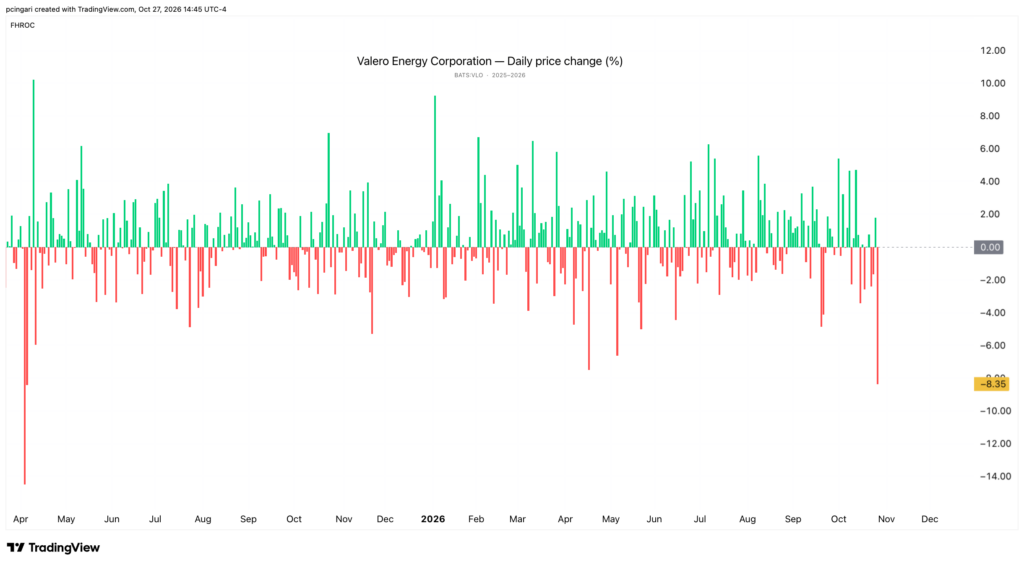
Valero Energy daily chart. Source: TradingView
A Margin Repricing, Not an Oil Story
West Texas Intermediate crude fell 1.8% to just under $100 a barrel. Gasoline futures lost 2.2%, and heating oil futures gave up 2.7%.
When refiners fall more than three times harder than the fuels they sell, the market is not repricing the barrel. Instead, it is repricing the crack spread.
The drop also interrupts a rare run. Marathon has risen for 10 straight months, matching the record streak it set between June 2012 and March 2013. October still has three sessions left to decide whether that streak survives.
Two Signals From Tehran and Moscow
On Tuesday, Iranian state media reported that Supreme Leader Mojtaba Khamenei met the country’s top security official after talks in Tehran with Saudi Arabia, Turkey and Pakistan.
Khamenei insisted that Iran’s conditions for ending the war must be met. Even so, the four countries agreed to keep talking.
Meanwhile, Russian diesel is moving west again. A tanker carrying 40,000 tons of Russian diesel left Primorsk on Oct. 22 and is due in New York around Nov. 7, Reuters reported last week.
It would be the first U.S. import of a Russian petroleum product since 2022. The cargo is moving under the sanctions relief tied to Trump’s deal with Vladimir Putin.
Neither development adds much physical fuel today. Together, however, they attack the premise of the trade.
The Bet Was on Two Closed Chokepoints
Oil flows through the Strait of Hormuz averaged 11.7 million barrels a day in October, according to Kpler data, up from 9.75 million in September but still about 18% below pre-war levels.
Russia banned diesel exports over the summer after Ukrainian drones damaged its refineries. In the U.S., distillate inventories stood about 9% below their five-year seasonal average in the week ended Oct. 16, Energy Information Administration data showed.
That squeeze pushed diesel margins above $100 a barrel at times. It also lifted U.S. retail diesel to $6.32 a gallon, from $3.63 a year ago.
For Valero, it produced a record quarter. Its third-quarter refining margin nearly tripled to $39.24 per barrel. Net income attributable to shareholders reached $6.8 billion, or $23.89 per share.
A refinery in this environment works like a toll bridge over a flooded river. The toll is worth most when every other crossing is under water.
Talks in Tehran and tankers out of Primorsk do not lower the water today. They do, however, give the flood a timeline.
Valero Saw the Headlines Coming
On last Thursday’s earnings call, Valero Chief Operating Officer Gary Simmons addressed the pressure directly.
“Some of the downward pressure on cracks is really related to more headlines, [but] when you digest the data and you look at how much volume is actually coming out, and then lifting of sanctions is more just a change in trade flows, I think we will see a recovery in cracks moving forward,” Simmons said.
He added that the Russian deal did not represent a “significant volume.”
Wall Street had flagged the same risks a month earlier. On Sept. 22, Jefferies analyst Lloyd Byrne downgraded both Valero and Marathon to Hold from Buy, with price targets of $401 and $413, respectively.
“The current share price implies 2030 midcycle margins near 2025 levels,” Byrne said in the note.
He named diesel demand destruction, an end to the war and political intervention as the key risks. Five weeks later, two of those three surfaced in the same week.
The Squeeze Has Not Gone Away
The physical market is still tight. Brent trades near $110 a barrel, and the first Russian diesel cargo has not yet reached New York.
Bjarne Schieldrop of SEB said, “There is a significant risk premium in crude oil prices.”
For refiners, the question is not whether that premium exists. It is how long it stays inside fuel margins.
The refining trade of 2026 was never just a bet on oil. It was a bet that two of the world’s most important fuel chokepoints would stay shut at the same time. On Tuesday, investors started to price in what happens when one of them begins to open.
Photo: Shutterstock