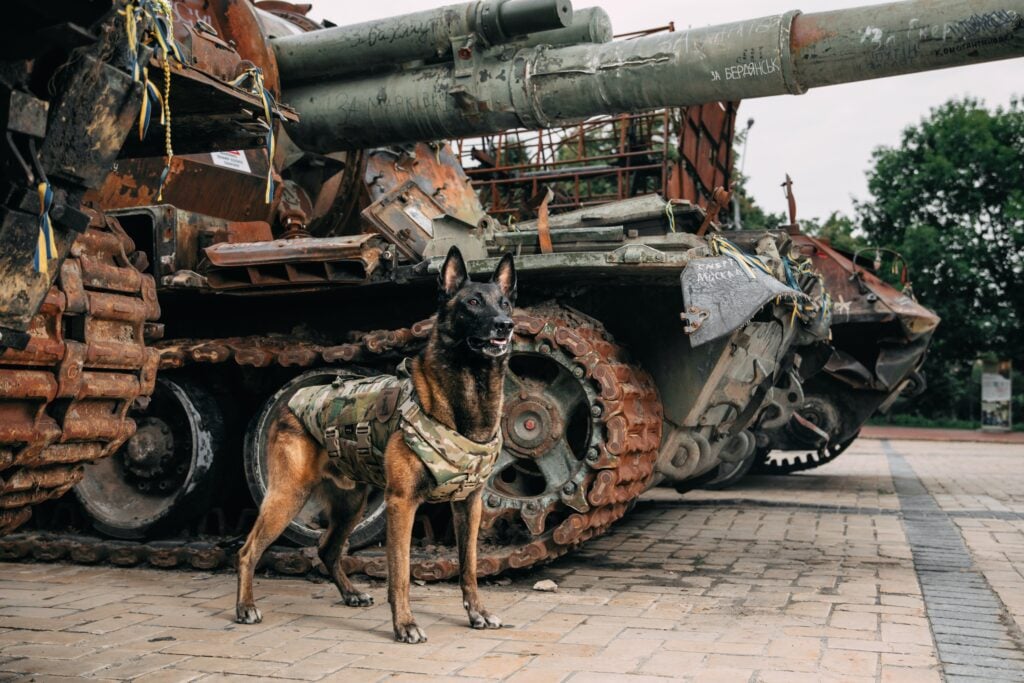
Palmer Luckey and Ben Lamm have launched Warhound, a stealth startup aiming to genetically engineer high-performance military working dogs for U.S. defense and first responders.
Warhound said it raised $200 million in seed funding and, in a Thursday press release, outlined plans to rebuild the U.S. supply of working dogs for military forces, law enforcement and emergency first-response teams, noting most military dogs currently working in the U.S. are acquired from Europe.
Warhound’s seed round drew a mix of intelligence, Wall Street and Silicon Valley money. The backers are In-Q-Tel, the nonprofit venture arm investing on behalf of the CIA, Cathie Wood’s ARK Invest and Sequoia Capital, one of Silicon Valley’s oldest venture firms.
The round valued the company at $1.2 billion according to Business Insider.
A Supply Chain Problem
More than 80% of U.S. military working dogs are bought in Europe, and fewer than half of the dogs purchased are judged fit for service after a roughly three-year acquisition and training pipeline, Warhound told Fortune.
The attrition is steep. The military must buy and train about 200 dogs to field 100 working animals.
Lamm told Fortune the plan runs in stages. Warhound will identify top dogs after they finish training, biobank their genetic material, clone those proven animals and pursue targeted gene edits.
The company will screen out harmful variants tied to muscle degeneration and other inherited diseases, and Lamm said further genetic enhancements aimed at performance are also planned. He expects to deliver the first dogs in about two years.
Warhound has no signed customers and is not quoting a price per dog. Lamm said the company is discussing a “Canine-as-a-Service” model, under which the government would buy a steady supply of trained dogs instead of individual animals.
Who Is Behind Warhound
Luckey first made his name as the creator of the Oculus virtual reality headset, which he sold to Facebook, now Meta Platforms Inc. (NASDAQ:META), for about $2 billion in 2014.
He founded Anduril Industries Inc. in 2017 and has built it into one of the most valuable defense startups in the U.S. Anduril raised $5 billion in a May round led by Thrive Capital and Andreessen Horowitz, doubling its valuation to $61 billion, CNBC reported.
Anduril has deep roots at Palantir Technologies Inc. (NASDAQ:PLTR). Several of Luckey’s co-founders came from Palantir, and Peter Thiel’s Founders Fund led Anduril’s $2.5 billion round in 2025 with a $1 billion investment. Even the names share a source. Anduril is named after a sword in “The Lord of the Rings,” the same Tolkien saga behind Palantir’s name.
Lamm is CEO of Colossal Biosciences Inc., a de-extinction company best known for its efforts to resurrect extinct species. In April 2025, Colossal announced it had brought back the dire wolf, a predator extinct for more than 10,000 years.
The company produced three pups, named Romulus, Remus, and Khaleesi. Its scientists edited about 20 sites across 14 genes in gray wolf cells to match DNA recovered from ancient dire wolf remains, cloned the pups from those cells and had domestic dogs carry them to term.
The Backlash
Warhound has drawn public backlash over its plan to clone and genetically engineer actual working canines, and Luckey is now drawing scrutiny from critics and bioethicists.
They argue that integrating gene-edited canines with battlefield software and advanced body armor turns living creatures into autonomous weapon components and risks severe ethical mission creep.
An animal advocate predicted “lawsuits galore” post on X, and pointed to her own experience in rescue, where she said rehoming Malinois is already “a nightmare.”
She tagged several animal rights organizations to bring attention to Warhound’s plans.
Luckey fired back. “Humane Society is literally partnered with Warhound and quoted in the press release on why this is good,” he replied.
The company maintains its primary focus is correcting hereditary health defects to reduce animal suffering and establishing a reliable domestic canine supply. Lamm has stressed the animals are genetically modified dogs, comparing them to Colossal’s genetically modified wolves.
Luckey also defended the pairing of defense technology and biology in the Warhound press release. “Man’s best friend deserves man’s best tech,” he said.
See More:
Top Value Stocks
The Robot Dog Alternative
Mechanical alternatives already exist. Massachusetts-based Boston Dynamics sells Spot, a four-legged, dog-shaped robot used by first responders and for industrial inspections.
Spot’s price runs from $175,000 to $300,000 depending on a client’s needs, and AI companies now use robot dogs to patrol their massive data centers, Fortune reported.
Robot dogs have also faced backlash. The New York Police Department deployed Spot in 2020 and returned the robot, which officers dubbed “Digidog,” earlier than planned after citizens complained about privacy and police overreach.
Lamm told Fortune Warhound’s dogs are neither a step toward robot dogs nor a hedge against them. “No machine today matches a dog’s nose or its judgment in complex environments,” he said.
Lamm expects Warhound to deliver its first dogs in about two years, and the company has yet to sign a customer. The American Humane Society will certify its training programs and help reunite retired dogs with their former handlers.
Critics will be watching the first litter closely. So will the Pentagon.
Photo: Shutterstock