
Iranian attacks have inflicted substantial damage on U.S. bases and aircraft in the Middle East, as the cost of the war has been estimated at $33.4 billion as of the end of June.
A Lead Inspector General report to Congress, released by the U.S. Department of Defense on Monday, detailed the impact of the conflict up until the end of June. The report revealed that Iranian strikes have damaged or destroyed hundreds of buildings and structures at U.S. bases, as well as dozens of U.S. aircraft.
The war’s costs include $184 million in physical damage to U.S. diplomatic facilities in Iraq, Kuwait, Saudi Arabia and the United Arab Emirates (UAE). It has also resulted in strategic inventory shortfalls and exposed industrial-base bottlenecks that could hinder munitions resupply.
The report documented the first instance of a fifth-generation F-35A suffering battle damage. By end-June, four F-15E fighter jets, an A-10 ground attack aircraft, seven KC-135 refueling aircraft, over 30 drones, and seven helicopters were either damaged or destroyed.
Trump Touts US Weapons Output
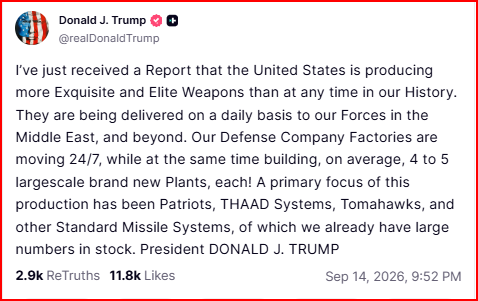
Before the release of the report, President Donald Trump took to Truth Social and said the U.S. is producing more “Exquisite and Elite Weapons” than at any point in its history.
This includes Lockheed Martin Corp‘s. (NYSE:LMT) THAAD, RTX Corp.‘s (NYSE:RTX) Tomahawks and Standard Missile Systems, and Patriot Missiles manufactured by Lockheed Martin and RTX Corp.’s Raytheon.
Notably, in August, Raytheon won a $22.9 billion contract to accelerate Tomahawk cruise missile production for the U.S. Navy, with annual output set to exceed 1,000 missiles.
In July, the Pentagon committed more than $135 billion to accelerate Patriot interceptor and nuclear-submarine production. Under the plan, Lockheed Martin received a seven-year contract worth up to $58.6 billion for PAC-3 MSE interceptors, supporting its goal of producing 2,000 missiles annually and tripling capacity by 2030.
In July, Defense Secretary Pete Hegseth told a Senate hearing that the war’s cost was estimated at $37.5 billion, up $8.5 billion from the Trump administration’s previous estimate of $29 billion released in May.
The updated estimate came as the Pentagon sought nearly $70 billion in supplemental funding for the Iran conflict. Hegseth called the request an “urgent, necessary” investment, warning that the U.S. faces “critical shortfalls” without the funds.
War Pushes Energy Costs Higher
The conflict has also added about $115 billion in energy costs, or roughly $860 per household, according to Moody’s Analytics Chief Economist Mark Zandi. This has particularly affected lower-and middle-income Americans, who have less stock-market wealth and more debt.
Meanwhile, supply disruptions in the Persian Gulf due to the conflict could drive crude oil prices above $120 per barrel, as Goldman Sachs warned. The firm views the increase in oil prices as relatively moderate despite heightened tensions in the Persian Gulf, citing two key factors. First, analysts noted that commercial inventories across OECD economies have declined only marginally since the war began. Second, they expect supply to continue adapting through “dark,” unrecorded flows via the Strait of Hormuz and rerouted pipelines. The analysts also argued that alarmist oil-price.
Disclaimer: This content was partially produced with the help of AI tools and was reviewed and published by Benzinga editors.
Image via Shutterstock