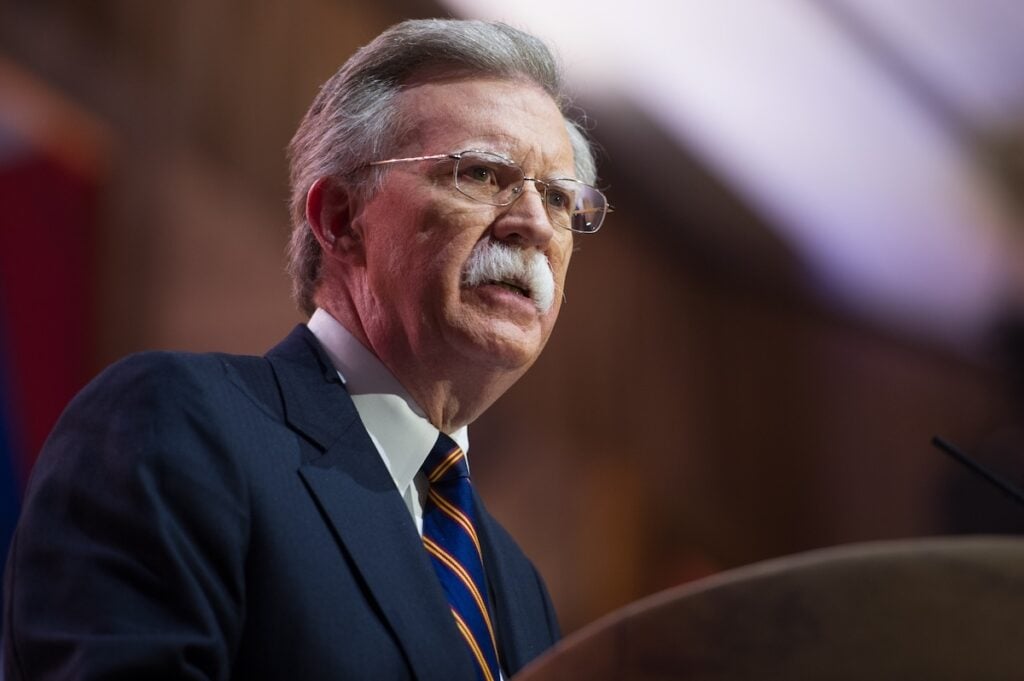
Former national security adviser John Bolton said Iran’s strategy of surrounding its adversaries with allied militant groups has suffered major setbacks, while arguing that the U.S. could still achieve broader goals, including potential regime change in Tehran.
Iran’s Military Strategy Weakens
On Sunday, Bolton said on X, “Iran’s ring of fire strategy now lies in ruins, like much of its military-industrial complex.”
He also criticized Washington’s approach, saying U.S. actions had failed to produce a satisfactory outcome.
“Although Washington’s own confusing, inconsistent actions have produced far less than a satisfactory outcome, success is still possible, including the potential for regime change in Iran,” Bolton said.
Trump, Zandi Highlight Iran War’s Energy Costs
President Donald Trump said that the U.S. could remain in Iran to “keep the oil,” while expressing optimism that the conflict could end this year and gasoline prices could “drop like a rock.”
Moody’s Analytics Chief Economist Mark Zandi said Thursday that the war had added about $115 billion in energy costs for U.S. households, or roughly $860 per household.
He said higher gasoline, diesel and jet fuel prices had disproportionately affected lower- and middle-income Americans.
According to data from the American Automobile Association (AAA), the national average price of regular gasoline was $4.3130 per gallon on Sunday, with California recording the highest state average at $5.9877 per gallon.
Trump-Iran Tensions Escalated
Last month, Trump said he was “not in a hurry” for Iran to return to peace negotiations and had “no time schedule” for talks, while claiming the U.S. was “winning very big.”
He also defended economic pressure and military strikes against Tehran.
As tensions continued, Iran was reportedly considering attacks on U.S. military targets in southeastern Europe, including Bulgaria’s Bezmer air base and potential targets in Cyprus.
Iranian commanders warned of a broader response that could extend to European targets and subsea fiber-optic cables in the Strait of Hormuz.
NATO said it was prepared to “address any threat” and defend its allies.
Disclaimer: This content was partially produced with the help of AI tools and was reviewed and published by Benzinga editors.
Photo Courtesy: Christopher Halloran on Shutterstock.com