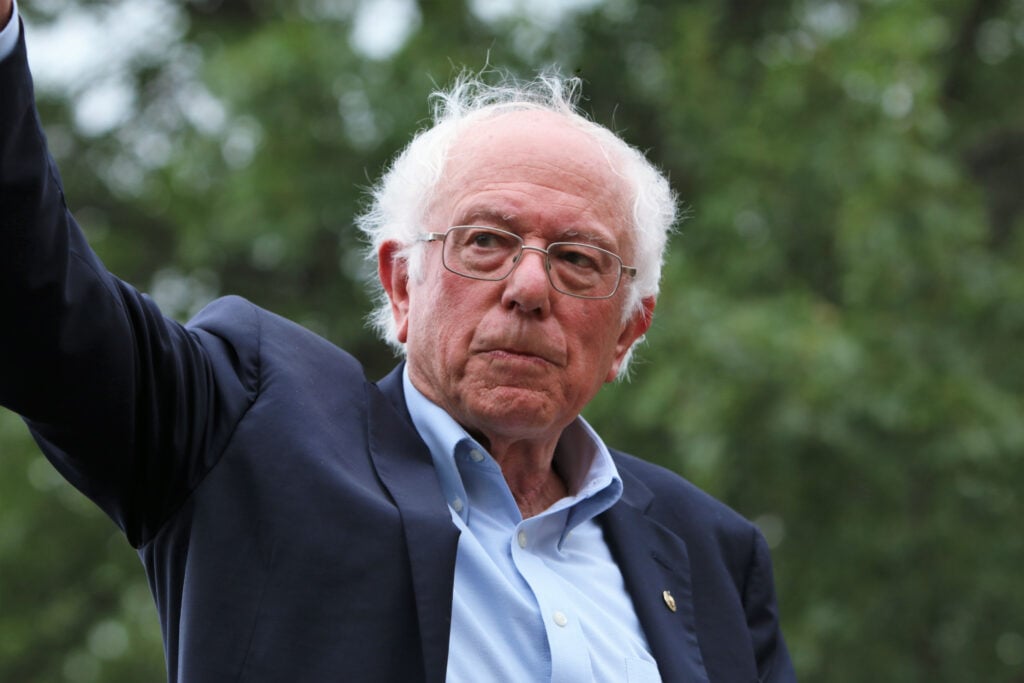
Sen. Bernie Sanders (I-VT) expressed his concern over the financial burden of cancer treatment in the U.S., attributing it to the high cost of new drugs.
Sanders took to X to talk about the financial strain cancer patients face due to the high cost of new cancer drugs. He pointed out that 42% of cancer patients in America deplete their life savings within two years of diagnosis.
“Well, maybe it has something to do with the greed of Big Pharma charging over $400,000 for new cancer drugs,” he wrote.
Sanders called the high cost of cancer treatment in the U.S. “insane,” arguing that getting cancer should not force Americans into financial ruin or bankruptcy.
The lawmaker did not provide the source for the 42% statistic. However, a 2018 study in The American Journal of Medicine found that 42.4% of adults with a new cancer diagnosis had depleted their entire net worth within two years, with average losses of about $92,098. The analysis used Health and Retirement Study data from 1998–2014 and estimated outcomes across roughly 9.5 million cancer diagnoses.
New Cancer Drug Raises Price Concerns
Sanders’ post came in the wake of the FDA approval of a new oncology therapy by Revolution Medicines Inc. (NASDAQ:RVMD) in late August. The pancreatic cancer drug, Rasonque, is the first approved targeted therapy from a new class of broad RAS-selective inhibitors and has shown significant efficacy in clinical trials.
Rasonque reduced the risk of death by 60% versus traditional chemotherapy in the ITT cohort. Patients receiving the targeted therapy had a median overall survival of 13.2 months versus 6.7 months with chemotherapy. It also nearly doubled progression-free survival, reaching 7.2 months compared with 3.6 months for the chemotherapy group.
According to a report by the New York Times on Monday, Revolution Medicines priced its new pancreatic cancer drug at about $480,000 annually, reflecting a broader trend of soaring cancer drug costs. Several treatments now carry price tags of $400,000 to $600,000, including CAR-T therapies and daily cancer pills. In 2024, nine newly approved cancer drugs launched with annual sticker prices exceeding $400,000, according to the Institute for Clinical and Economic Review.
Meanwhile, cancer drugmakers argue that high prices reflect breakthroughs that have turned some deadly diseases into manageable chronic conditions or even cures. They also say smaller drug companies need higher prices to recover the substantial costs of developing treatments and conducting expensive clinical trials.
Disclaimer: This content was partially produced with the help of AI tools and was reviewed and published by Benzinga editors.
Photo courtesy: Shutterstock