

After the stellar 2010s, the bond market performance has been disappointing in the 2020s. According to technical analyst Francis Hunt, this post-2020 rout marks the end of a 40-year debt bull market.
In his view, sovereigns and large institutions are increasingly forced to preserve capital in hard assets rather than chase paper gains.
Debt Cycle Is Rolling Over
For Hunt, the global financial system has moved past the easy-money era that began in the early 1980s. Since the 2020 bond-market capitulation, he argues in a recent interview, yields have entered a structural reversal marked by “ever lower highs and ever lower lows” in debt prices and an eventual nominal devaluation of the instruments themselves.
Furthermore, the shift has, in his opinion, changed how investors should read headline gains in equities and other risk assets. What looks like growth in index levels is, in large part, the denominator effect of weakening fiat purchasing power.
“It’s not the same dollar anymore,” he remarked. In such an environment, nominal wealth expands, while real wealth contracts. For Hunt, that dynamic makes gold the pressure valve.
“The debt crisis is the turbo juice for gold,” he remarked, arguing that capital starts prioritizing preservation over return. Investors stop asking what can compound the fastest, and start asking what can’t be printed, diluted, or blocked.
The “Hotel California” Liquidity Regime
The treasury market, in Hunt’s view, is a one-way architecture – an easy entry, but constrained exit. “You can check out any time you like, but you can never leave,” he said, recalling the evergreen lyrics.
Instead of outright liquidation, creditors are pushed toward swap lines, repo facilities and borrowing against the collateral they already own. That creates what Hunt sees as a manufactured asymmetry: buyers are welcome, sellers are constrained.
He cites U.K.’s 2022 liability-driven crisis, strains at the California State Teachers’ Retirement System, and recent pressure on Gulf states in the aftermath of an Iran war. In each case, the system responded by constraining liquidation and extending liquidity against pledged assets.
Japan as the Pressure Point
Yet Japan might be the most important test case. With over $1.1 trillion in U.S. Treasuries, it’s large enough to matter and constrained enough to be trapped.
Rather than selling freely, he said, Japanese holders are effectively offered limited borrowing capacity against their bonds — “at the moment we’re allowing 60 billion,” he said, pointing at the discrepancy compared to the size of the stockpile.
A deeper rupture, he warns, could force a violent unwind in the carry trade. It would drag the capital out of global risk assets and push Treasury yields higher- something the US cannot afford.
That scenario would invert the standard textbook logic where higher yields attract durable inflows. In sovereign stress, Hunt says, yield can look less like reward and more like risk premium.
Gold in the Real Denominator
Hunt’s chart work centers on measuring equities against gold rather than against the dollar. In that frame, he says, U.S. stocks peaked in 1999, staged a secondary high in 2021 and now look vulnerable to a longer secular reset.
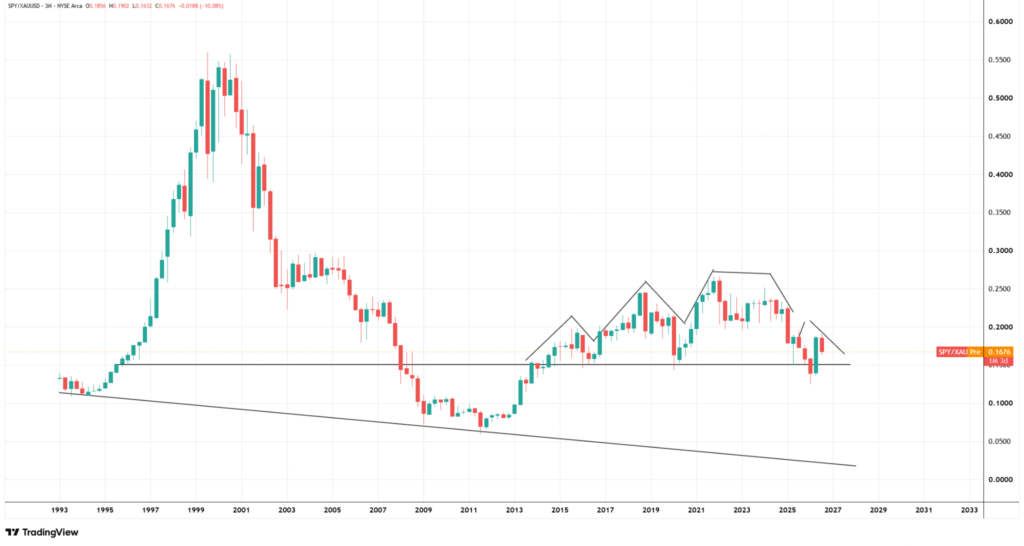
SPY divided by Gold, 3-Month chart, Source: TradingView
In Hunt’s view, the technical line in the sand is around 0.15. A break of that neckline would signal a potential rapid move in gold against the State Street SPDR S&P 500 ETF Trust (NYSE:SPY).
The S&P 500 and Nasdaq may still grind higher in nominal terms, he argues, but that is because the benchmark currency is being debased at the same time. Gold, by contrast, captures the loss of confidence in paper claims.
“We are entering a far more convex period,” he said, borrowing Ernest Hemingway’s line that bankruptcy happens “slowly at first, and then suddenly.”
Image via Shutterstock