Editor’s note: This article was updated to add more context and detail.
The Consumer Price Index (CPI) rose 3.4% year-over-year in July, line with the annual inflation economists expected and down from June’s 3.5% increase, the Bureau of Labor Statistics reported Wednesday.
On a monthly basis, prices rose 0.1%, a rebound from June’s 0.4% decline and matching the 0.1% economists expected.
Core CPI, which strips out food and energy, rose by 0.2% on the month, in line with forecasts.
The annual core inflation rate eased from 2.6% to 2.5%, again matching expectations.
The print lands four days after the July jobs report showed payrolls contracting by 23,000 against expectations of a roughly 80,000 gain.
Odds of a September interest-rate increase by the Federal Reserve, as priced in by the rate futures market, stood at 45% ahead of the release.
Where Did Prices Rise and Fall Last Month?
Shelter was the biggest contributor to monthly inflation. The index rose 0.1%, accounting for roughly two-thirds of the overall 0.1% increase.
Food prices also rose 0.1%. But the details were mixed. Grocery prices fell 0.1%, helped by a 0.7% decline in the index for meat, poultry, fish and eggs.
Restaurant prices moved in the opposite direction. Food away from home rose 0.3%, with limited-service meals up 0.4%.
Energy provided the biggest relief. The energy index fell 1.5% in July, while gasoline prices dropped 2.9%.
That decline matters because energy remains much more expensive than a year ago. The energy index was still up 14.7% over the past 12 months, with gasoline prices up 24.6%.
Services were less cooperative.
Core prices rose 0.2% in July after being unchanged in June. Airline fares jumped 2.2%, while medical care rose 0.4% and communication increased 0.6%.
Shelter remains the bigger issue, however. It was still up 3.2% from a year earlier, keeping pressure on the broader services inflation picture.
There were some signs of easing underneath the surface. Motor vehicle insurance fell 0.3%, prescription drugs dropped 0.8% and lodging away from home declined 2.8%.
The result is an inflation report that gives the Fed some room, but not necessarily a clear green light.
Market Reaction: Stocks Rise, Yields Fall
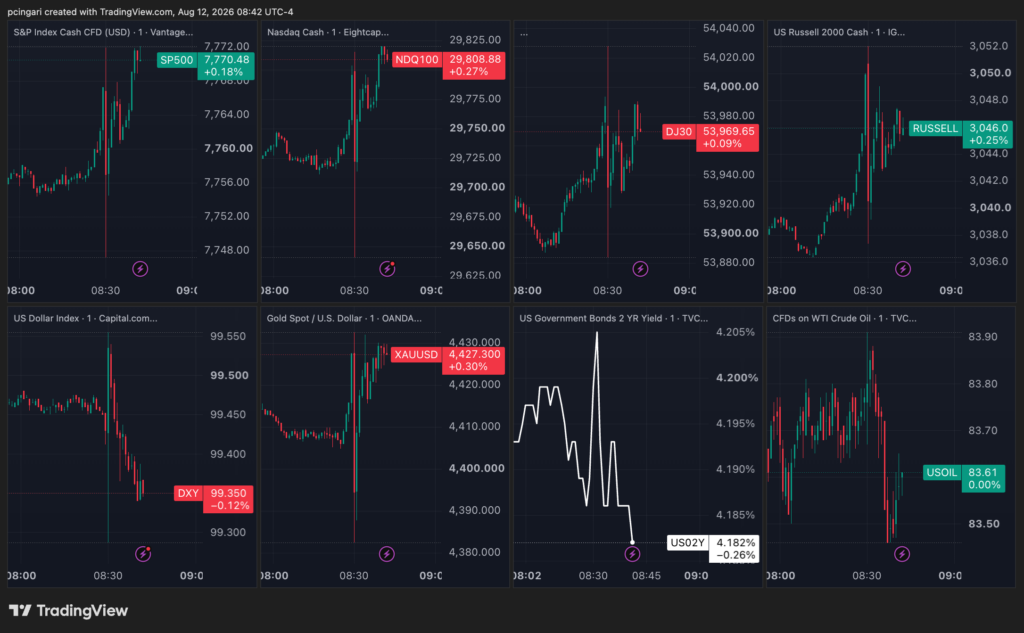
Markets initially treated the report as a modest positive for risk assets.
The S&P 500 futures were up 0.1% after the release, while Nasdaq 100 futures gained 0.2%. Dow futures rose 0.1% and Russell 2000 futures added 0.2%.
The bond market delivered a clearer signal.
The two-year Treasury yield, which is particularly sensitive to expectations for Federal Reserve policy, fell to around 4.18% after the data, down by about 2 basis points.
The dollar also weakened. The U.S. Dollar Index – as tracked by the Invesco DB US Dollar Index Bullish Fund (NYSE:UUP) – fell 0.12%, while gold rose 0.30% to around $4,427 an ounce.
The move in interest-rate expectations was particularly notable.
Before the CPI release, markets had priced a 43% probability of a rate hike at the Federal Reserve’s September meeting. The probability of leaving rates unchanged stood at 57%.
A week ago, futures implied a 54.4% probability of a September hike.
Image: Shutterstock