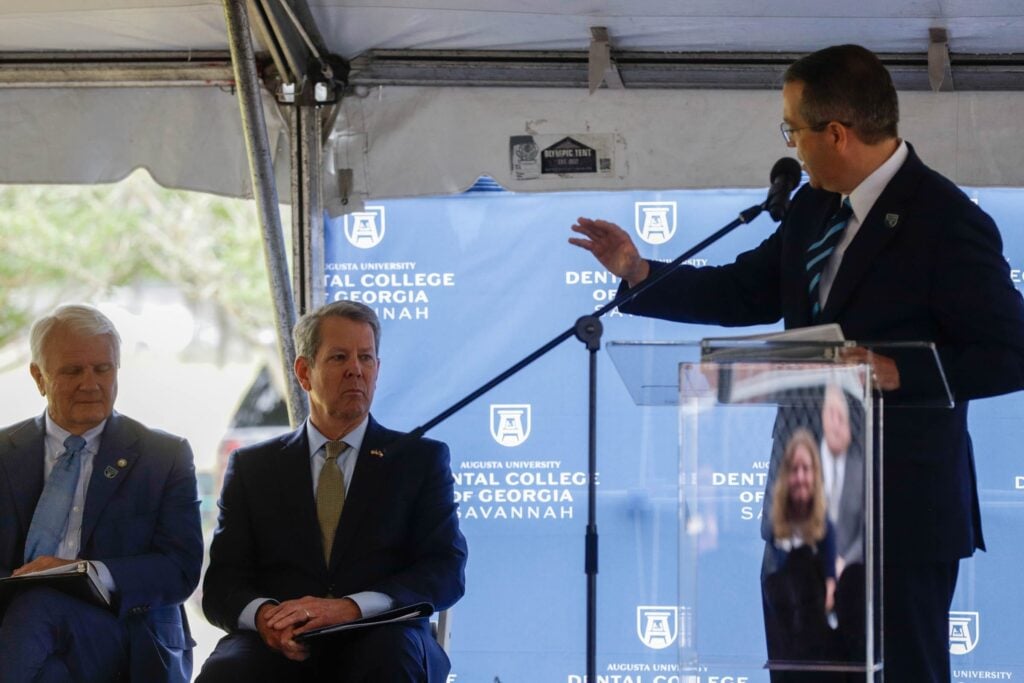
Georgia Gov. Brian Kemp (R) believes that the expiration of federal electric vehicle tax credits has not weakened his drive to make the state an EV manufacturing hub, arguing that buyers rather than Washington should determine the technology’s future.
Federal Credit Loss Fails To Shift Strategy
“I still feel very strongly that EVs are going to have a place in the country along with a lot of the other great vehicles that we have, and you know, it really just needs to be customer choice,” Kemp told Politico’s Energy Podcast.
Kemp opposed former President Joe Biden’s Inflation Reduction Act. President Donald Trump’s 2025 tax law later ended clean-vehicle credits for vehicles acquired after Sept. 30, according to the IRS, removing an incentive worth as much as $7,500.
Trump has earlier expressed support for gas-powered vehicles and has been critical of federal policies pushing electric vehicle adoption. His administration has prioritized traditional automotive fuels over EV mandates, arguing they protect consumer choice and industry jobs.
Georgia’s strategy predates that change. Kemp pledged in 2023 to make Georgia the “electric mobility capital of America.” The state says companies committed more than $27.3 billion and 32,200 jobs to its electric-mobility, battery and clean-energy supply chains between 2018 and 2024.
Georgia Builds Out Its EV Manufacturing Base
Hyundai anchors that push. Its $7.6 billion Metaplant near Savannah began producing electric SUVs in 2024 and can initially build 300,000 vehicles annually, with expansion planned to 500,000 electric and hybrid models. Hyundai and SK On also began production at a $5 billion Bartow County battery plant designed to supply cells for about 300,000 EVs yearly.
Georgia has also backed Rivian Automotive Inc.’s (NASDAQ:RIVN) planned $5 billion factory near Social Circle. The Energy Department closed a $6.57 billion loan for the project in January 2025, and Rivian later broke ground after delaying construction amid softer EV demand.
Kemp suggested more announcements could come before he leaves office. “I’ve only got about six months left in office, but I’ve got a couple of really, really good economic development projects that the team and I are working on,” he said.
Data Center Growth Raises Power Questions
The governor is also courting power-hungry artificial intelligence data centers while residents scrutinize electricity costs. Kemp said large operators would fund the infrastructure.
“We’re making the hyperscalers pay,” he said. “The bottom line is we’re not going to put that on the back of the ratepayers.”
Image Credit: USA TODAY Network via Reuters Connect