Space Exploration Technologies Corp. (NASDAQ:SPCX) formally joins the Nasdaq-100 today, less than one month after the largest U.S. market IPO in history.
The index addition will force ETFs and index funds to acquire shares of SPCX, producing billions of dollars of mandatory buying that could cause one of the stock’s most tumultuous trading sessions since its public debut.
The move bolsters SpaceX’s position as one of the largest tech companies in the market. However, traders are faced with a tough question: Is today’s opening rise worth chasing?
The answer lies not so much in the fundamentals as in how the institutional order flow plays out in the opening hour of trade.
Why Today’s Nasdaq-100 Inclusion Matters
The Nasdaq-100 is an index of the 100 largest non-financial companies listed on the Nasdaq exchange.
The benchmark’s inclusion of SpaceX forces passive investment vehicles such as the Invesco QQQ Trust (NASDAQ:QQQ) to buy SPCX shares to match the index.
The analysts think the rebalancing might create about $4.3 billion in passive flows.
These funds cannot wait for a better price, as active investors do. Their mandate requires them to take the stock at any price, producing demand that often exceeds typical trading.
That request comes at a time when the readily tradable quantity of the stock is still relatively small.
SpaceX’s IPO garnered $75 billion by selling 555.56 million shares. Yet, CEO Elon Musk still controls more than 82% of the company’s voting power. Most existing owners still can’t sell for several more months due to insider lockup regulations.
Today’s session could see wide price swings due to the mismatch of forced demand and constrained supply.
SPCX Stock Analysis: Price Levels to Watch
SPCX finished Friday at $162, up around 20% from its $135 IPO price.
With the stock expected to attract billions of dollars in passive fund inflows, traders will be closely watching how the stock reacts around several key resistance and support levels
On the upside, the $185 to $190 range represents the first major resistance area. The zone closely aligns with Wedbush’s $190 price target, which accompanied the firm’s recent Outperform initiation.
Wedbush based its bullish outlook partly on SpaceX’s growing artificial intelligence business. In its analysis, it included an estimated $27.8 billion in annual AI-related revenue generated through partnerships with Anthropic and Alphabet.
If mandatory index buying drives SPCX’s stock price higher after the opening bell, traders could see increased profit-taking near this widely watched valuation target.
On the downside, the $158 to $161 area remains the SPCX stock’s most important near-term support.
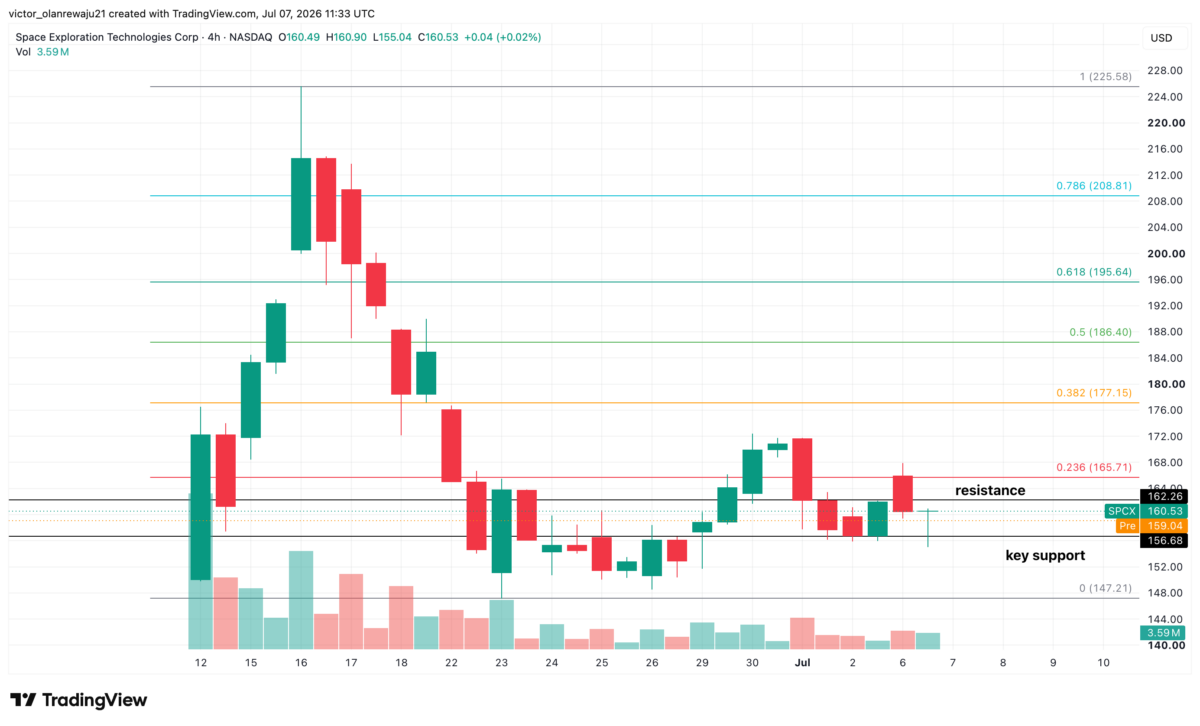
Heavy trading during SpaceX’s June 12 market debut established a strong volume anchor around the first-day closing price of $160.95, placing the zone just below Friday’s close of $162.
A successful defense of this range would suggest institutional demand continues to absorb selling pressure created by early volatility.
Below that, $150 could be a key level for the market. The level marks SpaceX’s opening price on its first day of public trading. During that period, roughly 58 million shares changed hands during the opening auction.
A sustained move below $150 would indicate that selling pressure has begun to outweigh the passive buying generated by the Nasdaq-100 rebalance. If sustained, such a move could potentially shift short-term momentum in favor of sellers.
Why Chasing the Opening Bell Can Be Costly
The first 30 to 60 minutes of trading are viewed as the most volatile session, as passive index funds finish their required buying and institutional desks reposition around the Nasdaq-100 rebalance.
Analysts expect SPCX to attract about $4.3 billion in passive flows as ETFs and index-tracking funds, notably the Invesco QQQ Trust (NASDAQ:QQQ), rebalance their holdings.
These funds need to be bought regardless of the price. Therefore, liquidity can turn one-sided for a while, typically resulting in violent swings and bigger bid-ask spreads.
That might set up a nice chance for short-term traders and market makers to sell into the opening strength. Similar index inclusions in the past have led to outsized opening volatility before prices settle down later.
Traders might want to sit on the sidelines and see whether the SPCX stock can build support above the $161 zone. The goal could be to avoid chasing an early breakout and waiting for volume to normalize.
If that range holds after the initial wave of passive buying, then it would suggest that demand is more than just forced index rebalancing.
Rebalance Beyond the Nasdaq-100 Inclusion
Today, index mechanics will mostly drive price activity. However, longer-term investors will eventually turn back to SpaceX’s operating performance.
The corporation had revenue of about $31.2 billion in the prior year, with Starlink contributing about $18.7 billion, or over 60% of total revenues. That subscription business continues to be a recurring income generator even as SpaceX cranks up spending on Starship, rocket infrastructure, and next-gen satellite deployments.
Those investments still are not cheap. The corporation posted a net loss of almost $4.9 billion last year as capital expenditures continued to rise, implying execution on future growth plans will remain key.
Other things traders should watch closely, aside from today’s index inclusion, are future Starship test flights and FAA licensing decisions.
Apart from those, the launch cadence, more Starlink subscriber growth, and the pace of government and commercial contracts are also areas to watch. The medium- and long-term valuation of SPCX is more likely to be determined by the catalysts rather than the rebalance of the Nasdaq-100
SPCX Stock Today: The Final Word
Adding SpaceX to the Nasdaq-100 is a structural milestone that might push one of SPCX’s biggest trading days since its IPO.
But today’s buying impetus is mostly index rebalancing, not a shift in the company’s fundamental value. When the passive fund flows dry up, the stock will move again on fundamentals, earnings expectations, and execution.
Patience may be the preferable tactic for traders. Perhaps, it is best to let the opening imbalance play out and then see if the SPCX stock can hold the $161 support zone. A risk-reward setup may be better than chasing the initial surge.
Benzinga Disclaimer: This article is from an unpaid external contributor. It does not represent Benzinga’s reporting and has not been edited for content or accuracy.