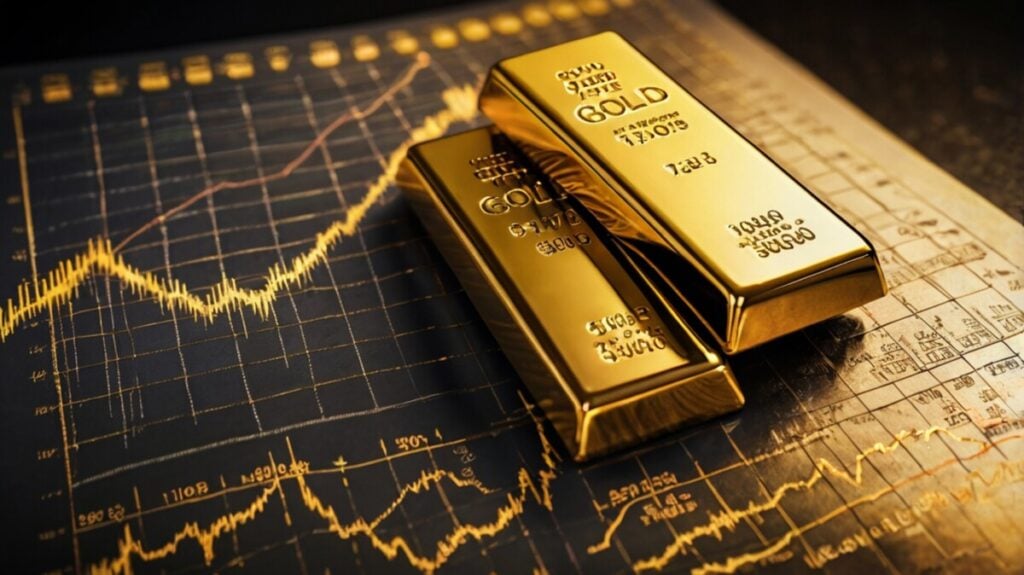
Gold has had a strange few days. Wall Street’s biggest banks just took turns cutting their price targets for the metal, blaming a surprisingly hawkish new Federal Reserve chair. That should be bad news for gold. Yet on Monday, gold actually rose, recovering from a more than one week low and climbing roughly 1% to trade near $4,195 an ounce.
The reason behind that bounce is more interesting than it first looks, and it is the part of this story that gets lost in most of the Fed-focused coverage. Progress in peace talks between the United States and Iran sent oil prices sharply lower, with Brent crude futures dropping more than 3% on the news. Lower oil prices ease worries about inflation, and easing inflation worries can actually be good for gold, even while the broader peace process should, in theory, reduce the safe haven fear that often drives investors toward gold in the first place.
So, you have two opposite effects from the same headline pulling against each other, on top of a Fed that is leaning hawkish. That is a more complicated setup than a simple “war fear up, gold up” story, and it is worth slowing down to understand before Thursday’s big inflation report, which could tip the balance one way or the other.
Wall Street’s Cooling Mood on Gold
Last week, new Fed Chair Kevin Warsh held his first policy meeting, and it caught a lot of investors off guard. The Fed kept interest rates unchanged, in the 3.50% to 3.75% range, but the tone was firmer than expected. Nine of the 18 Fed officials who submitted projections this time now see at least one rate hike by year end, a sharp reversal from March, when the committee was still pointing toward a cut. Warsh himself declined to submit a projection at all, saying he does not believe in the practice, which only added to the sense that the Fed’s playbook is being rewritten in real time. Traders have noticed too. According to the CME FedWatch Tool, the odds of a rate hike by December have jumped to 89%, up sharply from just 61% before the Fed’s meeting.
For gold, that shift comes down to a simple relationship. Think of gold like a tenant who doesn’t pay rent. If you own a bond or a savings account, you get paid interest just for holding it. Gold gives you nothing while you hold it; its only payoff comes from the price going up. So when interest rates rise, or even just look more likely to rise, other places to park your money start looking more attractive by comparison, and the case for gold gets a little weaker.
That shift has sent several major banks back to their spreadsheets, though not all of them in lockstep. Bank of America walked back its $6,000 price target, with strategist Michael Widmer writing that the move from “inflationary cuts” to tighter policy cuts gold’s potential upside by around half. UBS strategist Joni Teves said the downside risks to her gold outlook have “increased materially” and that the bank may need to push its price targets further into the future.
Deutsche Bank sketched out a scenario where gold could fall to $3,800 an ounce if the Fed actually goes through with three or four rate hikes. Goldman Sachs trimmed its year end target to $4,900 from $5,400, and Morgan Stanley said its old forecast of $5,200 now looks “more challenging.” Several major banks have clearly turned more cautious in the near term, even as some of them, Goldman especially, still describe their longer term view as bullish.
The Impact of Oil and Inflation
The piece worth sitting with is this. Over the weekend, the United States and Iran agreed on a roadmap toward ending their war within 60 days, following talks in Switzerland. The deal includes reopening the Strait of Hormuz to oil tankers, a pause in hostilities, and the start of technical negotiations this week on tougher issues like Iran’s nuclear program.
The intuitive read is that less war fear should mean less demand for gold as a safe haven. That part is true on its own. But the bigger effect showing up in the price action right now runs through oil, not fear. Saxo Bank analyst Ole Hansen pointed out that ongoing talks in Switzerland are pointing toward a deal that would add fresh barrels of crude into the market, which puts pressure on oil prices. Lower oil prices mean a calmer outlook for inflation, since energy costs feed directly into the price of almost everything else. And a calmer inflation outlook, ironically, can support the case for gold even while the same headline is also reducing the fear-driven demand that usually goes along with conflict.
Picture two people pulling a rope from opposite ends, except one of them just grabbed a second rope on the other side too. The net pull on gold from this single weekend of news is genuinely mixed, not simply negative. It is also worth remembering this deal is still just a roadmap, not a finished agreement. Israel was not part of the talks and has kept up military action against Hezbollah in Lebanon, so there is plenty of room for this fragile truce to wobble in the weeks ahead, which would flip some of this calculus right back around.
Why Long-Term Bulls and Short-Term Skeptics Are Both Right
Goldman’s own research team summed up the split about as cleanly as anyone could. Their gold view, in their words, is “structurally constructive but tactically cautious.” In plain English, they still like gold over the long run, but they are nervous about the next few months.
That sentence captures the whole story in miniature. Nothing happening right now erases the reasons people bought gold in the first place, like central banks around the world stockpiling it at record levels, or persistent inflation that refuses to fully go away. Demand for physical gold bars was actually up sharply earlier this year. None of the long-term arguments for owning gold have disappeared.
What has changed is the short-term math. Gold is up roughly 24% over the past year, which is a massive run by historical standards. After a move that big, it would almost be more surprising if gold did not pause to catch its breath, especially with a new Fed chair signaling he is in no hurry to cut rates. Calling this a crash would be an overreaction. A 24% annual gain pausing for a few weeks is not the same as a trend breaking down.
What Comes Next: Thursday’s Inflation Report
If you are watching gold this week, mark your calendar for Thursday, June 25. That is when the government releases its May reading on the PCE price index, the inflation gauge the Fed watches most closely. Some early estimates point toward inflation running hotter for the month, though the exact figure is worth confirming once the report lands rather than locking in a specific number ahead of time.
This report carries more weight than usual right now because it is the first real inflation data point investors will get since Warsh’s hawkish debut. If inflation comes in hot, it could reinforce the case for a rate hike later this year, adding more weight to the bearish side of gold’s tug of war. If it comes in cooler than expected, it could ease some of the hawkish pressure and give gold bulls a reason to push back, especially if oil prices keep drifting lower on continued progress in the Iran talks.
There is also a second event worth flagging for anyone trading around this. Technical negotiations between the US and Iran are scheduled to continue through this week in Switzerland, meaning headline risk on the geopolitical side is not going away either. Between the PCE report on Thursday and whatever comes out of Switzerland in the days before it, gold traders have an unusually busy week ahead, with two genuinely separate stories capable of moving the price in either direction.
Put plainly, gold is not simply a fear trade anymore. Right now it is closer to a live scoreboard for three different debates at once: how high rates are likely to go, how durable this peace effort turns out to be, and whether oil staying cheap is enough to offset both. Nobody, including the banks cutting their targets, seems fully certain which of those debates will end up driving the next move.
This article is for informational purposes only and does not constitute investment advice. Prices and figures cited reflect data available as of June 22, 2026, and are subject to change.
Benzinga Disclaimer: This article is from an unpaid external contributor. It does not represent Benzinga’s reporting and has not been edited for content or accuracy.