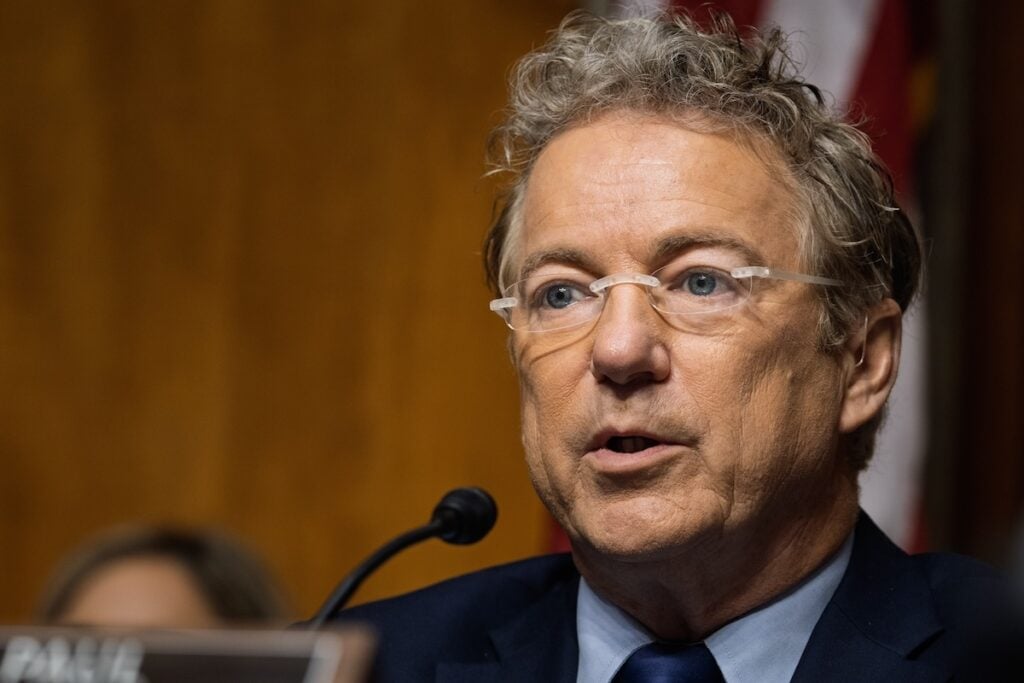
Sen. Rand Paul (R-Ky.) warned that the federal government’s $17.6 billion in daily spending and growing reliance on borrowing were fueling the national deficit, calling for spending cuts instead of additional expenditures.
Paul Slams $17.6 Billion In Daily Federal Spending
On Tuesday, Paul criticized federal spending, saying that approximately 75% of the government’s daily expenditures came from taxpayers, while the remaining 25% was borrowed.
“Every day, the government spends ~$17.6 billion. About 75% of that is your tax dollars. The other 25% is borrowed,” Paul wrote in a post on X.
He described “deficit spending is completely out of control,” arguing that lawmakers should prioritize reducing government expenditures.
“We should be talking about cutting federal spending, not increasing it,” Paul added.
According to the Congressional Budget Office, the federal government spent approximately $7.4 trillion in fiscal year 2026, averaging roughly $20.3 billion per day. It collected $5.4 trillion in revenue, leaving a nearly $2 trillion deficit that had to be financed through borrowing.
Paul Criticized Republican Spending Priorities
Last week, Paul warned that federal debt could rise by at least $8 trillion over four years, saying Republican and Democratic spending under the last two administrations showed “not an iota of difference.”
He criticized Republicans for supporting military spending funded through borrowing despite campaigning on balanced budgets and lower debt, saying, “They’re fiscally conservative until it comes to warfare.”
Rising US Debt Costs Raise Concerns
U.S. national debt interest accounted for a record 31.3% of government spending in October, reaching $115 billion, up $11 billion from a year earlier.
The monthly interest bill had surged 505% since 2022, according to The Kobeissi Letter, citing Treasury Department data.
Last month, SkyBridge Capital founder Anthony Scaramucci warned that if the average interest rate on $40 trillion in national debt reached 6%, annual interest costs could theoretically climb to $2.4 trillion.
He argued that restoring tax rates from former President Bill Clinton’s administration could reduce projected deficits by $10 trillion to $12 trillion over a decade.
BlackRock Inc. (NYSE:BLK) CEO Larry Fink said AI investments could make the $40 trillion national debt less consequential if they helped drive economic growth to 3% or higher. He argued that sustained growth could lower the debt-to-GDP ratio.
Disclaimer: This content was partially produced with the help of AI tools and was reviewed and published by Benzinga editors.
Photo Courtesy: Maxim Elramsisy on Shutterstock.com