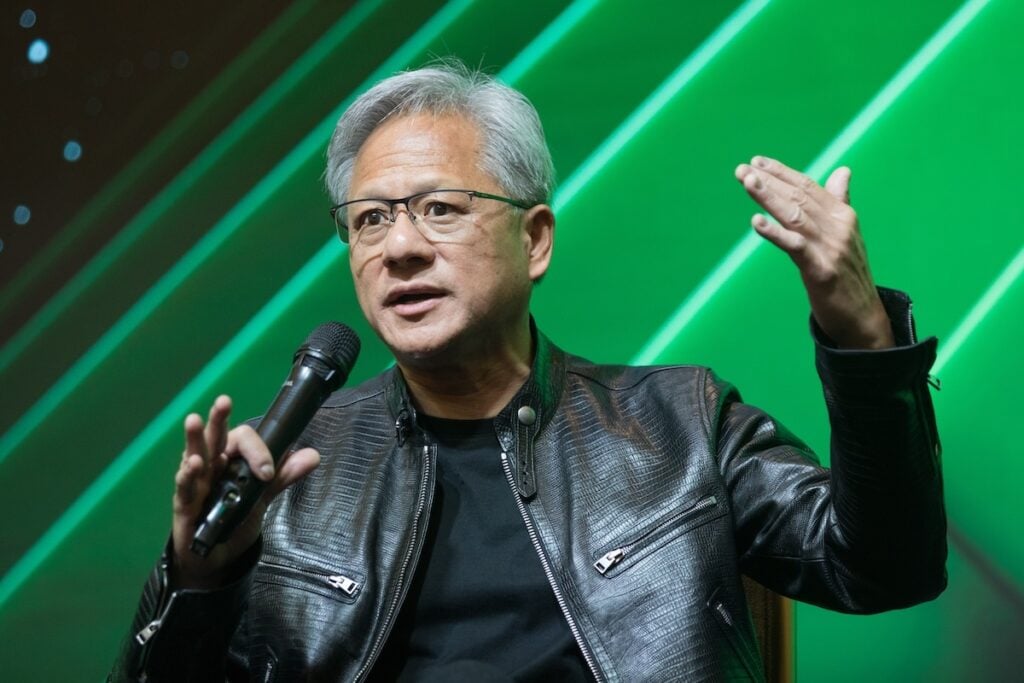
Michael Burry says the Wall Street Journal buried the most important part of its reporting on Jensen Huang’s ouster from Nvidia Corp. (NASDAQ:NVDA).
In a Thursday post on his Cassandra Unchained Substack, Burry argued the coverage leaned too heavily on Huang’s affairs and boardroom intrigue. The business problems described in the same story deserve far more attention, in his view.
“The story here is not the affairs,” Burry wrote. “The story is about why there is trouble in Camelot in the first place.”
- NVDA stock is sinking. Get all the latest details here.
Huang’s August Warning
The Journal reported Huang called his senior finance team into his office in August, as the AI economy showed signs of strain.
During the meeting, he criticized Colette Kress, the executive now taking over as interim CEO, describing her as a “reporting CFO” rather than a strategic partner.
Burry focused on what Huang said next. According to the Journal, Huang told executives major cloud providers were planning to use alternative chips and lessen their reliance on Nvidia.
The company was also in talks to provide billions of dollars in guarantees to customers who could not afford its chips. Some of those deals were led by Huang’s son-in-law, Nico Caprez. Huang added the wafer and memory supply Nvidia had committed to buying was coming at the company like an “avalanche.”
A Summer Slump Before the Scandal
Burry said those problems explain why the stock struggled over the summer, well before the personal scandals became public. He also took aim at CNBC and Wall Street analysts for staying bullish during the slide.
“The stock stank, and no one covered the real story,” he wrote.
Burry’s Year-Old Bubble Thesis
The post ties the Journal’s reporting to a thesis Burry has pressed since his first Cassandra Unchained article on Nov. 23, 2025.
Titled “The Cardinal Sign of a Bubble: Supply-Side Gluttony,” the piece laid out a capital-cycle argument about overbuilding during periods of mania.
“Companies are allowed to innovate themselves to death,” he wrote at the time. Later installments in his “Heretic’s Guide to AI’s Stars” series examined vendor financing and related themes.
Cheap Stock, Structural Risks
Burry on Thursday acknowledged Nvidia’s valuation now looks low. Shares bounced off $150 and traded in the mid-$160s, leaving the company near $4.0 trillion in market value, and retail investors are piling in.
He also pointed to the Journal’s Heard on the Street column, which highlighted Nvidia’s growing free cash flow.
Still, he argued GPUs were never designed for AI work and called them “already overkill, resource hogs not necessary to most AI inference.” The shift away from GPUs was predictable, he said, yet Nvidia took on operating leverage anyway. He also cited a duration mismatch as a lasting risk.
Burry had little patience for bullish forecasts. “Their job is to predict rosy numbers. Never forget,” he wrote of analysts.
See More:
Top Growth Stocks
Burry’s Positions
Burry disclosed no direct position in Nvidia shares or Nvidia puts. His exposure comes through puts on the VanEck Semiconductor ETF (NASDAQ:SMH) and puts on the Nasdaq-100, which investors can track through the Invesco QQQ Trust (NASDAQ:QQQ).
‘The Signs Were There’
Burry argues the AI bubble began to unravel this year, with evidence visible in Nvidia’s share price, its financing activity and regulatory filings well before reporters caught on.
“The signs were there,” Burry wrote. “They always are.”
NVDA Stock Price Activity: Nvidia stock was down 3.29% at $160.72 on Friday, according to Benzinga Pro.
Photo: Samuel Boivin / Shutterstock