
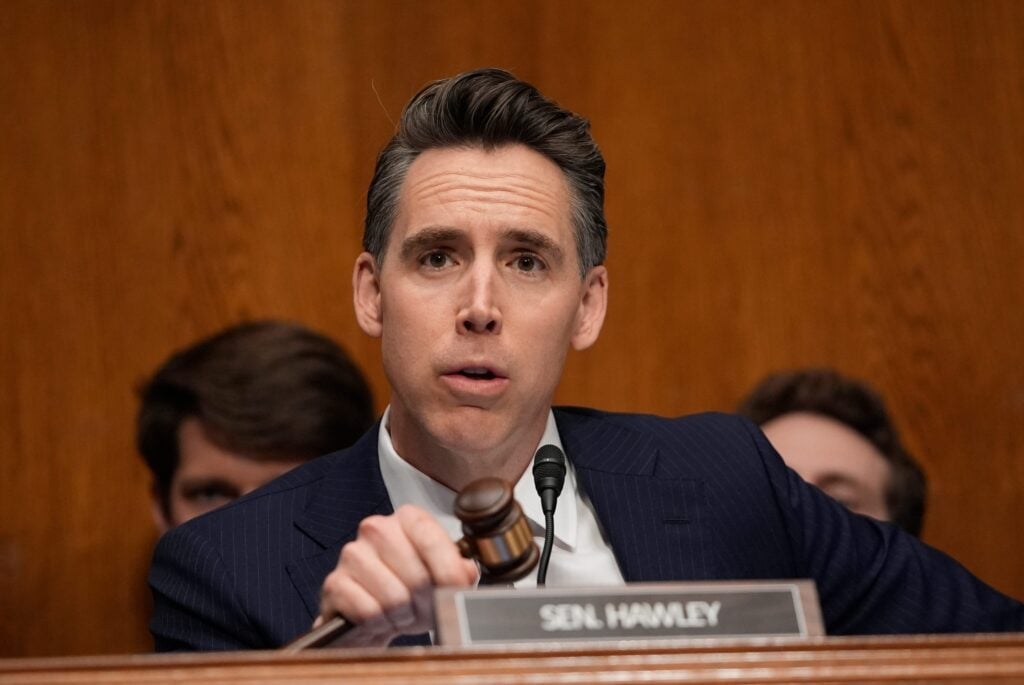
Sen. Josh Hawley (R-Mo.) called for a nationwide moratorium on new data center construction until Congress guarantees that their growing electricity demands will not increase Americans’ utility bills, becoming the first Senate Republican to publicly back such a pause.
Hawley Pushes For Stronger Consumer Safeguards
On Wednesday, Hawley listed a “MORATORIUM on data centers” among his priorities for the Senate’s remaining legislative session. His spokesperson told Politico that the senator wants a federal pause until Congress passes a “bill of rights giving taxpayers guarantees of no rate increases.” Hawley has not specified its detailed terms.
The proposal builds on legislation Hawley introduced with Democratic Sen. Richard Blumenthal (D-Conn.) in February. Their GRID Act would require new data centers to obtain electricity from sources separate from the grid and publicly disclose their power usage, according to Hawley’s announcement in February.
“American families should not have to shoulder the burden of the rising electricity costs produced by data centers in Missouri and across the country,” Hawley said then. His position follows earlier warnings that opposition to data centers could threaten Republican electoral prospects.
Midterm Backlash Reshapes Data Center Debate
Hawley’s call follows the November 3 midterms, when candidates seeking tighter limits on data centers made gains. The Associated Press reported last Friday that 32 of 34 victorious gubernatorial candidates supported stronger restrictions, while 12 endorsed bans or moratoriums.
Independent Sen. Bernie Sanders (I-Vt.) and Democratic Rep. Alexandria Ocasio-Cortez (D-N.Y.) have also pushed for a national construction pause through their AI Data Center Moratorium Act. Sanders renewed his call for an immediate moratorium following the midterm elections. Hawley has not indicated whether he would support their legislation.
Congress Struggles To Contain Power Costs
Reuters reported back in September that the House passed the Ratepayer Protection Act 417-3, requiring state regulators to consider making large electricity users cover grid expansion costs. The Senate blocked its advancement later that month on a 57-43 vote, short of the 60 votes required.
The urgency reflects rising power demand. A Department of Energy report in June projected data centers could consume 11.8% of U.S. electricity by 2030. President Donald Trump, meanwhile, has backed faster energy development alongside measures intended to shield households from data-center costs.
Photo courtesy: USA TODAY NETWORK via Imagn Images