
Solar stocks just posted their biggest one-day win against oil producers in four years.
The Invesco Solar ETF (NYSE:TAN) rose 5.7% to $45.79 on Wednesday. Meanwhile, the State Street SPDR S&P Oil & Gas Exploration & Production ETF (NYSE:XOP) sank 6.4% to $179.29.
As a result, the ratio between the two funds jumped nearly 13%, its best session since 2022.
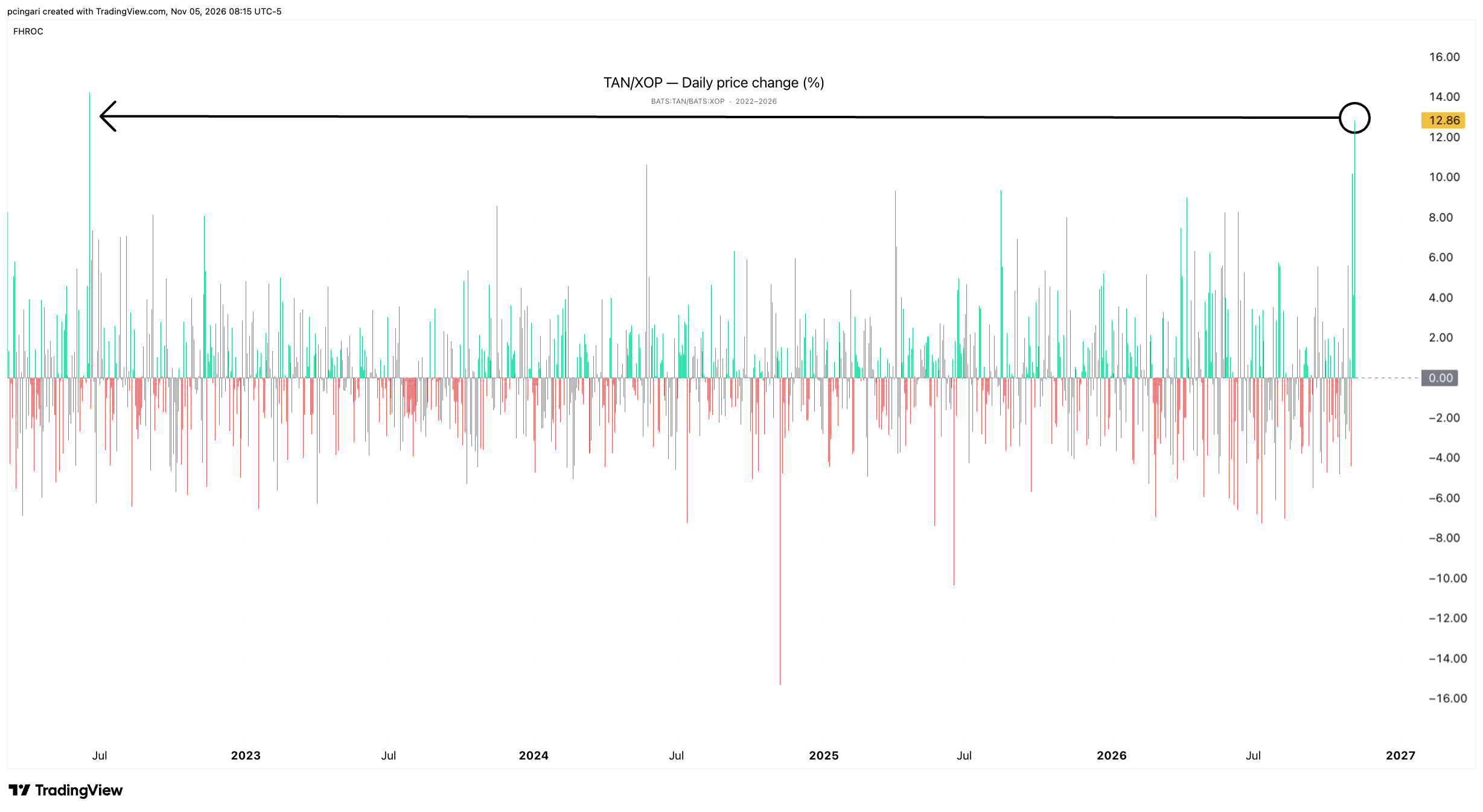
TAN/XOP daily price change, 2022-2026. Source: TradingView
The rebound came out of a deep hole.
TAN fell for 12 consecutive weeks through Oct. 30, closing lower in 21 of the previous 22 weeks. Over that stretch, the fund lost about 46% from its late-May weekly close of $73.93.
Since last Friday’s close, TAN has climbed 13.9% in three sessions, while XOP has dropped 12%. Wednesday’s TAN volume was nearly five times its average of the previous nine sessions.
Two Catalysts Hit on the Same Day
The first came from Washington.
Democrats won control of both the House and the Senate in the Nov. 3 midterm elections. For clean-energy companies, that offers a potential check on further cuts to federal support under President Donald Trump.
The second came from the oil market.
West Texas Intermediate crude fell 8.3% to $88.12 a barrel on Wednesday, its biggest daily drop since April, and Brent lost more than 8%. Traders bet the election outcome would push the White House toward an end to the Iran war.
In other words, the two sides of the energy trade moved in opposite directions at the same time.
Trackers and Installers Led the Solar Rally
Array Technologies Inc. (NASDAQ:ARRY) jumped 14.9%, Nextpower Inc. (NASDAQ:NXT) gained 11.1% and Shoals Technologies Group Inc. (NASDAQ:SHLS) rose 8.1%.
First Solar Inc. (NASDAQ:FSLR) added 4.6%, while Enphase Energy Inc. (NASDAQ:ENPH) rose 3.7%.
SolarEdge Technologies Inc. (NASDAQ:SEDG) was the exception. The stock fell 8.7% after the company guided fourth-quarter revenue to $245 million to $275 million, down from $326.1 million in the third quarter.
The rally carried into Thursday’s premarket.
Sunrun Inc. (NASDAQ:RUN) jumped 21% after reporting third-quarter revenue of $1.10 billion and net income of $153 million late Wednesday. TAN was up 3.3%.
Jeff Currie Had Already Stepped Off the Oil Trade
Jeff Currie, founder and CEO of Real Macro and former head of commodities research at Goldman Sachs, took money off the table before the votes were counted.
“Time to take prompt oil profits,” Currie said in a post on X on Monday.
He added that he was cashing in near-term crude and fuel contracts into the midterms, while keeping his longer-term bet on energy in place.
WTI settled at $96.46 that day. Two sessions later, it was 8.6% lower.
Wall Street Sees Room for More in Solar
Citrini Research added solar to its model portfolio this week, noting that First Solar trades at about 10 times earnings.
“We could see another big rip in solar names,” Citrini Research said in a note on Wednesday, citing a political pendulum that is now swinging back toward the sector.
On Thursday, William Blair analyst Jed Dorsheimer upgraded First Solar to Outperform from Market Perform.
According to Benzinga Analyst Ratings, First Solar carries a Buy consensus among 27 analysts. The average price target of $254.44 sits about 31% above Wednesday’s close.
However, not every analyst has turned bullish. Barclays and Citigroup both cut their First Solar targets on Nov. 2, to $230 and $283 respectively, after the company trimmed its 2026 sales outlook.
Is the Clean Energy Trade Back?
One session does not erase a five-month slide.
TAN is still down 9.1% this year, while XOP is up 41.9% over the same period.
What changed on Wednesday is the policy backdrop and the oil premium. Both had worked against solar for most of 2026, and both moved in its favor within a single session.
For now, the trade looks less like a new trend and more like a reversal of the two forces that drove the slide. Whether it lasts depends largely on oil, and WTI was already back near $90 early Thursday.
Image: Shutterstock