
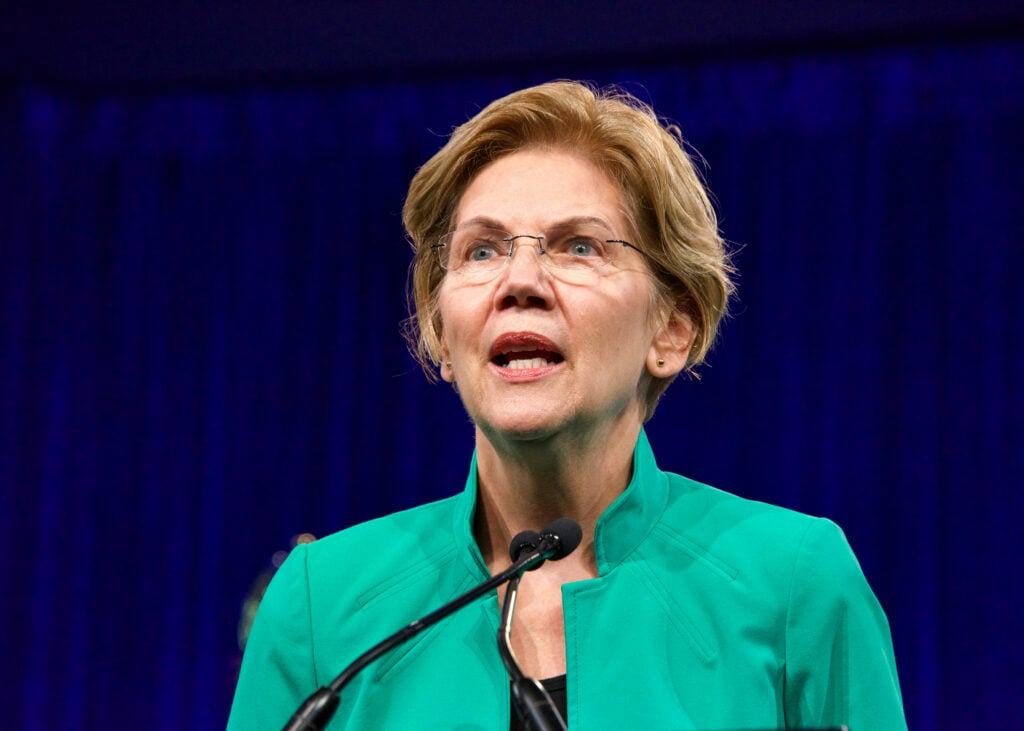
Sen. Elizabeth Warren (D-Mass.) said CVS Health Inc.’s (NYSE: CVS) planned split lets the company “continue to own a massive conglomerate and rip people off,” as billionaire investor Mark Cuban said the breakup “changes nothing for patients or anyone who pays for insurance or care.”
Warren and Cuban posted on X on Wednesday after Matt Stoller of the American Economic Liberties Project wrote that CVS Health Chairman and CEO David Joyner said on CNBC that the “Break Up Big Medicine” bill from Warren and Sen. Josh Hawley (R-Mo.) is one reason for the breakup. Joyner appeared on CNBC’s ‘Squawk on the Street’ on Wednesday.
CVS Maps Out Its 2028 Breakup Plan
CVS had announced plans to separate its healthcare solutions business from its retail pharmacy business. The healthcare solutions business will retain the CVS Health name, while the retail pharmacy business will be named CVS Pharmacy.
The company expects to complete the separation in the first half of 2028, subject to regulatory requirements. It also reported third-quarter revenue of $108.399 billion, up 5.4% year over year, and raised its 2026 adjusted EPS guidance to at least $8.20 per share from a previous range of $7.90 to $8.10.
Warren and Cuban Question Whether Split Helps Patients
“CVS sees the writing on the wall: Americans want to break up the giant corporations dominating health care,” Warren wrote. “But this CEO is not fooling us.” She added: “We must break up these monopolies and put patients over profits.”
Cuban called Joyner “a genius financial engineer” and wrote that “the split is great for shareholders.” He added: “Don’t fall for it,” urging Hawley and Warren to pass the bill “now more than ever.”
Hawley Backs Breakup Push
Sen. Josh Hawley (R-Mo.), who co-sponsored the “Break Up Big Medicine” bill with Warren, also weighed in on X. “Good. All these huge companies gobbling up local pharmacies should be broken up,” Hawley wrote.
The reactions drew in policy voices outside Congress who were debating which health care ideas could win support from both parties. Larry Levitt, executive vice president for health policy at KFF, listed antitrust, lower drug prices, curbing prior authorization and more price transparency as ideas that could, “at least in theory,” get bipartisan support.
Marc Goldwein, senior vice president and senior policy director at the Committee for a Responsible Federal Budget replied that the focus could be on ideas that lower costs for everyone, or on “driving up Medicaid spending to pad hospital budgets.”
CVS CEO Defends Separation as Move From Strength
Joyner, meanwhile, described the split in his CNBC interview as a move made from strength. “We’re doing it out of a position of strength,” he said. He said the company is now guiding retail pharmacy for a third year of growth into 2027, after guiding it down 5% two years ago.
Mark Cuban had previously urged Sen. Ted Cruz (R-Texas) to back the bill, saying it would bar companies from owning both a health insurer and a pharmacy benefit manager.
Price Action: CVS Health shares fell 12.53% to close at $79.96 on Wednesday. The stock was up 0.69% at $80.51 in Thursday’s pre-market trading.
Image via Shutterstock