
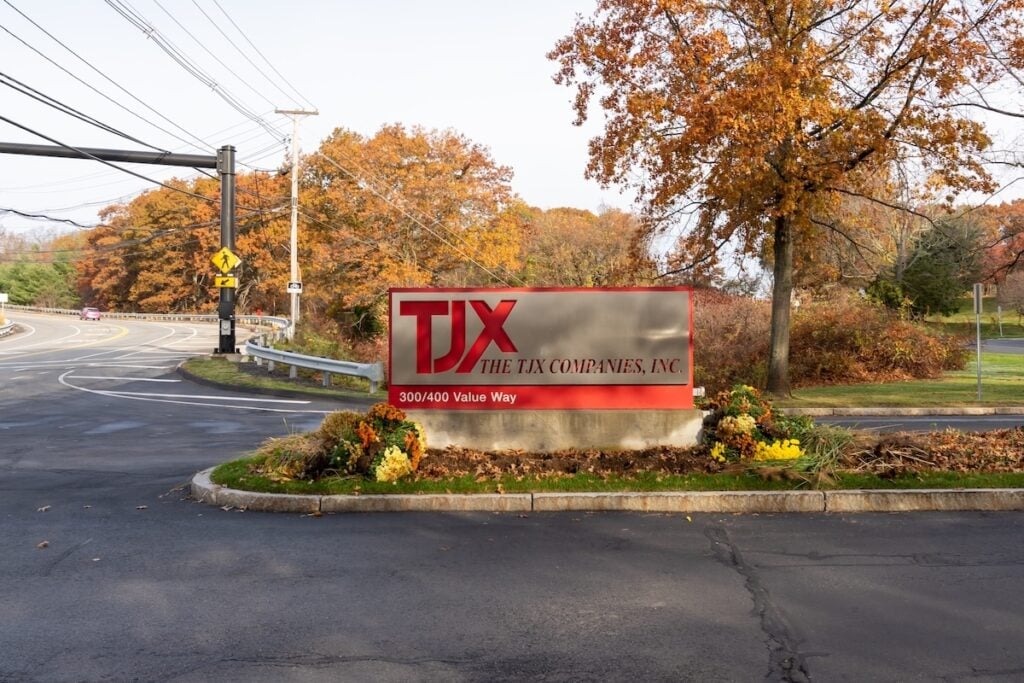
Almost every bargain on an off-price rack has made two trips before reaching the store. The first is by container ship. The second is by truck.
This year, both trips became far more expensive. Even so, the retailers selling those bargains have not yet paid most of the bill.
According to Bank of America Global Research, that changes in April.
On Tuesday, analyst Lorraine Hutchinson cut her earnings estimates and price targets on The TJX Companies Inc. (NYSE:TJX), Ross Stores Inc. (NASDAQ:ROST) and Burlington Stores Inc. (NYSE:BURL). Her reason is a freight bill that has been building since the Iran war pushed fuel prices to record highs.
However, she kept Buy ratings on all three stocks.
The Diesel Bill Is Already Written
The U.S. average price of diesel stood at $6.35 a gallon on Tuesday, according to AAA. That is about 73% higher than a year ago, and only a few cents below the record of $6.53 set on Sept. 22.
Meanwhile, heating oil futures, the main U.S. benchmark for diesel, traded at $4.64 a gallon. That is roughly 79% above where they ended February, before the conflict in the Gulf sent energy markets into turmoil.
Retailers have been partly shielded so far. Most domestic trucking contracts were signed last April, and many shipping contracts were fixed then as well.
As a result, the real test comes when those contracts are renegotiated. Bank of America expects the new rates to start in May, which hits the second quarter of fiscal 2027.
How Big the Hit Could Be
Bank of America said domestic freight rates, including fuel surcharges, are up 13% since April. Ocean rates on the Shanghai-to-Los Angeles route are up 168%, a jump the bank ties largely to congestion linked to the Red Sea.
Hutchinson models a 15% rise in domestic freight and an 80% rise in ocean freight next year. That assumes container rates come down from today’s peak.
Under that scenario, she sees about 60 basis points of extra pressure on gross margins. She also put the message bluntly: “It is clear that inflation is here to stay.”
In dollar terms, 60 basis points is not trivial. Applied to the past 12 months of sales, it equals about $374 million for TJX, $147 million for Ross and $73 million for Burlington.
Combined, that is roughly $595 million.
| Company | Next-year EPS (old → new) | Price target (old → new) | Upside to new target |
|---|---|---|---|
| The TJX Companies Inc. TJX | $5.56 → $5.38 | $175 → $170 | 21% |
| Ross Stores Inc. ROST | $8.84 → $8.54 | $265 → $258 | 12% |
| Burlington Stores Inc. BURL | $13.08 → $12.33 | $365 → $344 | 46% |
Why Bank of America Is Still Buying
The bank’s case rests on a paradox. The inflation that raises freight costs also squeezes shoppers, pushing more of them toward bargains.
Timing could help too. Bank of America’s economists expect costly airfares to steer more holiday money from travel into stores.
The risk lies in the April rates. In late 2021, freight cut about 300 basis points from the three chains’ gross margins. Under the bank’s own sensitivity table, a 30% rise in domestic freight and a 120% jump in ocean rates would more than double the 60-basis-point hit.
Bank of America Is Still Ahead of the Street
Even after the cuts, Bank of America sits above the consensus on two of the three names, according to Benzinga Analyst Ratings.
TJX has a Buy consensus from 20 analysts and an average target of $165. Ross has a Buy consensus from 18 analysts and an average target of $248. Burlington is the exception, with a $363 average from 21 analysts that sits above Bank of America’s new $344.
Not everyone is bullish. Jefferies downgraded TJX to Hold in August, and Wells Fargo has a $140 target with an Equal-Weight rating. By contrast, UBS upgraded Ross to Buy on Monday with a $315 target.
On Tuesday afternoon, TJX was down 2.4% at $140.30, Ross was off 1.9% at $229.67 and Burlington was 2.1% lower at $236.18. Year to date, Ross is up 27.2%, while TJX is down 8.5% and Burlington is down 17.8%, against a 1.8% gain for the SPDR S&P Retail ETF (NYSE:XRT).
The freight bill is coming in any case. What matters now is the size of the April contracts and whether value-hungry shoppers spend enough to cover them.
Photo Courtesy: JHVEPhoto on Shutterstock.com