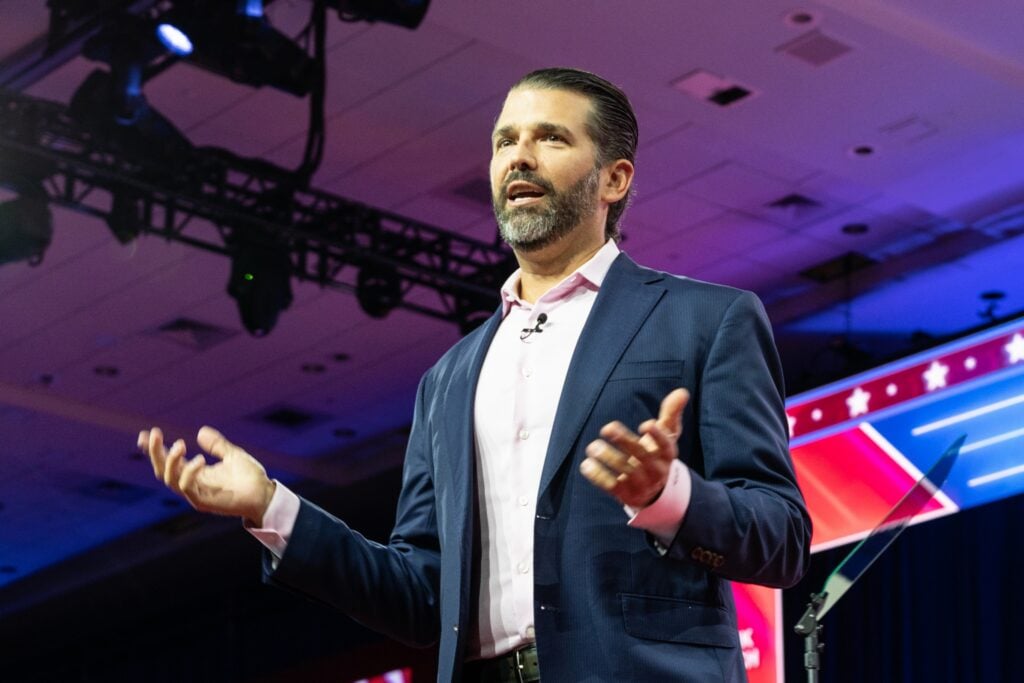
Donald Trump Jr. or Don Jr., the eldest son of President Donald Trump, has reportedly opposed the ongoing war with Iran in private.
Trump Jr. has repeatedly criticized the war from the beginning and also communicated his position to his father, The Atlantic reported on Tuesday, citing people with knowledge of the matter.
He has long questioned foreign intervention and resisted another U.S. military conflict in the Middle East, highlighting growing disagreements within the MAGA movement over “America First.” Trump Jr. was also close to the late conservative activist Charlie Kirk, who opposed the Iran war, according to the report.
“Don has kept his views on the subject private, as he would never publicly break with his dad on an issue like this,” a person close to Trump Jr. told the publication.
Notably, during the 2024 campaign, Donald Trump Jr. portrayed his father’s foreign policy as focused on keeping the U.S. out of another Middle East war.
In April 2024, he posted on X, “Times like these should make us all realize how lucky we were to have Trump, his strength and his resolve.”
The Trump Organization and the White House did not immediately respond to Benzinga’s request for comment.
Iran War Strains Budgets, Hurts Trump’s Rating
Trump Jr.’s reported opposition follows earlier warnings from inside the administration about expanding the conflict. In July, Vice President JD Vance and Joint Chiefs Chairman Gen. Dan Caine reportedly cautioned Trump against escalation. Caine cited depleted U.S. munitions stockpiles and other risks.
Rising gas prices, fueled by energy-market disruptions, are straining household budgets and intensifying the political fallout, due to which public support for the war has also weakened. Diesel averaged $6.3174 per gallon on Tuesday, while gas prices stood at $4.26 per gallon, according to the American Automobile Association (AAA)
Trump’s approval rating fell to 31%, its lowest level across both presidential terms, according to a Reuters/Ipsos poll. His rating has declined from 47% after his inauguration, as economic concerns and elevated gasoline prices as a result of the war weigh on voters. Democrats held a 40%-33% advantage over Republicans on handling the economy ahead of the midterm elections.
Sen. Rand Paul (R-Ky.) also blamed Washington’s foreign conflicts and climate policies for driving up energy costs, calling for a restrained foreign policy and fewer restrictions on domestic energy production to ease the burden on American families.
Economist Mark Zandi estimated that the Iran war has added nearly $2,000 to the costs faced by the average American household since February, totaling $265 billion nationwide.
Disclaimer: This content was partially produced with the help of AI tools and was reviewed and published by Benzinga editors.
Image via Shutterstock