
For most of this year, Brent crude at $100 a barrel has been a reliable sell signal. The signal came from the White House.
Each time crude approached or crossed triple digits, President Donald Trump faced pressure to reduce tensions in the Middle East. Talk of negotiations, ceasefires or safer passage through the Strait of Hormuz then knocked prices lower.
Wall Street calls Trump’s tendency to retreat under economic or market pressure the “TACO” trade, short for “Trump Always Chickens Out.”
Will $100 oil trigger it again?
Trump’s Oil Put Appears At Triple-Digit Prices
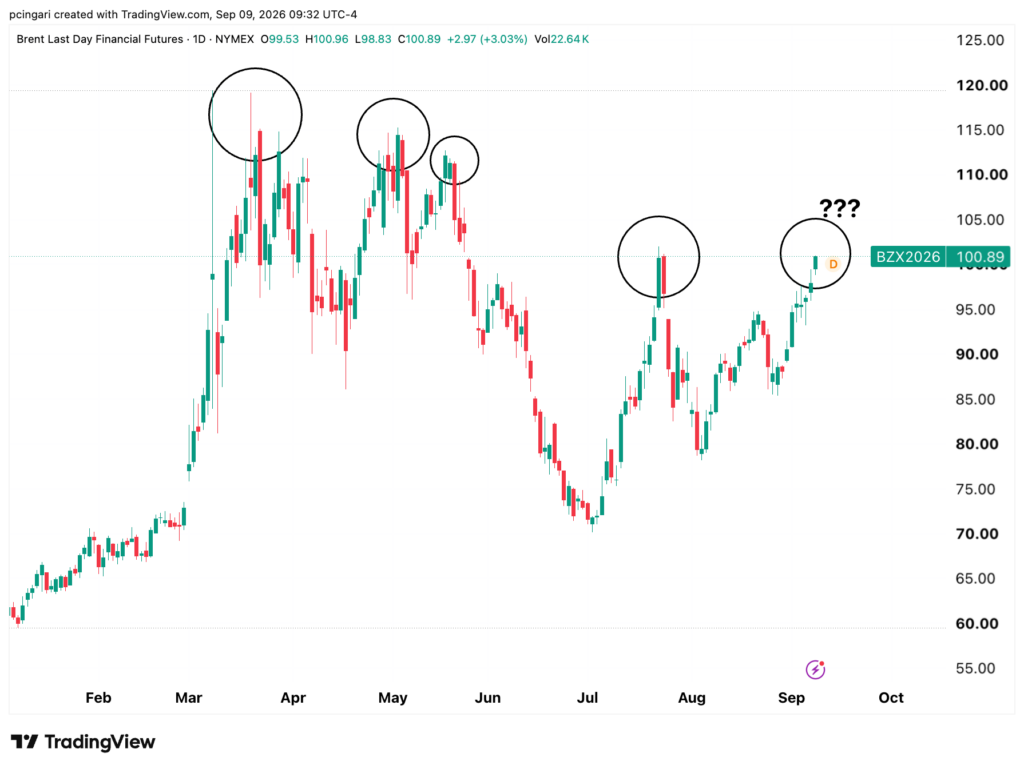
Brent – tracked by the United States Oil Brent Fund LP (NYSE:BNO) – climbed as high as $100.95 Wednesday, its strongest level since July.
The latest escalation included U.S. strikes on five Iranian tankers. Iran responded by targeting ships near the Strait of Hormuz and firing missiles at an American base in Jordan.
Iran-backed Houthi militants also attacked Saudi energy infrastructure.
This is the fourth time Brent has reached $100 since the Iran war began in late February. On each previous occasion, Washington soon paused military action, floated a withdrawal or opened diplomatic talks. Oil then retreated.
On March 10, Trump said the war would end soon. Brent, which had touched $119 two days earlier, fell 8.5% that session.
On March 23, after Brent returned to $115, Trump postponed planned strikes on Iranian power plants and energy infrastructure for five days.
Brent plunged more than 10% toward $100. Trump said prices would “drop like a rock” after a deal, making the economic objective difficult to miss.
On April 1, with Brent above $108, Trump suggested U.S. forces could leave Iran within two to three weeks.
The pattern appeared again in July. After Brent reached $102, Washington and Tehran paused strikes to create room for diplomacy. Brent closed July 27 down 8.7% at $88.36.
Traders may therefore view $100–$110 Brent as the approximate strike price of the “Trump oil put”—the level at which political intervention becomes more likely.
$4 Gasoline Is A Midterm Problem
The political cost of expensive crude appears at America’s gas stations.
The national average price for regular gasoline reached $4.22 per gallon Wednesday, according to AAA, up from $3.19 a year earlier.
Diesel climbed to a record $5.94 per gallon.
Unlike many economic indicators, fuel prices are displayed on street corners and paid directly by consumers every week. That makes them particularly dangerous less than two months before the midterm elections.
Prediction markets already favor major Democratic gains.
Polymarket assigns an 88% probability that Democrats capture the House. Its balance-of-power market gives a Democratic sweep a 51% chance.
A split Congress, with Democrats controlling the House and Republicans retaining the Senate, carries a 36% probability. A Republican sweep is priced at only 12%.
Entering the midterms with Brent above $100 and gasoline above $4 would hardly support Trump’s economic message.
$100 Oil Collides With Trump’s Demand For Lower Rates
The second problem is monetary policy.
U.S. consumer inflation stood at 3.4% in July, well above the Federal Reserve’s 2% target. Economists expect Friday’s August report to show another strong monthly increase, with headline inflation remaining above 3%.
If crude remains near $100, higher gasoline and transportation costs could appear more clearly in subsequent inflation reports.
Fed Chair Kevin Warsh made the central bank’s position clear at Jackson Hole.
“The recent rise in overall commodity prices also bears watching,” Warsh said.
Warsh added that the Fed must be confident that underlying inflation is moving toward 2% “clearly and at sufficient speed.”
“Otherwise, we have work to do,” he warned.
Markets received the message.
Fed funds futures assign a 60.2% probability to a quarter-point rate increase on Sept. 16. If the Fed waits, markets price an 89% probability that rates will be higher by the October meeting.
A second increase is almost fully priced by March 2027.
Trump wants the exact opposite.
Following last week’s stronger-than-expected employment report, he demanded that the central bank lower interest rates.
“Lower the rate or I’ll stop trading with countries with which we have a deficit,” Trump said in a Truth Social post.
Something Has to Give
The two positions are becoming increasingly difficult to reconcile.
Trump cannot easily demand lower interest rates while a foreign-policy shock pushes oil, gasoline and inflation higher. He cannot control the Fed’s decision, but he can influence the military and diplomatic choices affecting crude prices.
That makes oil the variable over which the White House has the most leverage
If the pattern from the spring repeats, the next major move in crude may come from a Trump post rather than an oil tanker.
Photo: USA TODAY Network via Reuters Connect