
Economists expected the Philadelphia Fed’s factory gauge to fall by nearly half this month. It hit a five-year high instead.
The Federal Reserve Bank of Philadelphia said Thursday that its diffusion index for current general activity rose to 47.4 in August from 41.4 in July, the strongest reading since April 2021.
The economist consensus had called for a decline to 25.0.
Nearly 57% of firms reported an increase in activity against 10% reporting a decrease.
The forward-looking number was the larger surprise.
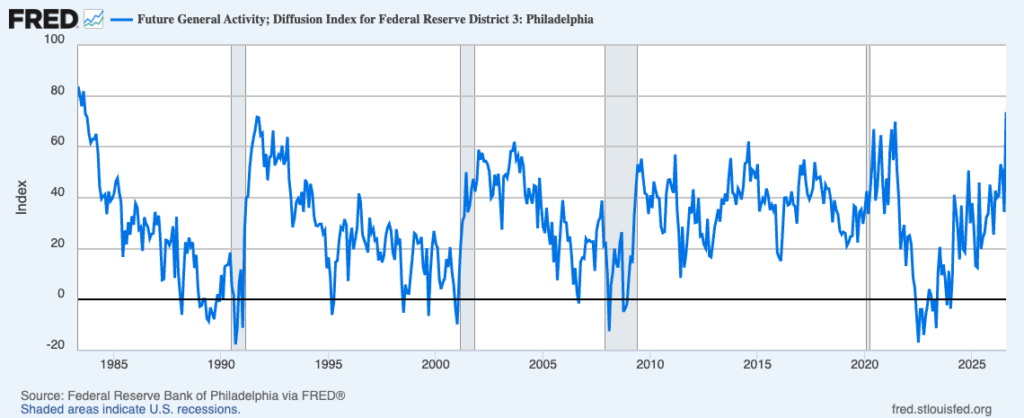
The index for future general activity climbed 39 points to 73.6, its highest reading since August 1983.
“Most future indicators jumped higher this month, suggesting widespread expectations for overall growth over the next six months,” the report said.
What Manufacturers Now Expect
Almost 75% of firms expect activity to rise over the next six months, up from 52% in July. Just 1% expect a decline, down from 17%.
The index for future capital expenditures rose 18 points to 48.2, the highest in 53 years.
That last figure is the one that matters for the real economy. Diffusion indexes measure how widely conditions are improving, not by how much, so a capital-spending reading at a five-decade high says planned investment is broadening across the district rather than concentrating in a handful of plants.
Meanwhile, the employment index rose 18 points to 27.9, the best since April 2022, with 33% of firms adding workers, up from 13% a month earlier.
Not everything accelerated. New orders fell 7 points to 30.1 and shipments dropped to 27.7 from 33.7, though both stayed above their long-run nonrecession averages.
Prices paid slid 13 points to 40.9 and prices received fell 10 points to 17.7, the lowest readings since February but still elevated.
Third Confirmation In Three Weeks
The Philadelphia survey is now the third consecutive factory report to run past forecasts.
The Institute for Supply Management’s manufacturing index registered 55.6% in July, up from 53.3% in June and the highest since May 2022, against a 54.0% consensus. Its employment component crossed into expansion for the first time in 33 months.
The production subindex jumped 6.3 points to 58.5%, the strongest since November 2021.
The New York Fed’s Empire State survey followed on Aug. 17, rising to 20.6 in August from 15.6, roughly double the 10 to 11 economists expected and the best reading in more than four years.
Here’s The Trade Investors Have Already “MADE”
Over the past year the iShares U.S. Manufacturing ETF (NYSE:MADE) has rallied 29%, outperforming both the tech-heavy Invesco QQQ Trust (NASDAQ:QQQ) at 25% and the SPDR S&P 500 ETF Trust (NYSE:SPY) at 19%.
The fund holds 116 names.
Its ten largest positions account for roughly 38% of assets: Eaton Corp. plc (NYSE:ETN) at 4.4%, RTX Corp. (NYSE:RTX) at 4.1%, Amphenol Corp. (NYSE:APH) at 4.1%, Deere & Co. (NYSE:DE) at 4.1%, Parker-Hannifin Corp. (NYSE:PH) at 3.9%, Cummins Inc. (NYSE:CMI) at 3.8%, Caterpillar Inc. (NYSE:CAT) at 3.7%, General Motors Co. (NYSE:GM) at 3.5%, Vertiv Holdings Co. (NYSE:VRT) at 3.3% and PACCAR Inc. (NASDAQ:PCAR) at 3.1%.
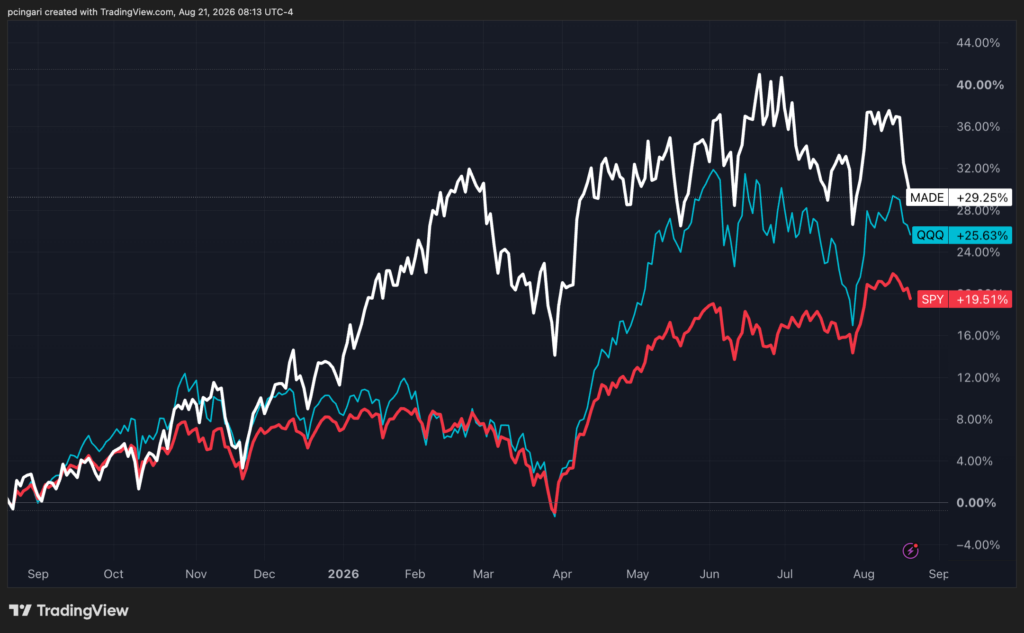
Image: Shutterstock