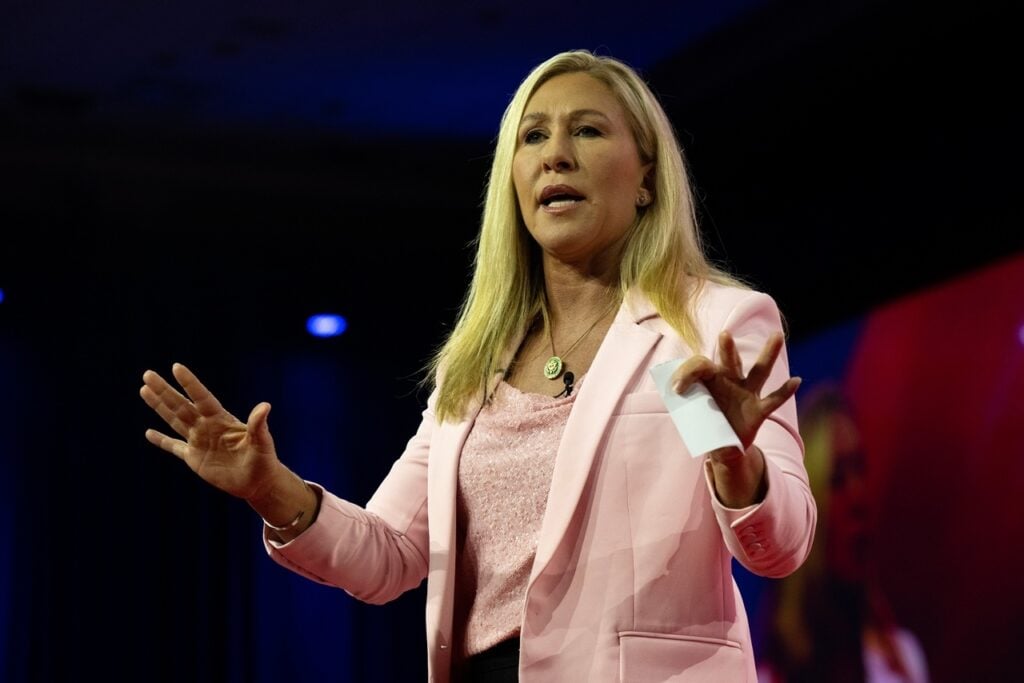
On Monday, former Rep. Marjorie Taylor Greene (R-Ga.) backed Mark Cuban’s criticism of pharmacy benefit managers, arguing that lawmakers know about the drug-pricing problem but have failed to pursue meaningful bipartisan reforms.
Marjorie Taylor Greene Backs Mark Cuban’s Criticism
Last week, Cuban turned to Anthropic’s Claude to examine the U.S. drug-pricing system.
On X, he shared the analysis and asked his followers, “Tell me where Claude and I got this wrong.”
He argued that the U.S. does not simply have a drug-price problem but a “$360B+ middleman rebate problem,” adding that PBM spreads, fees and rebates inflate list prices.
His proposal calls for an open federal formulary, transparent cost-plus pricing and penalties for drug price increases that exceed inflation.
Cuban estimates the changes could generate roughly $142 billion in annual savings, including $122.2 billion in direct drug savings and $20 billion in administrative savings.
On Monday, Greene shared Cuban’s proposal on X and said lawmakers already understand the problem.
“Yes it’s the middle man,” Greene wrote. “My former colleagues ALL know it, talk about, yet refuse to do anything real, tangible, and actionable about it.”
PBMs negotiate drug prices and formularies between insurers, pharmacies and drugmakers, with critics arguing that opaque rebate arrangements can make it difficult to determine the true cost of medications.
Cuban has long advocated for greater transparency through his Cost Plus Drugs business.
Greene Calls for Bipartisan Healthcare Reform
Greene said solving the issue will require lawmakers to move beyond partisan politics.
“Our future will need left and right coalitions that come together to fix problems instead of fighting like drunk football fans in a bar,” she said.
In a follow-up post, Greene expanded her criticism to the Affordable Care Act, arguing that it has contributed to unaffordable insurance costs for small businesses, contractors and independent Americans.
She also said that the law has harmed doctors’ practices and private hospitals, while calling for a broader coalition focused on healthcare reform rather than party politics.
The debate comes as federal regulators have also targeted PBM practices.
In July, the Federal Trade Commission announced a settlement with CVS Caremark that included measures aimed at increasing transparency, addressing rebate practices and allowing employers to move toward cost-plus pharmacy reimbursement.
Disclaimer: This content was partially produced with the help of AI tools and was reviewed and published by Benzinga editors.
Image via Shutterstock/ Consolidated News Photos