
“Elon is obviously amazing and incredibly successful, but he always oversells to get people excited. So I’m not quite up there with him.”
– Mark Cuban On Elon Musk’s vision of a post-money world
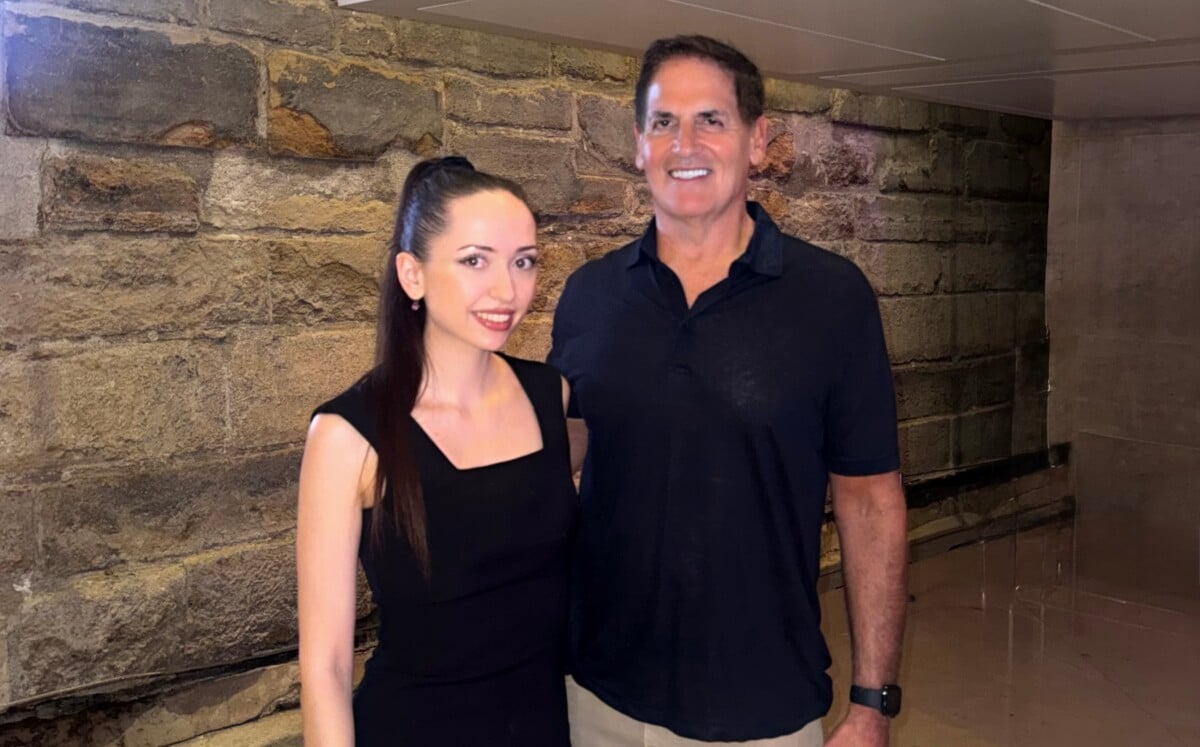
Credit: Anna Tutova(Founder AI Crypto Minds) and Mark Cuban(entrepreneur, investor, ex-Shark Tank judge, co-Founder Cost Plus Drugs) at RAISE Summit in Paris.
The billionaire investor on the AI startups he’s hunting, how his drug company shrunk a factory to the size of a truck and why he sold 98% of his Bitcoin.
Mark Cuban is the self-made serial entrepreneur, billionaire investor and former Shark Tank judge. He’s also lived through a tech bubble before and he doesn’t think artificial intelligence is one of them. Valuations are getting “a little bit high,” he told me at the RAISE AI summit in Paris last week, but the frenzy looks nothing like the dot-com crash.
“That’s a good question. I’ve been through a bubble before,” – Mark Cuban told me. “I don’t think we’re in as much of a bubble right now simply because, even though a lot of the valuations for some companies are crazy, there are more private investors as opposed to public investors.” The dot-com collapse burned millions of ordinary shareholders. Today’s froth, he argues, is largely confined to private markets. “Now that can change because there’s a lot of secondary markets where people can do transactions. But I don’t think a lot of normal people invest that way. So I don’t think we’re in a bubble yet, but I think the valuations are getting a little bit high. So we’ll see what happens next.”
It’s a measured assessment from someone who has spent a decade in the AI weeds. Mark Cuban began investing in the space in 2017, well before ChatGPT made it a household term. His first bet: Synthesia, a London-based avatar and video platform. “As someone who’s been in technology, pretty obvious to me AI is going to have a large impact. So starting with neural networks, I started educating myself, getting involved, investing in companies like Synthesia, using it for my businesses. And as it’s evolved to the large language models and transformer-based, I just try to invest where I see opportunity and integrate it into my companies so we can get the biggest edge.”
Product or Feature?
Mark Cuban’s filter for AI startups is brutally simple. He’s hunting for companies that won’t get flattened the moment a tech giant enters the space.
“In terms of AI startups, I think ones that are very application-specific, that are ones that won’t be preempted by the foundational model,” – he explained. “There’s certain things that have become features, not products, where you know that Anthropic and OpenAI are going to just do that at some point.”
The moat he prizes is proprietary data. “I look for companies that can stand on their own, that have a data moat, where they have specific types of data or intelligence that you can’t just recreate, you have to have it.”
When entrepreneurs pitch him, the litmus test is as direct as it gets: “Are you a product or are you going to be a feature for something that OpenAI does?” He’s also unconcerned with headcount. “I don’t care how many employees they have, the fewer the better. It’s really whether or not it can stay as a product when Claude and OpenAI try to compete with them. You know, what kind of moats do you have?”
He’s actively avoiding the crowded herd. “I try to find applications or opportunities that don’t replicate what everybody else is already doing,” – he said.
On a daily basis, Mark Cuban relies on a handful of AI tools. He uses Lovable, an AI app builder, alongside Anthropic’s Claude. For healthcare work, he turns to Open Evidence, a medical research platform. “From there I jump around just trying to learn,” he said.
When I asked how founders should steer toward profitability, he didn’t cite unit economics or customer acquisition costs. He named a tool. “Use Lovable. One of the great things about Lovable, it’s really oriented towards startups and entrepreneurs, no matter where you are in the world. You could be in Brazil, you could be in Paris, you can be in the US, but it’s really oriented specifically for entrepreneurs to start companies.” The logic is implicit: start lean, burn less, build faster.
His investment map is shifting, too. “It’s been in the US for a long time, but now it’s more in Europe. AMI from Yann LeCun, Lovable, Synthesia is out of London. The number of companies I’m investing here is just growing exponentially.” Asia and the Middle East are less of a priority. “Not as much, just because it’s too far to travel. I try to keep it as simple as possible. So coming to Europe is easy.”
A Factory the Size of a Truck
Mark Cuban’s most vivid AI application isn’t a startup he’s backed, it’s inside his own company. Cost Plus Drugs, which he co-founded in 2022 to bring radical price transparency to US healthcare, has used AI and robotics to collapse its manufacturing footprint in ways that sound like science fiction.
“The United States healthcare is kind of a mess. There’s no transparency. Nobody knows the price of anything that they pay for,” – he said. The fix: Cost Plus Drugs, where medications are sold with a flat 15% markup. “Believe it or not, that was a big change for a lot of people because we only mark up our medications 15%, we’re typically a lot cheaper than everybody else.”
The company is “pretty close to break-even,” Mark Cuban said, and is now pushing heavily into manufacturing. That’s where AI has delivered its biggest surprise. “We use AI for everything, and particularly our manufacturing. We’ve been able to shrink manufacturing injectable drugs from the size of a football pitch to, you know, the size of a tractor-trailer that you can put behind a truck. So we’ve really been able to use it for robotics and for optimizing things in the factory.”
He intends to stay focused on the US “Probably just in the US, just because healthcare in the US is just a mess and it’s right for disruption.” With millions of customers already served and more exclusive manufacturing capabilities in the pipeline, he’s no longer just a transparent drug reseller. He’s becoming a manufacturer.
Walking Away from Bitcoin
Mark Cuban’s AI conviction is sharpened by what he’s left behind. He revealed he sold 98% of his Bitcoin, a position that was once worth hundreds of millions of dollars. “I have a little bit, but I sold 98% of it,” – he said.
The original thesis broke. “When I originally got excited, I wasn’t into it, then I got excited about it because with only 21 million being made it made sense to me that it could be a hedge to inflation or geopolitical problems, as opposed to just being an investable asset. A high alpha asset. But that’s not what we’ve seen. Since last January, there’s been a lot of geopolitical uncertainty, the value of the dollar has dropped, we’ve had inflation, all of which should make Bitcoin go straight up. And we haven’t seen that”.
He watched Bitcoin behave more like a high-beta tech stock than a safe haven. “It was too dependent on Michael Saylor and what he was doing with Strategy, and that isn’t why I bought it. I think it’s kind of lost the plot. It’s not the hedge we all thought it would be.”
Mark Cuban’s investment discipline is well-known: “My approach is always, I have a thesis. And if the thesis stays true, then I stay with it, even if the market’s going against me. But when it turns out my thesis is wrong, that’s when I get out, even if the market is going in my direction.” So he got out, almost entirely.
Ethereum fares only slightly better. “I still own a little bit more Ethereum, but I thought that we would start to see applications that everybody would use. But now it’s still just DeFi and transferring USDC. And there’s no limit to the number of competitive blockchains that can be created. So I’m a little bit more bullish on Ethereum than I’ve been on Bitcoin recently, but I’m still disappointed in Ethereum.”
He also flagged an existential threat. “All the research is saying that [quantum computing] is a threat to crypto. It’s not a risk yet, but it’s something everybody’s going to have to pay attention to.” Quantum itself, he admitted, is “over my head.”
One crypto holding remains untouched. “All the Dogecoin I’ve ever owned, I still own. It’s not a ton, but I keep it out of principle.”
What’s Next
Mark Cuban parted company with the most famous voice in AI. When I asked about Elon Musk’s vision of a post-money world, he was direct. “Elon is obviously amazing and incredibly successful, but he always oversells to get people excited. So I’m not quite up there with him.”
He also pushed back on fears of mass job destruction. “I think when companies were out there saying half the people are going to lose their jobs, that was like three, four years ago, and they were saying two years, right? And obviously we haven’t seen that yet, and I don’t expect to see that.” His forecast: “AI will make white-collar workers, people in offices, a lot more productive. And so if you can help the company grow by becoming more productive, you’ll be fine. And as the companies grow, you’ll need those people using AI to keep up with the growth.”
Mark Cuban has narrowed his ambitions to two lanes. “Yeah, healthcare and AI. Those are my two areas of focus, and healthcare, you know, exclusively in the US,” he said.
On the healthcare side, he’s not diversifying, he’s going deeper into Cost Plus Drugs. “Mostly with my own company and trying to be disruptive. We’ve been successful so far. We have millions of people we’ve helped. We keep on expanding, more in manufacturing. We’ve got a lot of exclusive things that we do there. So we’ll just keep on pushing, pushing the envelope.”
The man who started by selling garbage bags door-to-door has built a fortune on knowing when to walk away from a broken thesis and when to double down. He sold the Bitcoin. He’s holding the Dogecoin out of principle. For someone who built his career on knowing when to fold, the signal is unmistakable: on AI and healthcare, he’s not folding. He’s doubling down.
Benzinga Disclaimer: This article is from an unpaid external contributor. It does not represent Benzinga’s reporting and has not been edited for content or accuracy.