
Semiconductor stocks just suffered their worst month in nearly 24 years, and ETF investors responded by buying more aggressively than ever.
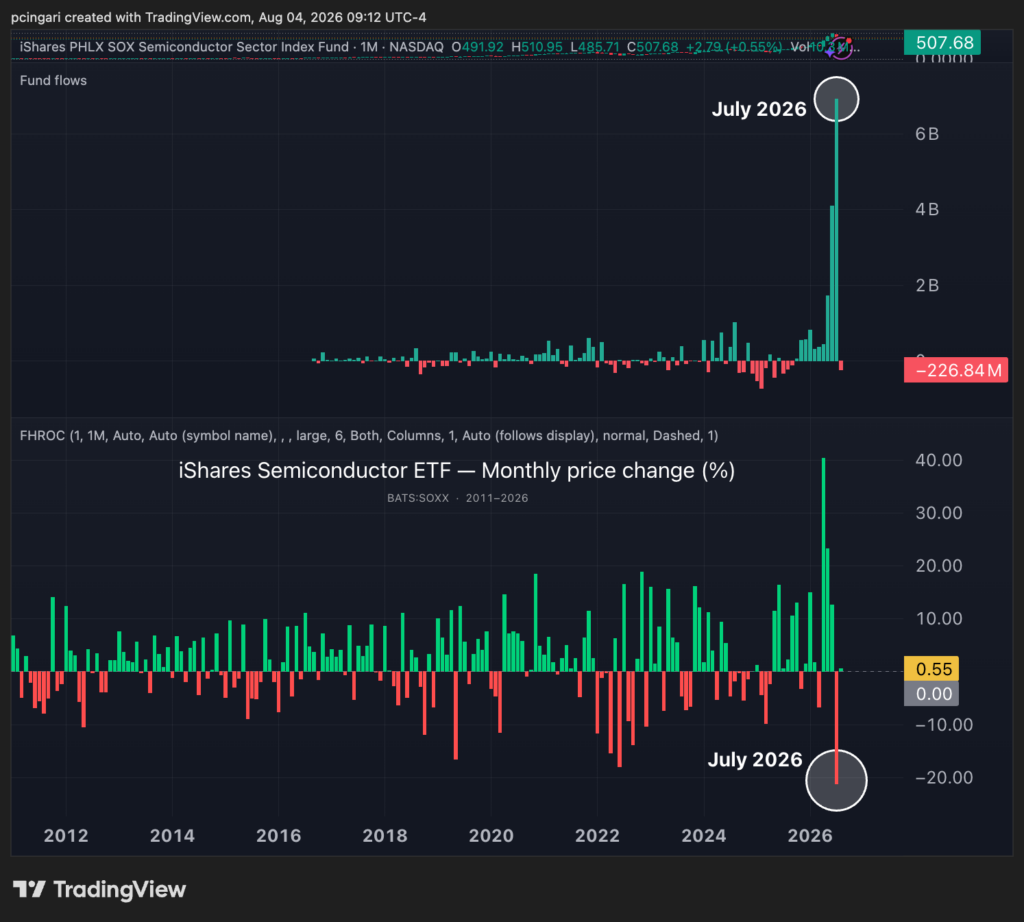
The iShares Semiconductor ETF (NASDAQ:SOXX) plunged 22.1% in July, its worst monthly performance since December 2002.
Yet beneath that historic selloff, fund flows told the opposite story.
SOXX attracted $6.92 billion in net inflows during July, according to TradingView fund-flow data. That was the largest monthly inflow since the ETF’s inception.
The scale is striking because investors had already poured $7.75 billion into SOXX during the first six months of 2026.
July alone added almost as much money as the entire first half. That lifted cumulative 2026 inflows to roughly $14.67 billion through July 31.
In other words, one of the semiconductor industry’s sharpest corrections in decades triggered record buying rather than an investor exodus.
Investors Are Betting The AI Cycle Isn’t Broken
That conviction has an increasingly powerful fundamental argument behind it: the companies buying AI chips are still accelerating spending.
Bank of America semiconductor analyst Vivek Arya now expects global hyperscaler capital expenditures to reach roughly $859 billion in calendar 2026, up 79% year over year.
By calendar 2027, Arya sees spending approaching $1.2 trillion, another 38% increase.
The numbers matter because semiconductor investors spent July questioning whether the AI infrastructure boom had gone too far.
Bank of America’s answer is essentially the opposite.
“Compute remains mostly supply constrained today,” Arya said.
That distinction matters. The current investment cycle isn’t being driven simply by companies building capacity ahead of hypothetical demand.
Bank of America estimates the largest cloud providers already have more than $2.3 trillion of customer commitments and backlog supporting those investments.
“We see surging demand outpacing the capacity being built,” Arya said.
The beneficiaries stretch well beyond GPUs.
Arya identified compute, memory, semiconductor equipment, power semiconductors and optical networking as the major semiconductor exposures to the spending cycle.
Chip Valuations Fell While the Earnings Story Held Up
Ed Yardeni, president of Yardeni Research, also sees the recent AI selloff as a “buying opportunity.”
His argument centers on the growing disconnect between prices and earnings.
The S&P 500 Semiconductors industry recently traded at roughly 15.9 times forward earnings, a significant discount to the broader market, according to Yardeni Research.
That valuation compressed not because analysts suddenly slashed semiconductor earnings forecasts, but because stock prices fell while forward earnings continued rising.
That hardly resembles a semiconductor cycle collapsing under weak demand.