One of Wall Street’s most closely watched technical support levels has finally given way.
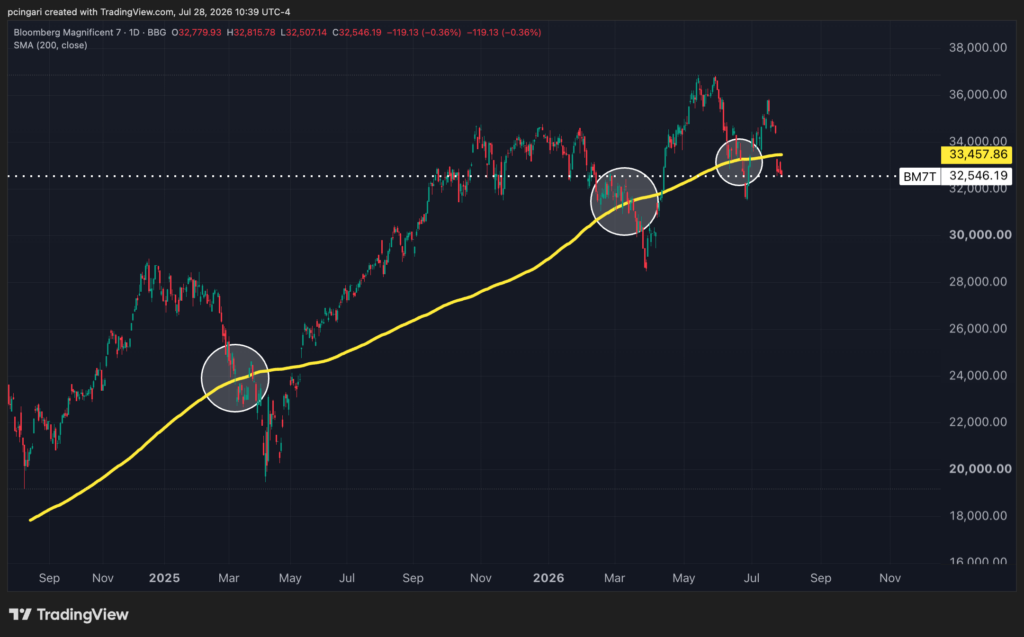
The Bloomberg Magnificent 7 Index, which tracks Apple Inc. (NASDAQ:AAPL), Microsoft Corp. (NASDAQ:MSFT), NVIDIA Corp. (NASDAQ:NVDA), Alphabet Inc. (NASDAQ:GOOG), Amazon.com Inc. (NASDAQ:AMZN), Meta Platforms Inc. (NASDAQ:META) and Tesla Inc. (NASDAQ:TSLA), has slipped below its 200-day moving average.
For many technical traders, that marks the transition from a long-term uptrend into a weaker phase.
• NVIDIA shares are showing limited movement. What’s the outlook for NVDA shares?
But some market strategists see something very different: another opportunity to jump back on the Magnificent Seven bandwagon.
Why the 200-Day Moving Average Matters
The 200-day moving average is one of the most widely followed technical indicators on Wall Street.
When an index trades above it, investors generally view the long-term trend as intact. Falling below it often triggers concerns that a bull market is losing steam.
The chart has become even more notable because the current breakdown marks only the fourth time since 2022 that the Bloomberg Magnificent 7 Index has closed below its 200-day moving average.
According to Invesco Chief Global Market Strategist Brian Levitt, every previous occurrence eventually proved to be a buying opportunity.
“The momentum-driven unwind in the so-called Magnificent 7 stocks appears to have run its course,” Levitt said.
“In each of the three prior instances, the subsequent rally ultimately pushed prices to new highs.”
Rather than signaling the end of the AI bull market, Levitt believes the latest pullback resembles “a mid-cycle pause driven by an unwinding of excessive enthusiasm.”
The Sell-Off Has Been Anything But Uniform
The technical breakdown reflects a difficult year for several members of the Magnificent Seven — but not all of them.
Tesla has been the biggest drag, falling 32.9% year to date.
Microsoft has lost 18%, while Meta is down 10.4%. Amazon has slipped just over 1%.
On the other hand, Apple has climbed 24.3%, Nvidia remains up 5.2%, and Alphabet has gained 4.8%.
History Suggests Investors Should Watch Earnings, Not Charts
Levitt argues that today’s environment looks very different from the conditions that have historically marked the end of bull markets.
Corporate earnings remain healthy. Analysts have not broadly slashed profit forecasts. AI spending continues to accelerate, even as investors question near-term returns.
“The hyperscaler and chip trade became crowded because the fundamentals had been so compelling,” Levitt said.
“The recent correction appears to reflect investors recalibrating their expectations, not abandoning the story.”
That distinction could prove critical.
Technical signals often attract headlines, but long-term market trends ultimately depend on fundamentals.
If earnings continue to grow and AI investment remains intact, the fourth break below the 200-day moving average may end the same way as the previous three — less as the beginning of a bear market than another reset before the next leg higher.