
For years, Core Scientific Inc. (NASDAQ:CORZ) traded as one of Wall Street’s largest publicly listed Bitcoin (CRYPTO:$BTC) miners. Tuesday’s earnings report suggests investors may need to stop thinking about it that way. The headline announcement was a new long-term infrastructure partnership with Advanced Micro Devices Inc. (NASDAQ:AMD), but the bigger story is what that partnership says about Core Scientific’s business.
Instead of generating most of its revenue from mining Bitcoin, the company is rapidly becoming an AI infrastructure provider that leases power-hungry data center capacity to hyperscale computing customers.
The AMD agreement may be the strongest validation yet that the transition is well underway.
AMD Validates the AI Strategy
Core Scientific said AMD has secured up to 2.5 gigawatts of future data center capacity, anchored by 15-year agreements covering approximately 530 megawatts across five sites. The initial contracts represent more than $14 billion in potential base contracted revenue, while the company’s total leased customer power capacity has now reached approximately 1.1 gigawatts, representing more than $24 billion in potential contracted revenue.
Those numbers illustrate how dramatically Core Scientific’s business has evolved.
Rather than selling mined Bitcoin into a volatile commodity market, the company is increasingly locking in long-duration infrastructure contracts tied to AI workloads.
The Financials Show the Transformation
The transformation is already showing up in the income statement.
Second-quarter colocation revenue surged to $136.7 million, compared with just $10.6 million a year earlier. At the same time, digital asset self-mining revenue fell to $21.5 million, reflecting the company’s continued shift away from operating as a traditional Bitcoin miner. Perhaps most striking, colocation gross margin expanded to 59% from 11% a year ago, highlighting the profitability of its AI-focused infrastructure business.
Overall, Core Scientific generated $164.2 million in quarterly revenue, while adjusted EBITDA climbed to $41.1 million. As of mid-July, the company was billing customers for 437 megawatts of capacity, representing approximately $635 million in annualized colocation revenue.
The Chart Says the Market Wants More
The AMD partnership may reinforce Core Scientific’s transformation, but the stock chart suggests investors are still waiting for execution before fully repricing the business.
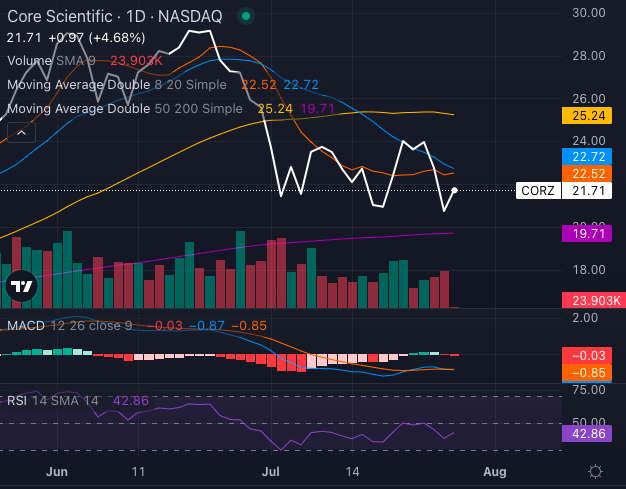
Chart created using Benzinga Pro
Even after rising in premarket trading following the announcement, shares remain below both the 20-day moving average of $22.72 and the more closely watched 50-day moving average of $25.24. Meanwhile, the stock continues to hold above its 200-day moving average of $19.71, indicating that the longer-term uptrend remains intact despite recent weakness.
That technical setup mirrors the broader investment debate. Core Scientific has largely convinced investors it is no longer just a Bitcoin miner—the financials increasingly reflect an AI infrastructure company—but Wall Street still wants proof that billions of dollars in contracted capacity can translate into sustained revenue growth and profitable execution.
If management delivers on that roadmap, AMD’s partnership may ultimately be remembered not as the reason Core Scientific changed, but as the moment the market realized the transformation was already underway.
Image via Shutterstock