The rise of cheap, open-source Chinese AI models was supposed to be a threat to the companies that sell expensive memory chips.
Bank of America thinks it is the opposite.
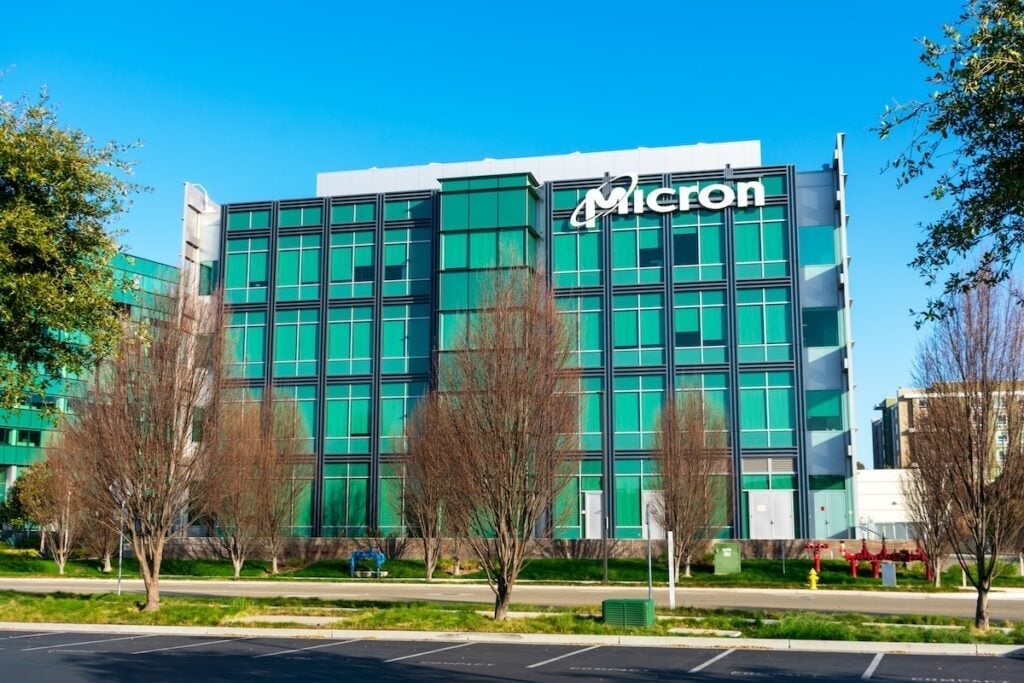
In a note published Monday, BofA analyst Vivek Arya reiterated its Buy rating on Micron Technology Inc. (NASDAQ:MU) with a $1,550 price objective, arguing that the flood of open-weight models pouring out of China expands the market for memory rather than shrinking it.
That target implies roughly 66% upside from Micron’s price near $931 on Tuesday.
The call lands the same week Moonshot AI released Kimi K3, a 2.8-trillion-parameter system BofA calls the largest open-weight model ever built.
The Counterintuitive Core of the Argument
A closed model like OpenAI’s GPT-5.6 lives in a handful of data centers, and every user in the world taps the same shared pool of chips.
An open model works differently. Every enterprise, government and cloud that downloads the weights has to load them onto its own hardware.
“Closed models consolidate memory demand; open models multiply it,” Arya said.
Every open-weight download, BofA notes, creates a new customer-side memory socket that would not otherwise exist.
Why Cheaper Chinese AI Needs Even More Memory
Chinese labs charge far less for access.
Kimi K3 runs at $3 per million input tokens against $15 for Anthropic’s Claude Opus 4.8, and some Chinese models undercut Western rivals by as much as 350x.
But the investment bank indicated that pricing is a business-model choice, not a hardware-cost readout.
Running Kimi K3 still takes about 1.4 terabytes of high-bandwidth memory — the ultra-fast chips, known as HBM, that sit beside AI processors and feed them data — spread across 64 or more accelerators per serving instance.
That memory has to be bought whether Moonshot charges $3 or $30.
“Open LLMs such as Kimi K3 pose no threats to memory demand,” Arya wrote.
“They require the same or more memory as their model weights and active parameters increase.”
What About Chinese Memory Competition?
The obvious risk is that China builds its own memory. BofA is not worried yet.
The firm notes that ChangXin Memory Technologies, China’s fastest-growing DRAM maker, is expanding hard but competes mainly in commodity chips rather than the HBM3E and HBM4 parts that feed AI systems.
It also remains unclear whether US equipment makers will win approval to sell into CXMT anytime soon.
Where Does The Rest Of The Street Stand On Micron?
Beyond AI demand, BofA highlighted another potential catalyst for Micron
The firm expects Micron’s restrictions on share repurchases under the CHIPS Act to expire around December 2026, potentially allowing the company to resume large-scale buybacks.
Arya estimates Micron could generate $120 billion to $130 billion in annual free cash flow over the next several years, with a hypothetical 40% payout policy translating into $50 billion to $60 billion in annual share repurchases, or roughly 5% to 6% of its projected market capitalization each year.
According to Benzinga Analyst Ratings, the consensus on Micron is a Buy, with an average price target of $1,316.79 and individual targets running from a low of $385 to a Street-high $2,000.
Cantor Fitzgerald, Barclays and DA Davidson all carry that $2,000 target, implying upside well north of 100%. KeyBanc raised its target to $1,750 from $1,600 on July 14.
Deutsche Bank already sits exactly where BofA now stands, at $1,550.
| Date | Firm | Price Target | Action | Rating |
|---|---|---|---|---|
| Jul 14, 2026 | KeyBanc | $1,600 → $1,750 | Maintains | Overweight |
| Jun 29, 2026 | Cantor Fitzgerald | $1,500 → $2,000 | Maintains | Overweight |
| Jun 25, 2026 | Barclays | $1,175 → $2,000 | Maintains | Overweight |
| Jun 25, 2026 | Deutsche Bank | $1,500 → $1,550 | Maintains | Buy |
| Jun 25, 2026 | Citigroup | $1,200 → $1,400 | Maintains | Buy |
| Jun 25, 2026 | Morgan Stanley | $1,050 → $1,200 | Maintains | Overweight |
Image: Shutterstock