While Wall Street remains fixated on AI revenue growth, a deeper look at Big Tech’s cash generation reveals a surprising divide. Microsoft Corp. (NASDAQ:MSFT), Alphabet Inc. (NASDAQ:GOOGL) (NASDAQ:GOOG) and Meta Platforms Inc. (NASDAQ:META) are generating more operating cash than ever before, but Amazon.com Inc. (NASDAQ:AMZN) is also telling a different story.
Despite producing record cash from its business, the e-commerce and cloud giant has watched its free cash flow evaporate as AI infrastructure spending accelerates.
The contrast highlights an emerging reality of the AI arms race: generating cash is no longer the challenge. Keeping it is.
Big Tech’s Cash Machines Keep Getting Bigger
Operating cash flow — the cash generated from day-to-day business operations — has surged across the largest technology companies over the past three years.
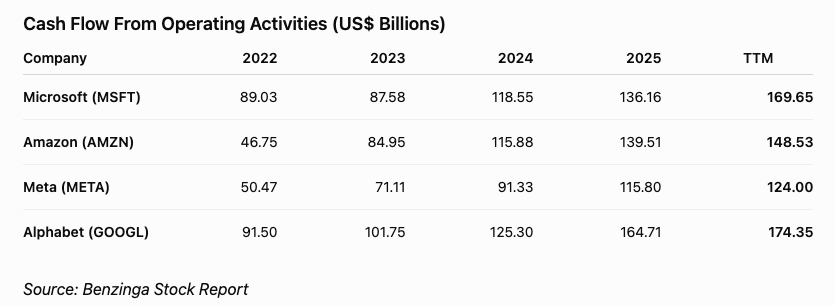
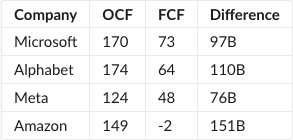
Microsoft’s operating cash flow has climbed from $89.03 billion in 2022 to $169.65 billion on a trailing 12-month basis, per Benzinga’s MSFT Report.
Alphabet has nearly doubled its operating cash generation over the same period, rising from $91.50 billion to $174.35 billion, while Meta’s operating cash flow has jumped from $50.47 billion to $124 billion.
Amazon’s growth has been equally impressive. The company has more than tripled its operating cash flow from $46.75 billion in 2022 to $148.53 billion over the trailing 12 months, underscoring the strength of its retail operations and AWS cloud business.
On the surface, Big Tech has never looked healthier.
Amazon’s Free Cash Flow Tells A Different Story
But one number stands out.
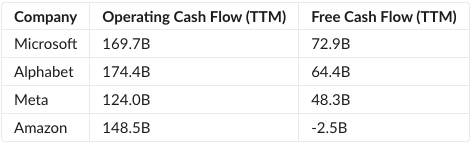
Amazon’s free cash flow has swung from $32.88 billion in 2024 to $7.69 billion in 2025, before turning negative $2.47 billion on a trailing 12-month basis.
By comparison, Microsoft’s trailing free cash flow remains at $72.92 billion, Alphabet’s at $64.43 billion, and Meta’s at $48.25 billion.
The divergence suggests Amazon is reinvesting virtually every additional dollar it generates back into the business, largely to fund the enormous infrastructure buildout required to support artificial intelligence workloads.
Chief Executive Andy Jassy has repeatedly described AI as a once-in-a-generation opportunity, with Amazon pouring tens of billions of dollars into expanding AWS data centers, custom Trainium chips and broader cloud infrastructure.
AI Is Changing The Cash Equation
The numbers illustrate a shift that investors may increasingly need to watch.
For years, Big Tech’s biggest attraction wasn’t just rapid revenue growth—it was the ability to convert that growth into massive amounts of free cash, fueling share buybacks, acquisitions and strategic investments.
Today, AI is changing that equation.
Microsoft, Alphabet and Meta continue to generate enormous free cash flow even as spending rises. Amazon, however, is offering an early glimpse of what happens when AI infrastructure investment begins consuming nearly all of the cash a company generates.
That doesn’t necessarily make Amazon’s strategy a negative one. If today’s investments produce years of AI-driven growth through AWS, they could strengthen the company’s long-term competitive position.
For investors, however, the AI story is evolving. Revenue growth remains important, but the next question may be even more consequential: how much of Big Tech’s record cash generation actually makes it back to shareholders—and how much is being recycled into the AI arms race?
Image via Shutterstock