For most of the artificial intelligence boom, one stock has stood in for the entire trade: Nvidia Corp (NASDAQ:NVDA).
The graphics-chip maker became the first company worth more than $4 trillion, and for nearly the whole of the past five years it sat at the top of any AI-era performance scorecard, including against its fellow semiconductor names.
As recently as May 2026, a head-to-head of five-year returns still showed Nvidia comfortably in front.
Then the leaderboard changed.
A New Name At The Top
The stock that passed it is Micron Technology Inc (NASDAQ:MU).
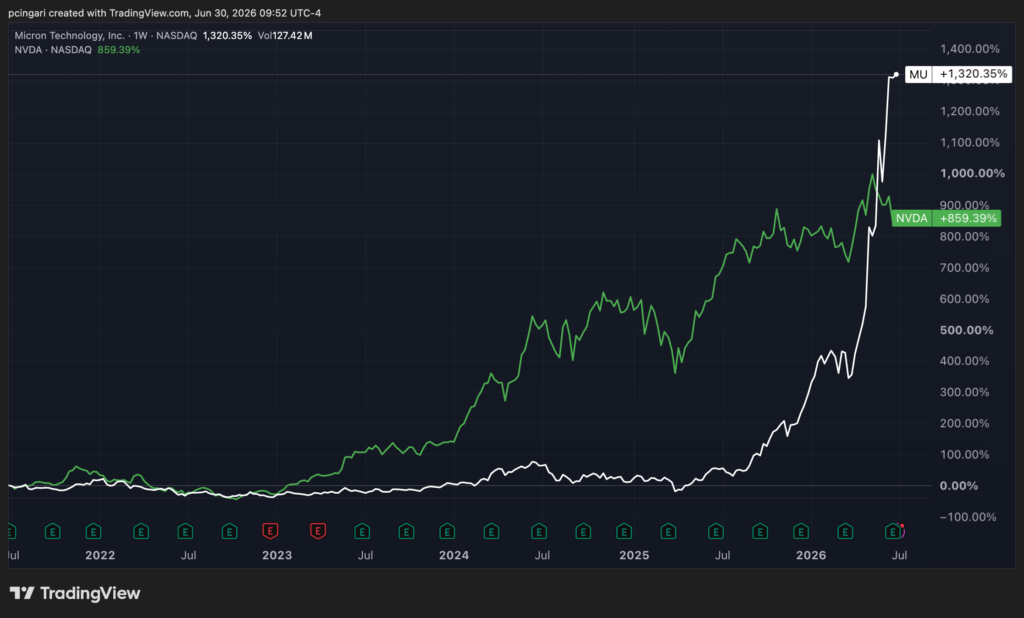
On a five-year basis, Micron is now up roughly 1,320%, ahead of Nvidia’s roughly 859%, according to TradingView data through June 30.
For years the two charts told opposite stories: Nvidia climbed early and steadily as the data-center buildout took off, while Micron stayed flat, weighed down by the memory industry’s familiar boom-bust rhythm.
The crossover came almost entirely in the past two months, as Micron went near-vertical and Nvidia’s stock cooled into a sideways range.
Chart: Nvidia vs. Micron – 5Y Stock Price Performance
Why Micron Did It
The fundamentals explain the move. In its most recent quarter, Micron reported revenue of about $41.5 billion, up roughly 346% year-over-year — a faster top-line acceleration than Nvidia, whose quarterly revenue grew about 85% over the same window.
The gap is even starker on the bottom line.
Micron posted adjusted earnings of $25.11 per share against Nvidia’s $1.87, and its adjusted EPS grew more than 1,200% from a year earlier, versus Nvidia’s still-formidable 131%.
The engine is high-bandwidth memory, or HBM — the fast memory stacked beside AI accelerators — where surging demand and tight supply have driven prices, margins and earnings sharply higher.
Cheap, And Micron Cheaper Still
What makes the rally unusual is that, even after the run, neither stock looks expensive on forward earnings.
Nvidia trades near 19.9 times next-twelve-month estimates — below its 31.3x historical average — while Micron sits around 8.0x, under its own 11.6x mean and well below Nvidia despite the bigger move.
That discount reflects an old reflex: the market still prices memory as a cyclical commodity rather than as core AI infrastructure.
The ‘Memory Race’ Thesis
In a June 29 note, Jordi Visser – head of AI Macro Nexus research at 22V Research – wrote that “AI started as a compute race. It is becoming a memory race,” citing KAIST’s Kim Jung-ho — the “father of HBM” — who frames the GPU as a brilliant analyst and memory as the desk, filing cabinet and library that analyst needs to actually do the work.
Micron has pointed the same way, tying future demand to AI agents, robotics and vehicles, and flagging long-term customer agreements worth roughly $100 billion through 2030.
Whether memory keeps the lead is the open question, but the AI trade no longer has a single face.
Photo: Shutterstock