In June 2025, memory was still seen as a classic boom-and-bust business — one where high prices eventually cure high prices as suppliers add capacity or demand cools.
A year later, that assumption no longer holds.
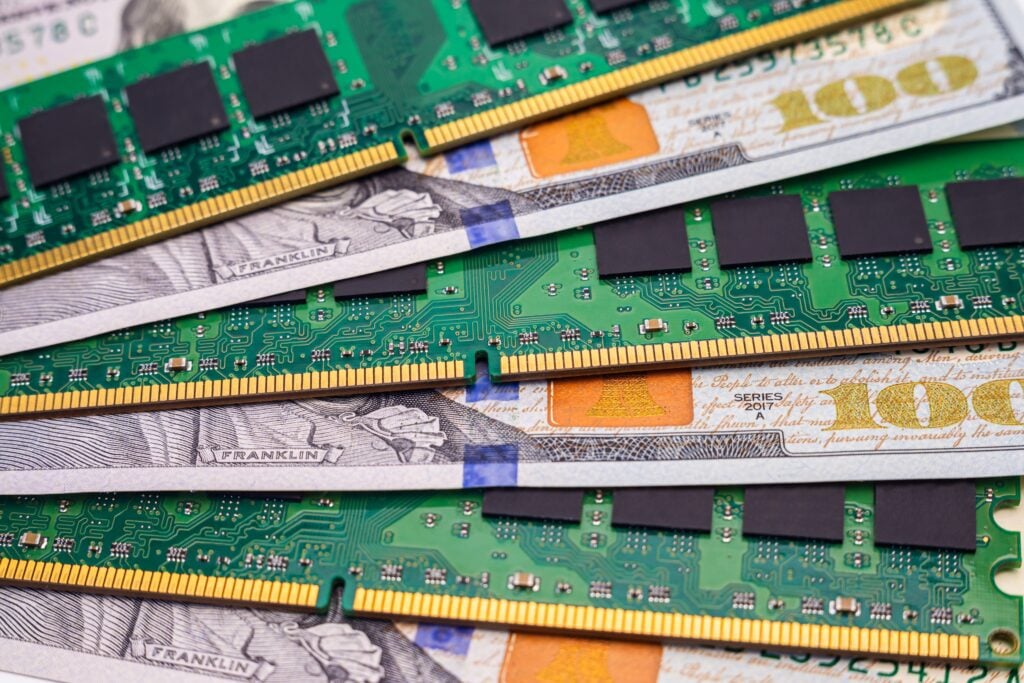
The price of 64 gigabytes of DDR5 memory — used in high-end PCs and AI servers — has risen roughly fivefold in 12 months. And one company has built an empire on it.
Micron Technology Inc. (NASDAQ:MU) just posted quarterly revenue up 346% year-over-year to $41.5 billion, with data-center revenue near $25 billion — close to $100 billion annualized.
Earnings per share rocketed from $1.68 to $24.67 a year later, a roughly 1,370% increase, and the company now commands a gross margin near 85%.
This is how a small group of companies now controls prices in the AI economy’s most needed market.
The Seven Who Rewired The Hierarchy
Micron is not alone.
Six other names anchor the group: Sandisk Corp. (NASDAQ:SNDK), Western Digital Corp. (NASDAQ:WDC), Seagate Technology (NASDAQ:STX), Kioxia, SK Hynix and Samsung Electronics.
The market-cap ladder shows the shift. Samsung now ranks among the 10 most valuable companies on earth at about $1.44 trillion, with Micron near $1.37 trillion and SK Hynix around $1.23 trillion — all inside the global top 15.
Year-to-date, Kioxia and Sandisk have each surged 800%–900%, with the rest posting triple-digit gains — a leaderboard that a year ago belonged to the Magnificent Seven.
| Memory company | Year-to-date performance as of June 26 |
|---|---|
| Kioxia Holdings Corporation | 895.21% |
| Sandisk Corporation | 816.18% |
| SK hynix Inc. | 348.98% |
| Micron Technology, Inc. | 305.21% |
| Western Digital Corporation | 260.11% |
| Seagate Technology Holdings plc | 250.30% |
| Samsung Electronics Co., Ltd. | 199.61% |
A De-Facto Oligopoly
The pricing power flows from concentration. Samsung, SK Hynix and Micron control close to 90% of the DRAM market and dominate high-bandwidth memory (HBM), the chips stacked beside AI accelerators.
After years of underinvestment in 2022–2023, a small club held all the cards as AI demand exploded.
According to TrendForce, DRAM contract prices jumped roughly 90%–95% in the first quarter and are set to rise another 58%–63% in the second, while NAND climbs 70%–75%.
Suppliers are also trying to engineer the bust out of existence: alongside its results, Micron disclosed 16 take-or-pay Strategic Customer Agreements worth a minimum $100 billion in contracted revenue, with pricing floors designed to lock in margins through any downturn.
One is a supply pact with AI lab Anthropic.
The Windfall Reshaping Korea
The profits are so vast that they are remaking Korea itself. At SK Hynix, each of roughly 35,000 workers could collect an average bonus of nearly $450,000 this year; Samsung’s chip staff are in line for about $410,000 after a deal their union won by threatening an 18-day strike.
The cash has lifted luxury sales across the Gyeonggi “semiconductor belt.”
But the Bank of Korea has flagged the payouts as an inflation risk, warning of a “wage domino.”
The Price To Pay For The AI Race
The buyers are the same hyperscalers driving the AI boom, and their bills are spiraling.
Memory is on track to absorb about 30% of hyperscaler data-center spending in 2026, roughly four times its 2023 share. Apple Inc. (NASDAQ:AAPL) has flagged price hikes, while Nvidia Corp. (NASDAQ:NVDA) pays ever more for the HBM bolted onto the accelerators it sells.
The strain is in the tape: each Magnificent Seven stock is in the red in June, and Microsoft is having its worst month in over two decades.
A Two-Way Bottleneck
The setup cuts both ways. Scarce, costly memory is a tax on the AI buildout, and the one release valve analysts cite for prices — an AI spending pullback — would land squarely on the memory stocks now sitting in the global top 15.
For now, the group holds the whip hand — proof that in this cycle, the real power may sit with the bottleneck.
Photo: Mentor57 / Shutterstock