In January 2026, buying silver was one of Wall Street’s highest-conviction trades.
The metal, tracked by the iShares Silver Trust (NYSE:SLV), had just posted its strongest annual gain since 1979. Analysts increasingly viewed silver not only as a precious metal but also as a critical component of the artificial intelligence infrastructure boom, thanks to its extensive use in semiconductors, data centers and advanced electronics.
The macro backdrop appeared equally supportive. Inflation was cooling, central banks were expected to ease policy, and investors were positioning for lower interest rates.
By late January, silver prices surged above $120 per ounce, marking an all-time high.
Fast-forward five months, and the narrative has completely reversed.
Silver has plunged more than 50% from its January peak, erasing one of the most crowded trades on Wall Street.
The war Iran triggered a return of energy-driven inflation. Overall price pressures, which investors expected to continue easing, staged a sharp U-turn, with the annual inflation rate hitting 4.2% in May 2026, the highest in three years.
Interest-rate expectations flipped from cuts to hikes.
The shift was reinforced by newly appointed Fed Chair Kevin Warsh, who surprised markets with an aggressively hawkish debut press conference, signaling that fighting inflation would take precedence.
The result has been relentless pressure on precious metals. Silver is down roughly 22% in June alone, putting it on track for its worst monthly performance since 2011.
Silver Price Sees A Major Technical Breakdown
The selloff has now pushed silver below its 200-day moving average, a closely watched long-term trend indicator.
The breakdown is notable because silver had remained above that support level almost continuously since February 2024. The only exception was a brief violation during the tariff-driven market turmoil of April 2025.
For trend-following investors, losing the 200-day moving average often signals a deterioration in market structure and can trigger systematic selling from quantitative and momentum-driven strategies.
Momentum has now weakened to the point that a widely followed technical indicator — the 14-day RSI — is signaling an oversold condition.
The 14-day Relative Strength Index, or RSI, fell below 30 on June 23.
According to historical data from TradingView, silver has entered an RSI-below-30 oversold condition only 17 times over the past decade.
Here’s what happened next.

Silver Is Now Oversold What History Says Happened Next
The 14-day Relative Strength Index tracks the speed and size of recent price moves on a scale of zero to 100. A reading at or below 30 is the textbook definition of oversold, the point where selling is treated as stretched and prone to exhaustion. It is one of the most watched mean-reversion triggers on a trading desk, and silver has just tripped it.
Since 2016 silver has closed with a 14-day RSI at or below 30 exactly 17 times before this week.
The subsequent performance has generally been favorable for contrarian buyers.
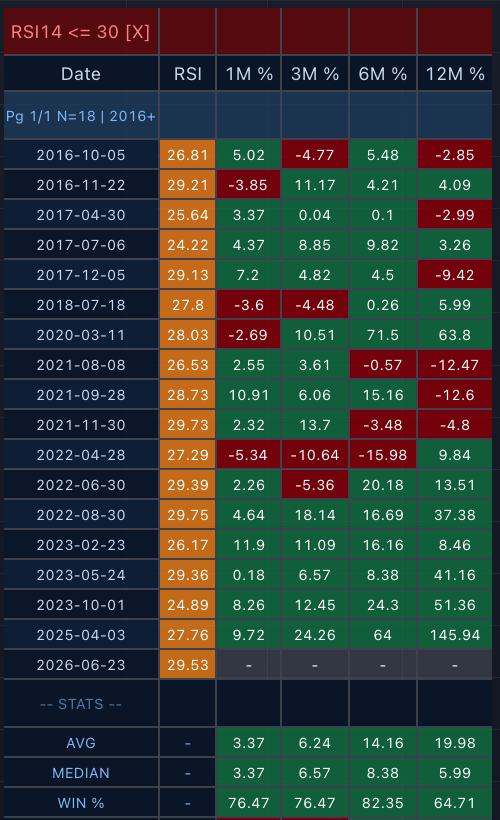
Since 2016, every time the metal’s RSI dropped below 30, silver went on to deliver average gains of 3.4% after one month, 6.2% after three months, 14.2% after six months and 20% after one year.
The strongest example came from the most recent signal on April 4, 2025. After silver slipped into oversold territory, the metal staged a powerful rebound, gaining 9.7% over the following month, 24.3% within three months, 64% after six months and an astonishing 146% over the next year.
The win rate was also particularly strong.
Silver posted positive returns 76% of the time after one month and three months, while the six-month success rate rose above 82%.
Yet, oversold conditions did not always coincide with a bottom.
The two signals in August and September 2021 were both roughly 12% lower a year later. The one of November 2021 generated a 4% loss a year later, and the April 2022 reading drew down nearly 16% over the next six months.
So, Should You Buy The Silver Dip?
The technical setup is the most extreme silver has handed traders in years. A 50% collapse, the 200-day broken, the worst month since 2011 and an oversold reading.
The macro backdrop of higher inflation and rising interest rates is generally unfavorable for non-yielding assets such as precious metals.
Yet, history suggests that when silver becomes this oversold, the metal has often delivered above-average forward returns.
The big question is whether today’s prices already discount the worst-case outcome for silver.
For now, one thing is clear: the AI metal that was Wall Street’s favorite trade at the start of 2026 has become one of its biggest disappointments.
And that is precisely when contrarian investors tend to start paying attention.
Image: Shutterstock