
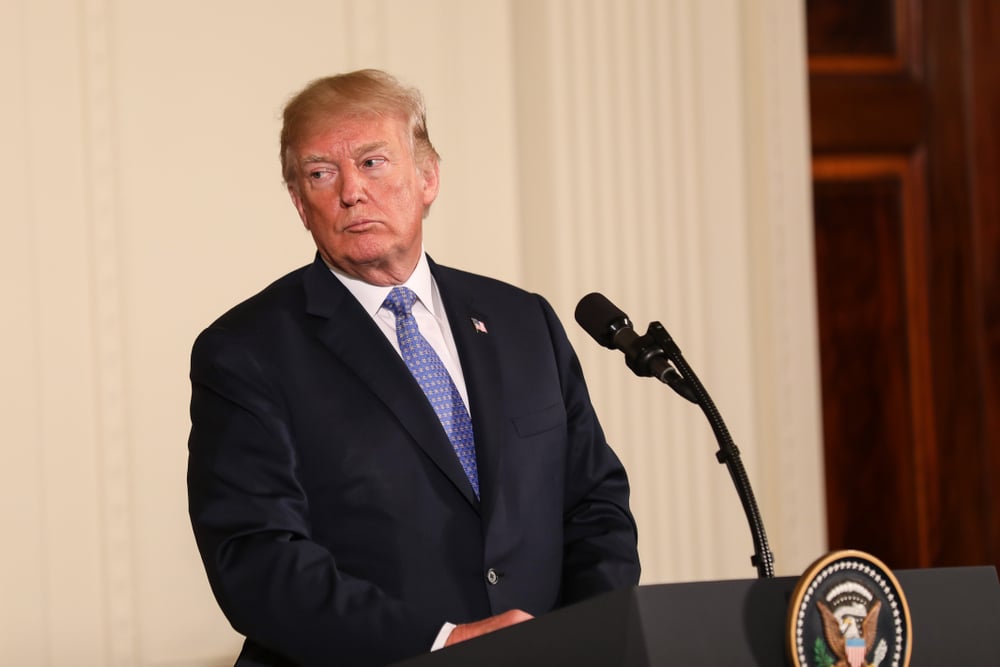
President Donald Trump has directed the Department of Justice (DOJ) to investigate oil companies for failing to reduce gasoline prices in line with declining crude oil costs.
Trump, in a Truth Social post early Wednesday, accused oil companies of overcharging customers by not adjusting their pump prices in accordance with the significantly lower prices they are paying for oil. He did not, however, name any specific companies.
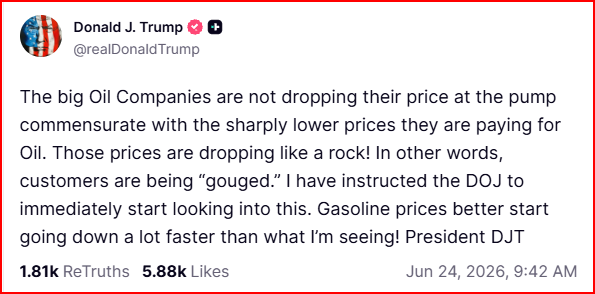
The President called for an investigation despite gasoline prices falling for six straight weeks, arguing that pump prices have not dropped enough relative to the decline in crude oil prices and should be decreasing much faster.
“Gasoline prices better start going down a lot faster than what I’m seeing!” Trump wrote.
Oil Drops, Pump Prices Stay High
Just a day prior to Trump’s call for a DOJ investigation, he had celebrated a record-breaking oil flow through the Hormuz Strait, which led to a significant decrease in oil prices.
However, despite the falling oil prices following the Memorandum of Understanding (MoU) with Iran, Americans have continued to pay more at the pump. At the time of writing, the average gas price in the U.S. stood at $3.92 per gallon, as per AAA.
Meanwhile, Brent crude oil price was trading 0.62% lower at $75.01 per barrel, while the WTI crude futures were trading 0.93% lower at $72.52 per barrel.
Karen Young of Columbia University told CNBC, “that’s not really how gasoline prices work in the U.S.,” arguing that state and local taxes, as well as refining and distribution dynamics, influence pump prices, and that it typically takes several weeks for lower crude costs to reach consumers.
GasBuddy analyst Patrick De Haan, on Monday, said that concerns over the Strait of Hormuz could slow the pace of the drop. He also indicated that the U.S. Strategic Petroleum Reserve is set to hit a 43-year low per upcoming Department of Energy (DOE) data, yet remains at about 47% of its 714 million barrel total capacity as of late June 2026. He added that practical limits mean much of the remaining volume is harder to extract, with estimates of 150-170 million barrels as unrecoverable “heel” oil and operational floors cited around 243 million barrels for emergency needs.
Disclaimer: This content was partially produced with the help of AI tools and was reviewed and published by Benzinga editors.
Image via Shutterstock