
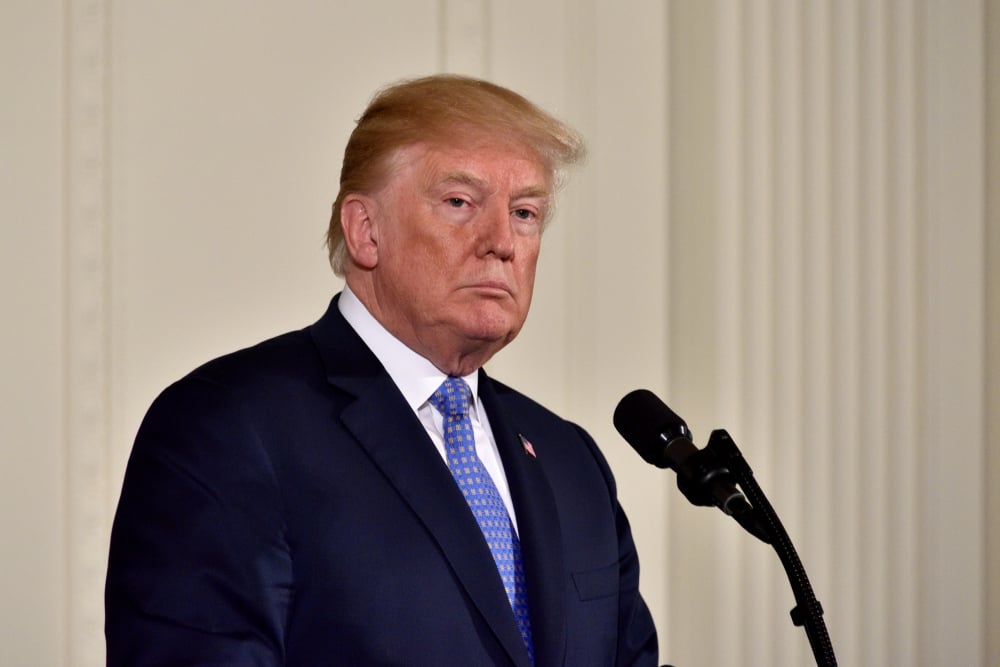
President Donald Trump reported a record-breaking oil flow through the Hormuz Strait, resulting in a significant decrease in oil prices.
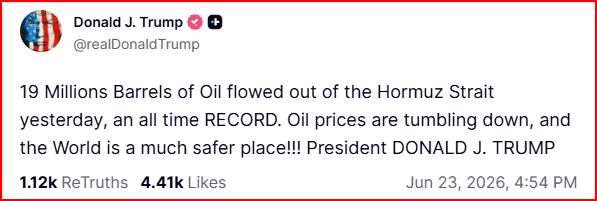
Trump revealed on Truth Social on Tuesday that 19 million barrels of oil had traversed the Hormuz Strait the day before, an “all time RECORD” according to the President.
“Oil prices are tumbling down, and the World is a much safer place!!!,” Trump wrote.
Hormuz Risks Continue To Loom
Iran’s Parliament Speaker Mohammad Bagher Ghalibaf had earlier reaffirmed that Iran would retain control over the Strait of Hormuz under a U.S.-Iran agreement, adding that the waterway will not return to its “pre-war” status, while ships will be allowed free passage for 60 days under a joint administration framework with Oman.
This came after Iran’s Foreign Minister Seyed Abbas Araghchi announced that the U.S. had lifted its naval blockade of the Strait of Hormuz, waiving oil export restrictions as well.
Last week, U.S. intelligence agencies reportedly found out that Iran can now shut the Strait of Hormuz “at will” and could use the Houthis to threaten shipping through the Bab-el-Mandeb Strait despite the deal, potentially posing major risks to global trade and the economy.
Meanwhile, oil market expert Dan Dicker had warned of a potential sharp rally in crude prices due to shrinking global oil inventories, despite the U.S.-Iran agreement. Dicker warned that unless oil supplies increase and inventories are replenished, stockpiles could continue to decline, putting further pressure on the market.
He noted that executives from Chevron Corp. (NYSE:CVX) and Exxon Mobil Corp. (NYSE:XOM) have cautioned that they cannot rapidly make up for shrinking inventories if supply conditions worsen.
Meanwhile, the latest Kpler data on Tuesday showed crude inventories at Cushing, Oklahoma, the key U.S. oil storage hub, have fallen by about 11 million barrels since early May and could approach operational minimum levels by mid-July if the current drawdown pace continues.
According to Kpler, traffic through the Strait of Hormuz surged between June 19 and 21, with 71 confirmed vessel transits and a peak of 35 crossings on June 20.
At the time of writing, Brent crude oil price was trading 0.63% lower at $75.39 per barrel, while the WTI crude futures were trading 0.68% lower at $73.35 per barrel.
Disclaimer: This content was partially produced with the help of AI tools and was reviewed and published by Benzinga editors.
Image via Shutterstock