
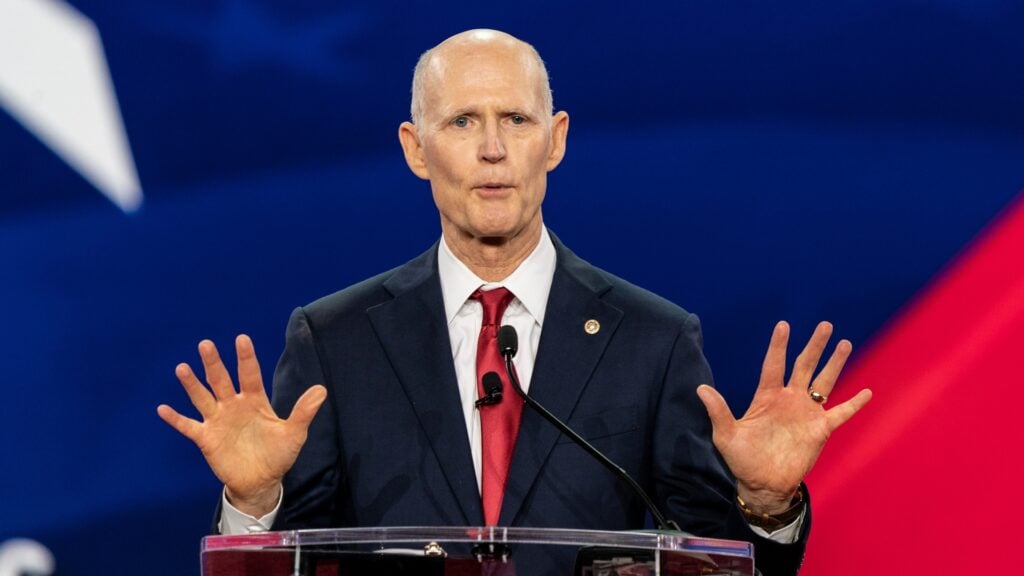
Sen. Rick Scott (R-Fla.) said that persistent federal deficits and the nation’s growing debt burden, not the Federal Reserve, Kevin Warsh, or President Donald Trump, are responsible for current economic pressures.
Scott Points To Debt and Deficits
On Tuesday, the Florida Republican posted on X, writing, “The problem behind inflation and interest rates isn’t Kevin Warsh or the President — it’s CONGRESS.”
“Our country is $39 trillion dollars in debt,” he added. “It’s time to STOP SPENDING MONEY WE DON’T HAVE.”
During a CNBC interview discussing the outlook for interest rates and whether Warsh could oversee potential rate cuts in the future, Scott shifted the focus away from monetary policy and toward federal spending.
“I think all of us would like to have lower interest rates,” Scott said. “But the problem is not Kevin Warsh, the problem is not the Federal Reserve, the problem is not President Trump. The problem is Congress.”
Scott pointed to the federal government’s fiscal position, adding, “We’re running $2 trillion a year deficits. We’ve got $39 trillion of debt.”
US Debt Debate Grows
Earlier, President Trump defended rising U.S. national debt, comparing it to real estate leverage and arguing the country remained financially strong due to its vast national wealth.
He suggested equity stakes in corporations and cited past government investments, while pointing to tariffs and foreign investment as possible ways to manage debt.
Economist Steve Hanke of Johns Hopkins University called for a constitutional “debt brake” after data showed U.S. debt had exceeded 100% of GDP for the first time since World War II, reaching 100.2% with public debt at $31.27 trillion.
Richard Haass of the Council on Foreign Relations warned the $38 trillion debt could become a national security risk, outlining scenarios ranging from financial instability to long-term erosion of U.S. global influence.
Economist Barry Eichengreen of the University of California, Berkeley, said the debt problem was largely driven by political polarization, arguing that both parties had failed to address deficits or maintain fiscal discipline.
Disclaimer: This content was partially produced with the help of AI tools and was reviewed and published by Benzinga editors.
Photo courtesy: lev radin / Shutterstock.com