
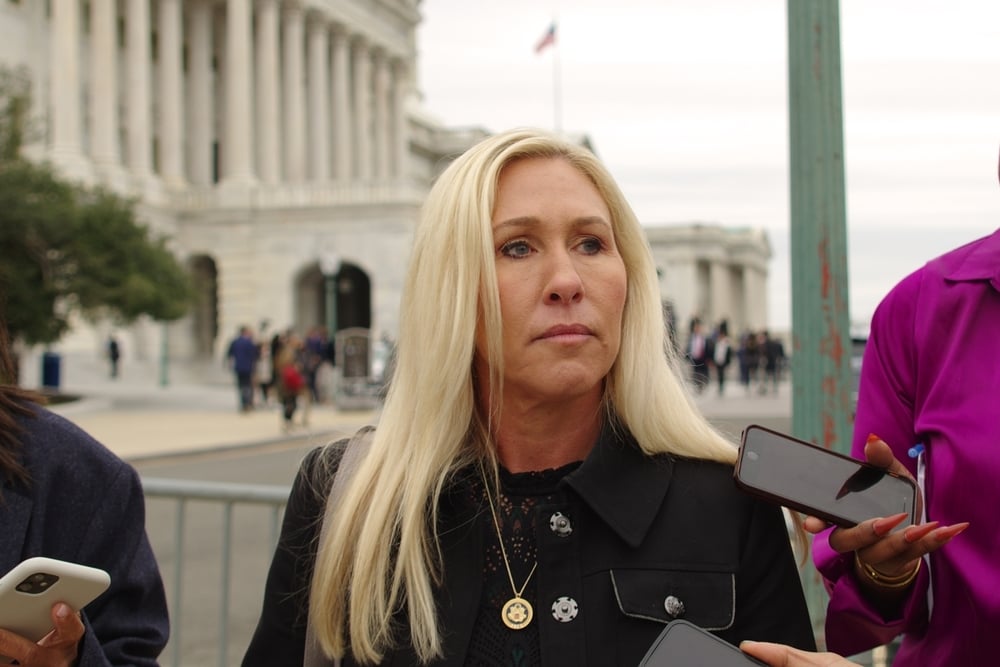
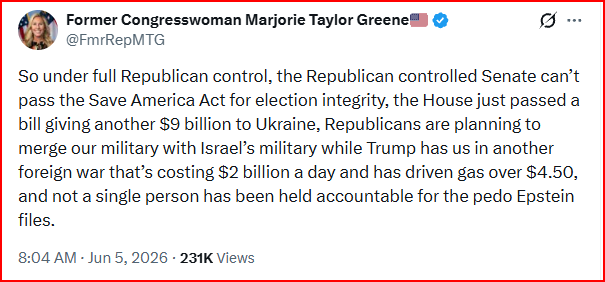
Former Congresswoman Marjorie Taylor Greene expressed her dissatisfaction with the Republican party’s inability to pass the Save America Act and the allocation of war funds to Ukraine.
Greene criticized Republican leadership, arguing that despite GOP control of government, key conservative priorities such as election integrity legislation have stalled.
She also objected to an additional $9 billion in aid for Ukraine, raising concerns about closer military cooperation with Israel. The former Georgia representative also opposed President Donald Trump‘s involvement in the Iran war, which is driving gas prices higher.
Congress Defies Trump On Two Fronts
Greene’s post comes in the wake of the Senate’s failure to pass the Save America Act on Thursday, a Republican-backed voting overhaul. The Act, which Trump had warned Republicans would be an ‘unrecoverable death wish’ if not passed, failed to garner enough support in the Senate.
The election bill has stalled in the Senate since passing the House in February. The proposal would have taken effect immediately, including during ongoing congressional primaries, and would have required voters to provide proof of U.S. citizenship, such as a passport or birth certificate, when registering to vote.
Furthermore, the U.S. House passed the Ukraine Support Act in a 226-195 vote on Thursday, with 18 Republicans joining Democrats to advance aid for Ukraine despite opposition from many party leaders in a pushback against Trump. The bill provides more than $1 billion in assistance to Kyiv, authorizes up to $8 billion in loans for reconstruction and recovery efforts, and imposes new sanctions and export controls targeting Russia’s financial, energy, mining sectors, and government officials.
Meanwhile, Section 224 of the proposed National Defense Authorization Act (NDAA) has emerged as a flashpoint in Congress. The provision would deepen U.S.-Israel military and defense-industry ties through joint research, weapons co-production, licensing agreements, and broader industrial integration. Although it has faced bipartisan pushback, a congressional panel on Thursday voted against stripping the measure from the defense bill.
Image via Shutterstock