
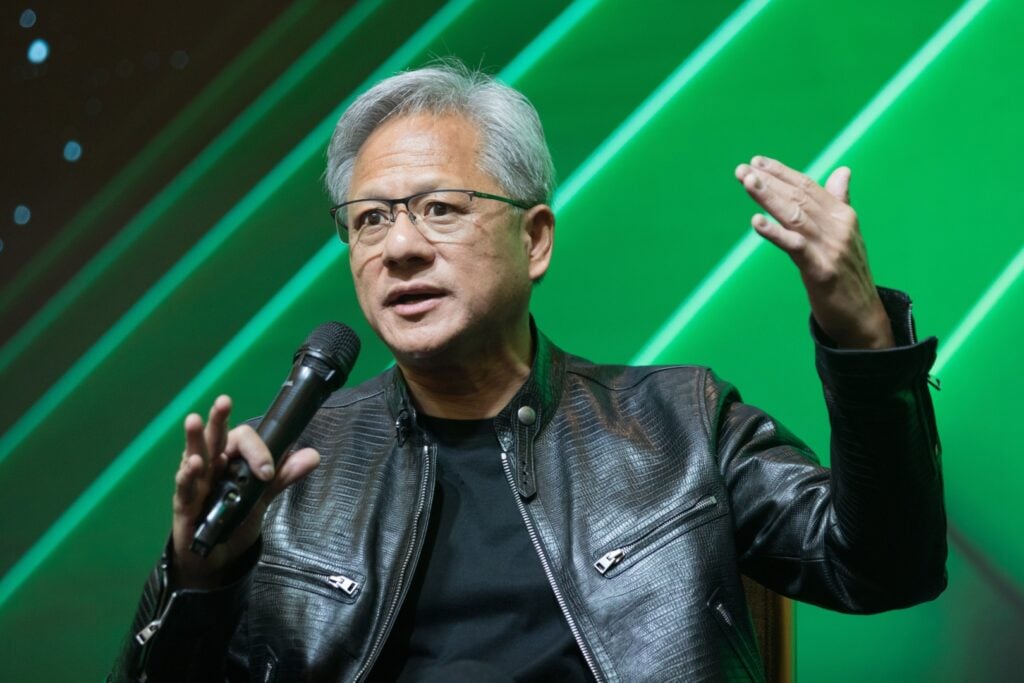
NVIDIA Corp. (NASDAQ:NVDA) stock extended its losses in Tuesday’s premarket trading as Jensen Huang’s abrupt departure fueled concerns about the chipmaker’s long-term leadership, competitive advantage and role in financing the artificial intelligence boom.
While industry experts expect NVIDIA’s near-term operations to remain stable under interim CEO Colette Kress, they warned that the leadership upheaval could create opportunities for rival chipmakers and weaken investor appetite for AI infrastructure spending.
Broader market weakness added to the selling pressure, with Nasdaq futures down 0.33% and S&P 500 futures falling 0.34%.
Wang Sees a Path, but Not a Clear One, for Huang’s Return
Constellation Research Chairman Ray Wang told CNBC on Monday that Huang’s ouster represented “a big loss for AI” because founder-led CEOs often play an outsized role in creating and sustaining new technology categories.
Wang said support from venture capitalists, technology founders and NVIDIA’s supply chain creates “a glimmer of hope” that Huang could return. However, he said NVIDIA’s board still needs to complete its investigation before making any decision.
He expects interim CEO Colette Kress to keep operations steady and said NVIDIA’s earnings should remain solid.
Fried Says Board Must Balance Huang’s Value Against Governance and National Security
Harvard Law professor Jesse Fried told CNBC on Monday that NVIDIA’s board must weigh Huang’s importance to the company against governance, political and national-security risks.
Fried said Huang’s personal conduct represents only one issue. He considers potential dishonesty with the board, upcoming political scrutiny and concerns about China-related chip controls more significant.
At the same time, Fried said the board cannot ignore Huang’s track record of innovation, ecosystem financing and value creation. He said the decision could ultimately depend on how much weaker any replacement would be compared with Huang.
Gerstner Says Near-Term Execution Is Already Set
Altimeter Capital CEO Brad Gerstner told CNBC on Monday that he has confidence in Kress as interim CEO and does not expect major execution problems over the next six quarters.
Gerstner said NVIDIA’s 2027 and 2028 product, fabrication and delivery schedules are already largely established.
His bigger concern is what happens beyond that period, because Huang provided both long-term vision and key industry relationships.
Gerstner has urged NVIDIA’s board to move slowly, gather the facts and keep all options open, including a potential Huang return.
See More:
Top Value Stocks
Franklin Sees Opportunity for Rivals
Manulife Investment Management strategist Marc Franklin told CNBC on Tuesday that NVIDIA’s distraction could create opportunities for other advanced chipmakers.
He said investors are already rotating toward competing semiconductor companies on the assumption that NVIDIA’s loss of its long-time innovation leader could allow rivals to close the gap.
Franklin also pointed to a broader shift toward internally developed chips at companies such as Alphabet Inc. (NASDAQ:GOOG) (NASDAQ:GOOGL), which could reduce dependence on NVIDIA.
He warned that greater competition could eventually lead to commoditization and lower memory-chip prices, although he does not see that risk as imminent.
Coxon Expects More Caution Around AI Financing
NFG Partners CIO Glenn Coxon told CNBC on Tuesday that Huang’s departure could reduce investors’ willingness to support aggressive AI capital spending.
He said NVIDIA’s interim leadership may take a more cautious approach toward investments across neoclouds and the wider AI ecosystem.
Because AI infrastructure remains highly capital-intensive, Coxon said tighter financing could ripple well beyond NVIDIA.
Coxon expects NVIDIA’s quarterly earnings and financial outlook to attract relatively little attention when the company reports results Tuesday.
Instead, investors will likely seek clarity on management’s willingness to fund the next phase of AI growth and how the leadership transition could reshape its capital allocation strategy.
He considers significantly greater caution in deploying capital across the AI sector inevitable. That shift could have far-reaching implications for an industry that relies heavily on sustained investment to finance its rapid expansion.
Altman and Srinivas Stress Huang’s Ecosystem Role
OpenAI CEO Sam Altman told CNBC on Monday that, “Jensen has long been a hero of mine. Heroes have flaws,” and said it is “hard to imagine the AI revolution without Jensen.”
Perplexity CEO Aravind Srinivas told CNBC on Tuesday that Huang helped establish the foundations for open-source and open-weight AI development, but believes others can now “pick up the baton.”
Srinivas also said NVIDIA remains an investor and active technology partner in Perplexity.
Broader Market Risks Remain
Former Goldman Sachs Asset Management Chairman Jim O’Neill told CNBC on Monday that NVIDIA’s importance extends across global portfolios, but warned that rising inflation and interest rates could pose an even broader threat to equity valuations.
Huang’s departure threatens to reshape the dynamics that have fueled the AI boom. Under his leadership, NVIDIA became more than a chip supplier, playing a central role in driving technological innovation, financing AI startups and forging strategic partnerships across the industry.
A shift toward more conservative spending, coupled with intensifying competition and the growing adoption of internally developed chips, could fundamentally change how the AI industry innovates, attracts investment and distributes market power. The leadership transition could mark a turning point for an industry whose rapid expansion has been closely tied to Huang’s vision.
NVIDIA Stock Nears 52-Week Low
NVIDIA shares remain under significant technical pressure, trading 20.9% below their 20-day simple moving average of $195.64 and 24.1% below their 200-day moving average of $204.02.
The relative strength index (RSI) stands at 22.04, indicating deeply oversold conditions. While this could set the stage for a short-term rebound, the broader bearish trend remains intact.
The stock is also approaching its 52-week low of $148.80, a key support level. Meanwhile, the 20-day moving average of $195.64 represents a potential resistance level.
Analysts Slash Price Forecasts
NVIDIA maintains a consensus Buy rating with an average price forecast of $241.74.
However, several Wall Street firms lowered their price forecasts Monday.
UBS maintained a Buy rating and lowered its price forecast to $240. Morgan Stanley maintained an Overweight rating and reduced its price forecast to $267. TD Cowen maintained a Buy rating and cut its price forecast to $200.
The chipmaker is scheduled to report third-quarter fiscal 2027 earnings after the market closes Tuesday. Analysts expect revenue of $109.08 billion and earnings of $2.48 per share.
NVDA Stock Price Activity: NVIDIA shares were down 0.73% at $155.00 during premarket trading on Tuesday, according to Benzinga Pro data.
Photo via Shutterstock