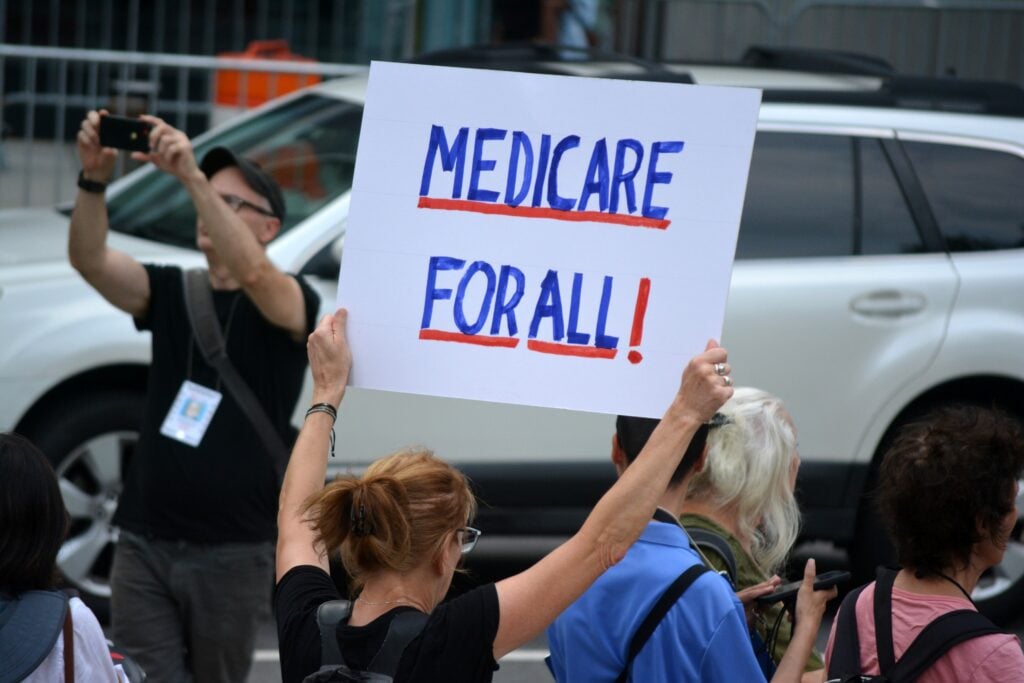
Marc Goldwein, senior vice president and senior policy director at the Committee for a Responsible Federal Budget, said financing Medicare for All could require a payroll tax in the “high 20s at least,” while explaining his earlier 32% estimate.
Goldwein made the comments in replies on X on Monday during a discussion about whether Medicare for All would save the average American money by replacing private insurance premiums and out-of-pocket healthcare expenses with taxes. The exchange also raised questions about how different payroll-tax options would affect people at different income levels.
Who Receives More Than They Pay
“The math isn’t that difficult,” Goldwein wrote, estimating that approximately 75% of people would receive healthcare benefits worth more than their payroll-tax contributions.
He said a much smaller percentage would actually “pay less” because some benefits would come through additional healthcare services and most people have below-average cost-sharing expenses in a given year.
Goldwein also questioned the economic consequences of replacing all insurance premiums and cost-sharing expenses with a 32% payroll tax, saying the impact could be significantly negative and reduce incomes.
Asked where the 32% figure came from, Goldwein said it was based on an analysis conducted in 2020, when a payroll tax of approximately that size would have been needed to finance an estimated $30 trillion in Medicare for All costs over a decade.
He said the payroll base has since grown and estimates of the program’s cost may have declined in inflation-adjusted terms. Although he has not updated the full analysis, he said he could imagine the required rate being in the mid-20s.
Updated Payroll-Tax Calculations
In another reply, Goldwein offered preliminary calculations. Citing a Congressional Budget Office estimate, he said a 2% payroll tax could raise $2.5 trillion over 10 years, or $2.7 trillion over the current budget window. He said the amount could reach $2.9 trillion without employer-sponsored insurance.
Goldwein said this suggested a 20% payroll tax could raise $29 trillion. However, he estimated that increasing the employer payroll-tax rate to 10% could reduce income and other tax revenue by approximately one-third, pushing the required rate to 24%.
Goldwein’s Earlier Cost Estimate
Goldwein had previously estimated that Medicare for All could cost the federal government between $20 trillion and $40 trillion over a decade, depending on the program’s design. He also said prescription drug reform could save several hundred billion dollars independently, or as much as $3 trillion in the context of Medicare for All.
The financing debate has also featured questions about tax increases as Sen. Bernie Sanders (I-Vt.) renewed his push for the program, including a proposal to lower Medicare eligibility to 55, cover children and expand dental, vision and hearing coverage.
Goldwein said the more people and businesses try to avoid higher taxes as rates increase, the more the required payroll-tax rate could rise. “I can’t estimate the impact on Twitter, but it’s likely to push you in the high 20s at least,” he wrote.
Disclaimer: This content was partially produced with the help of AI tools and was reviewed and published by Benzinga editors.
Image via Shutterstock