

The periods before and after midterm elections are famously volatile for stocks.
Historically, midterm election years have had an average intra-year drawdown of 18% for the S&P 500. This is worse than the average 14% drawdown across all years.
On the plus side, the stock market has tended to perform well once there’s a clearer indication of what the election results could look like. As the midterm election gets closer, markets typically react positively, regardless of the party in power.
“Since 1970, the market has started to rally on average around a month (22 trading days) before a midterm election, as polling data provides clearer indications of results,” BlackRock analysts wrote earlier this year. “As event risk passes post-election, equities have historically experienced tailwinds, with an average return of 14.1% in the following six months compared to 5.7% in non-midterm years.”
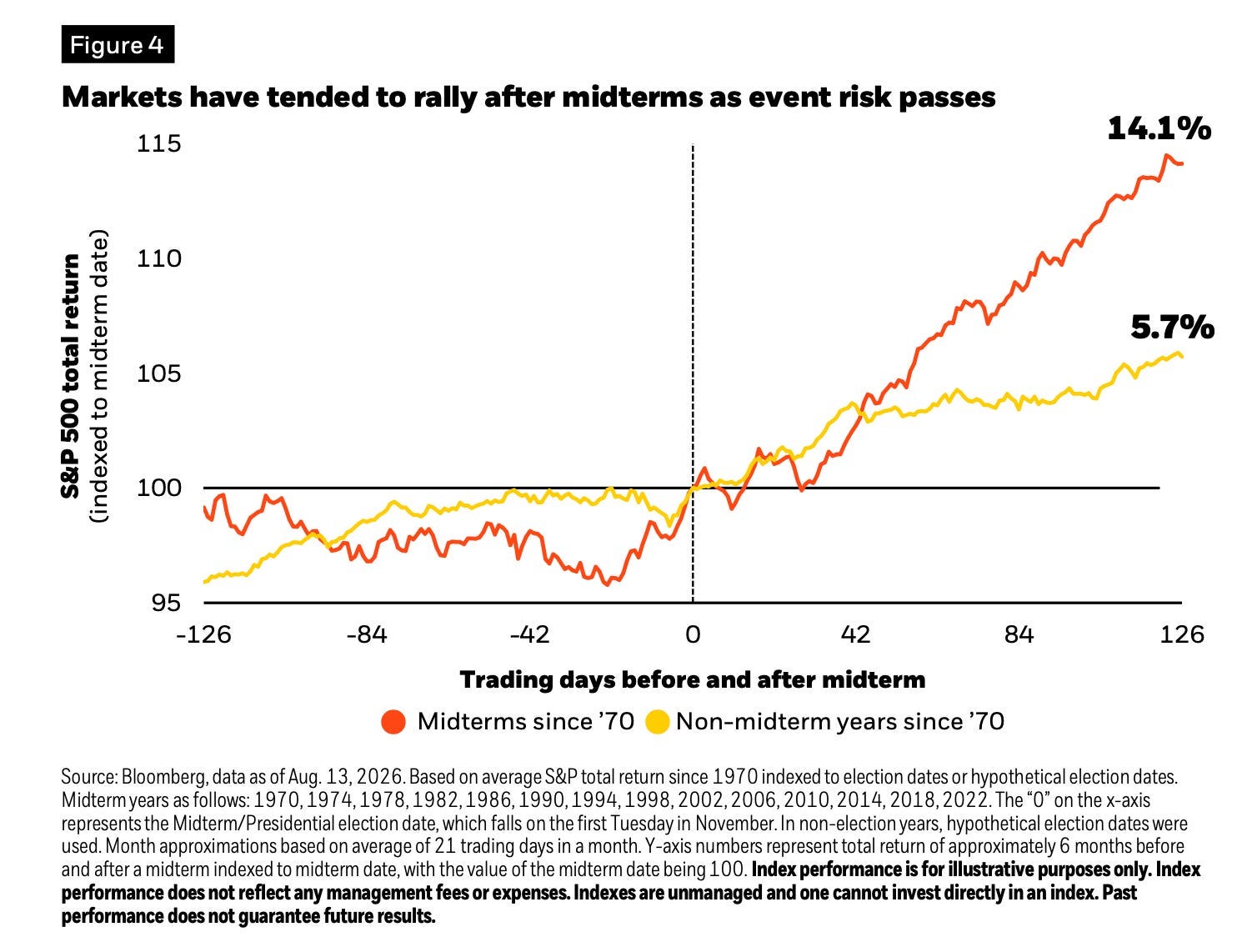
Other analysts have found similarly compelling data points.
Jeffrey Hirsch of Almanac Trader has noted the strongest 6-month period of the 4-year presidential cycle has historically started in November of midterm election years.
Joe Terranova of Virtus Investment Partners found that since 1939, the stock market has produced a positive return from the midterm election date to June 30 of the following year 100% of the time. Of those 21 observations, 14 had double-digit returns.
There’s a basic explanation for this pattern: Midterm elections can have significant policy implications, and the uncertainty caps prices as everyone waits for clarity on the policy outlook.
And the elections are an uncertainty-clearing event.
There are cases to be made that certain election results are more bullish for the market than others. But regardless of the outcome, removing uncertainty alone seems enough to boost prices, as businesses move forward with any plans that may have been exposed to upcoming policy decisions.
A cautionary note
All of these historical patterns are consistent with a stock market that experiences intermittent volatility even as it usually goes up.
But especially in the short run, there’s never a guarantee that what’s been a statistically regular event will repeat next time.
In other words, I’d be reluctant to get too creative with trades based on what history suggests could happen in the next several months.
Keep in mind that so far this year, the S&P 500 has experienced a max drawdown of just 9%, which is already a bit inconsistent with the historical averages.
To be clear, I’m not suggesting you reposition your portfolio for one outcome or another. Personally, I don’t expect to stray from my long-term strategy. I almost never do.
Rather, I’m just cautioning against getting too excited about what’s historically been a bullish short-term period for stocks.
Benzinga Disclaimer: This article is from an unpaid external contributor. It does not represent Benzinga’s reporting and has not been edited for content or accuracy.