
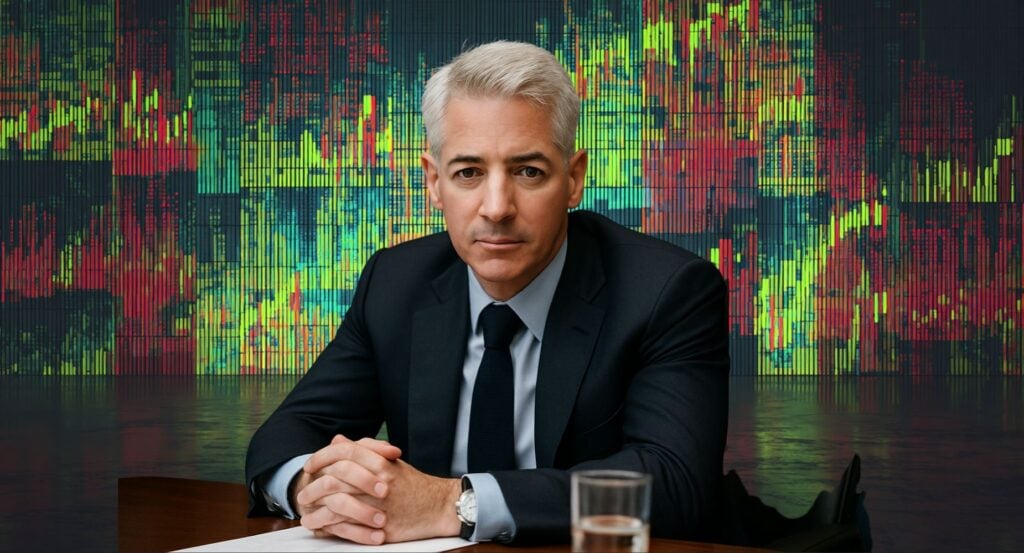
Bill Ackman’s latest investing advice offers a timely framework for ETF investors navigating AI-driven volatility: prioritize durable businesses, strong cash generation and competitive advantages over short-term earnings surprises.
In an interview on Norges Bank Investment Management CEO Nicolai Tangen’s podcast, published Wednesday, the billionaire investor argued that great businesses should remain valuable even if markets are closed for 20 years. One way to align with Ackman’s philosophy is by using ETFs to find businesses built to last as rising AI spending fuels concerns over valuations and future cash flows.
AI Spending Tests Business Quality
The stakes are growing. Major technology companies have committed enormous sums to AI infrastructure, raising questions about whether future returns will justify the spending.
For instance, Meta Platforms Inc.’s (NASDAQ:META) third-quarter 2026 results illustrate the tension. Revenue rose 26% year over year to $64.6 billion, but free cash flow turned negative at $2.12 billion. Capital expenditure, including finance-lease principal payments, reached $34.91 billion, while the company raised its full-year spending outlook to $135 billion to $145 billion.
For investors following Ackman’s philosophy, strong revenue growth is not enough. The bigger question is whether companies can turn heavy investment into sustainable cash generation over time.
COWZ Bets on Free Cash Flow
The Pacer US Cash Cows 100 ETF (BATS:COWZ) screens for companies with high free-cash-flow yields. The fund has approximately $19.5 billion in net assets and an expense ratio of 0.49%. Its largest holdings include Accenture PLC (NYSE:ACN), Lockheed Martin Corp. (NYSE:LMT), Qualcomm Inc. (NASDAQ:QCOM) and ConocoPhillips (NYSE:COP).
COWZ’s approach aligns with Ackman’s preference for businesses that generate substantial cash. However, its portfolio is not a pure technology or AI play. Energy stocks account for approximately 20.24% of assets, while information technology represents around 20.7%.
There is a catch. High free-cash-flow yields do not necessarily indicate durable competitive advantages. Cash generation can fluctuate, and an elevated yield may reflect concerns about a company’s future growth or profitability.
MOAT Targets Competitive Advantages
The VanEck Morningstar Wide Moat ETF (BATS:MOAT) focuses on companies that Morningstar assesses as having sustainable competitive advantages.
As of Oct. 12, its holdings included Danaher Corp. (NYSE:DHR) at 2.89%, Microsoft Corp. (NASDAQ:MSFT) at 2.82% and Estee Lauder Companies Inc. (NYSE:EL) at 2.81%.
Companies with strong brands, proprietary technology or entrenched customer relationships may enjoy pricing power and resilient demand. But even businesses with competitive moats can disappoint investors if valuations are excessive or capital spending fails to generate adequate returns.
MOAT is not an AI hedge, either. Its exposure to major technology companies leaves it vulnerable to shifts in expectations around AI investment and profitability.
Which ETF Fits Ackman’s Philosophy?
COWZ emphasizes cash generation, while MOAT prioritizes competitive advantages. Both offer frameworks for identifying potentially durable businesses, but neither guarantees attractive valuations or decades of growth.
Ackman’s own investments demonstrate that even a long-term strategy can experience sharp short-term losses when market expectations change.
For ETF investors, the takeaway is to look beyond headline returns. Comparing free-cash-flow generation, competitive advantages, valuations and capital intensity can help distinguish companies capable of compounding over time from those relying on an increasingly expensive growth story.
Image created using artificial intelligence via Midjourney and Dall-E.