
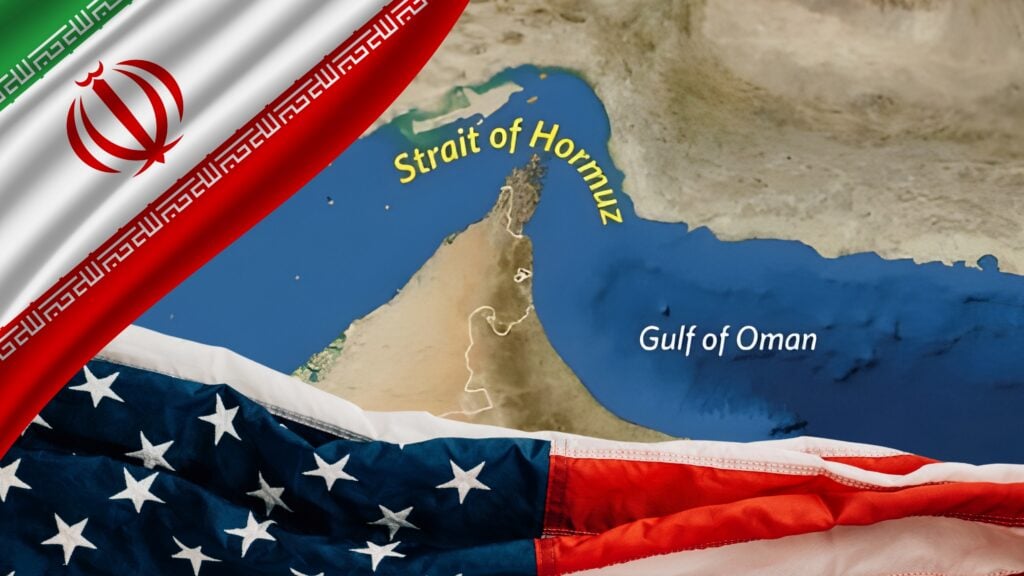
Obsidian Risk Advisors‘ Managing Principal Brett Erickson warned on Monday that Iran always could control the flow of traffic in the Strait of Hormuz following fresh vessel strikes in the Middle East.
New Strikes Confirm Iranian Missile Capabilities
In a post on X on Monday, Erickson cited a report by the United Kingdom Maritime Trade Operations Center (UKMTO) that shared an incident of a vessel on fire nearly 72.5 miles Southeast of Iraq’s coastal town of Al-Faw in the Persian Gulf.
“The UKMTO confirms earlier reports of a vessel on fire off of Al-Faw Iraq following what is almost certainly an Iranian strike,” Erickson said, adding that the incident showed that Iran was hitting targets “FAR outside the Strait of Hormuz into the Persian Gulf and Gulf of Oman.”
He then questioned if it was harder to strike vessels that were “moving under active U.S. air cover” or if it was more difficult to hit “undefended” static vessels. “Iran has always had the ability to shut down Hormuz,” he said.
Erickson had earlier warned of Iran’s capabilities to strike vessels outside of the Strait of Hormuz after the Persian Gulf Strait Authority (PGSA) had added 122 vessels to its “sanctions” list. He had also said that Iranian strikes deep into the Persian Gulf and the Gulf of Oman showed that Tehran was “taking it easy” on President Donald Trump.
Mojtaba Khamenei Slams Tehran’s Enemies
Meanwhile, Iran’s Supreme Leader Ayatollah Mojtaba Khamenei issued a warning on Monday via a series of posts on the social media platform X.
Khamenei said that “Every drop of blood shed from the bodies” of Iran’s scientists, professors, schoolchildren and university students and more had given rise to a “storm of determination and progress.”
Khamenei also said that the “malice and criminal actions” of Iran’s “enemies” had demonstrated the “pivotal” role played by the scientists and the elites in “strengthening the country.”
He also said that Tehran’s “enemy” that had “assassinated” the country’s “prominent scientists and the influential elite, cannot bear to see Iran advance and grow stronger.”
Notably, Iran has accused Israel of targeting its nuclear scientists on multiple occasions in covert operations, while also alleging U.S. complicity in the strikes.
Late last month, Khamenei had taken to social media, warning that Iran’s enemies, without explicitly mentioning Trump, had suffered “painful” blows at the hands of the Islamic Revolutionary Guard Corps (IRGC) and that the enemies would not advance beyond the Arabian Sea.
On the other hand, reports emerged of a possible round of talks between the U.S. and Tehran last week, which was quickly dismissed by Iran’s Security Chief Mohsen Rezaee, who warned that there would be no clearances of enriched uranium until Trump met Iran’s conditions.
Oil Movement
Oil prices remain a key factor amid escalating tensions between Washington and Tehran. At the time of writing this article, the West Texas Intermediate (WTI) crude futures contracts ending in December 2026 recorded a marginal decline, slipping 0.14% to $101.62. Brent futures contracts ending in December fell about 1.05% to $114.59.
The United States Oil Fund (NYSE: USO) ETF, on the other hand, fell 0.79% to 164.88 during pre-market trading on Tuesday, while the ProShares Ultra Bloomberg Crude Oil (NYSE: UCO) ETF dipped 0.51% to $65.05 during pre-market trading.
Check out more of Benzinga’s Future Of Mobility coverage by following this link.
Image via Shutterstock