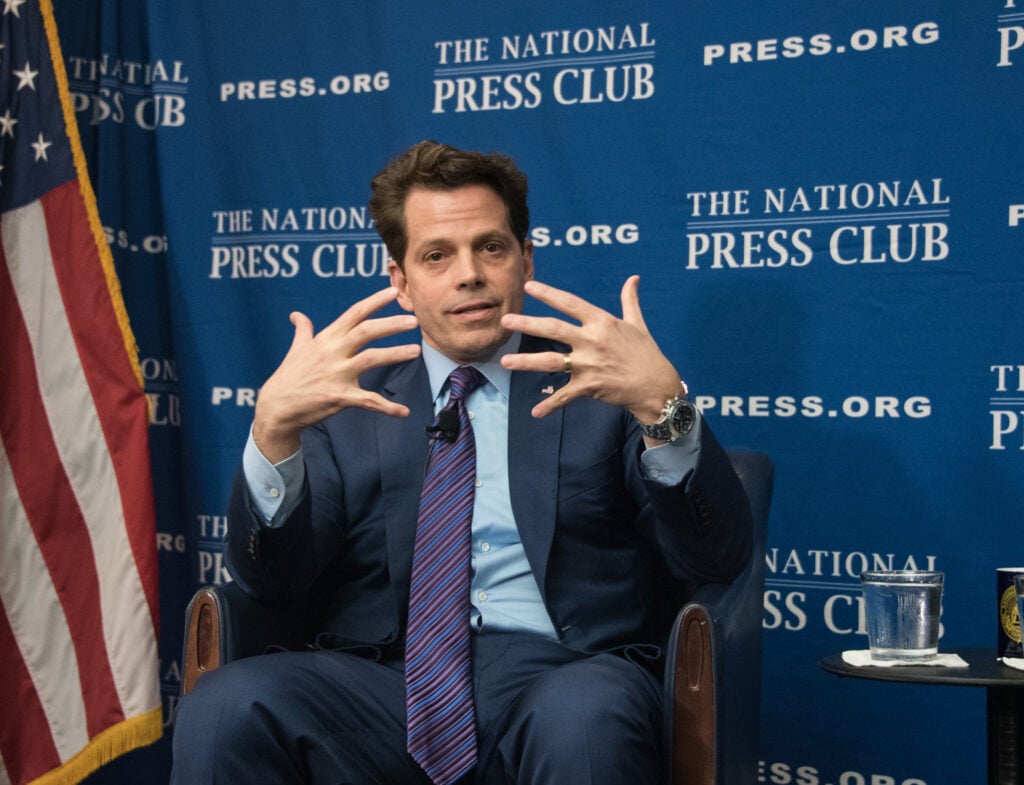
Former White House communications director Anthony Scaramucci said three past U.S. policy decisions — China-related offshoring, deficit-funded wars and the Wall Street bailout — fueled economic anxiety and public distrust that helped propel President Donald Trump to power.
In a podcast with the Daily Beast on Sunday, Scaramucci discussed his book, “All the Wrong Moves: How Three Catastrophic Decisions Led to the Rise of Trump,” and its account of the President’s political rise.
Scaramucci argued that policies favoring China contributed to wage compression and weakened earning power for workers, particularly economically aspirational families already facing increased financial pressure.
He also criticized wars financed through borrowing rather than taxes, saying the resulting deficit spending eventually requires repayment through inflation, which he called as the “pernicious and most regressive” form of taxation. “That destroys the lower and middle income people because they don’t have any assets…So they can’t hedge themselves,” he said.
Scaramucci said the U.S. dollar has lost 28% of its purchasing power since January 2020, reducing workers’ effective income and intensifying concerns over household affordability.
He identified the roughly $1 trillion Wall Street bailout as the third damaging decision. According to Scaramucci, about 5,000 bankers received bonuses of at least $1 million during the rescue, creating a lasting perception that financial institutions recovered while ordinary Americans were left behind, even though banks later repaid the funds with interest.
Scaramucci then said, this created “anger based politics” and pushed Trump’s political rise in 2017. “He understands that these people have no hope and they’re clinging to him,” Scaramucci said about the President.
Economists Sound Alarm Over Rising Debt Cost
The fiscal concerns that Scaramucci, a vocal Trump critic, highlighted remain active in current economic debate. Earlier this month, the Treasury Department reported a $1.992 trillion fiscal 2026 deficit for the period ended September 30, with net interest payments reaching $1.052 trillion, above defense spending. Mark Zandi, chief economist at Moody’s Analytics, described the trajectory as a potential fiscal reckoning. He argued that low unemployment should allow the U.S. to balance its primary budget, blaming the country’s ballooning debt for roughly $1 trillion in interest payments.
At the same time, economist Justin Wolfers called the deficit “wildly irresponsible,” saying Washington was financing tax cuts for wealthy Americans while reducing programs serving people who need assistance while national debt stood at approximately $40.38 trillion.
More recently, Sen. Rand Paul (R-Ky.) criticized federal programs for repeatedly seeking additional taxpayer funding after failing to deliver promised benefits, adding another dimension to the debate over spending, accountability and public trust.
Disclaimer: This content was partially produced with the help of AI tools and was reviewed and published by Benzinga editors.
Photo courtesy: Shutterstock