
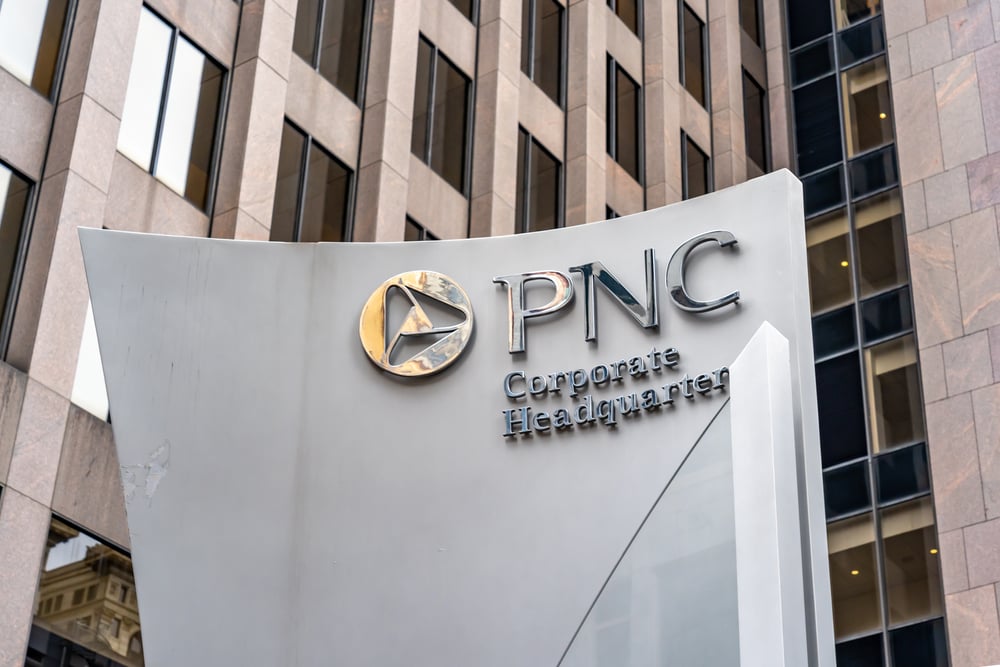
PNC Financial Services Group, Inc. (NYSE:PNC) stock traded higher Thursday after the bank reported better-than-expected third-quarter earnings and raised its full-year revenue outlook.
Adjusted earnings of $5.09 per share beat the analyst consensus estimate of $4.92.
However, revenue of $6.562 billion missed Wall Street’s estimate of $6.610 billion.
GAAP diluted earnings rose to $4.97 per share from $4.35 a year earlier.
Net Interest Income Drives Earnings Growth
PNC’s third-quarter revenue increased 11% year over year, driven by stronger lending activity and higher interest income.
Net interest income climbed 15% to $4.206 billion, while noninterest income rose 4% to $2.356 billion.
Net interest margin improved to 2.94% from 2.79% a year earlier, although it declined 2 basis points from the second quarter.
Fee income increased 4% to $2.142 billion. Card and cash management contributed $769 million, followed by $447 million from asset management and brokerage services and $433 million from capital markets and advisory services.
Pretax, pre-provision earnings rose 15% to $2.811 billion.
Meanwhile, return on average tangible common equity improved to 18.28% from 16.77%. The efficiency ratio improved to 57% from 59%, reflecting better cost management.
Commercial Lending Fuels Loan Growth
Average loans increased 14% year over year to $372.2 billion, supported by 19% growth in commercial lending.
Average deposits rose 7% to $461.2 billion, while investment securities increased 5% to $151.4 billion.
However, credit costs remained a focus. PNC recorded a $189 million provision for credit losses.
Net loan charge-offs reached $257 million, or 0.28% of average loans. This included $35 million related to the transfer of a $1.4 billion student-loan portfolio.
Nonperforming loans totaled $2.2 billion, representing 0.58% of total loans. The allowance for credit losses stood at 1.42%.
See More:
Top Value Stocks
Corporate Banking Leads Earnings
Corporate & Institutional Banking generated $1.552 billion in earnings, compared with $1.425 billion from Retail Banking and $128 million from Asset Management Group.
Average loans in Corporate & Institutional Banking increased 17%, driven by stronger commercial and industrial lending.
PNC maintained solid capital levels, with an estimated common equity Tier 1 (CET1) ratio of 9.8% and an average liquidity coverage ratio of 106%.
The bank returned $1.4 billion to shareholders, including $800 million in common dividends and $600 million in share repurchases.
Quarterly results also included $36 million in FirstBank integration costs and a $25 million net loss from Visa-related activity. Together, these items reduced earnings by 12 cents per share.
PNC Raises Full-Year Revenue Outlook
PNC raised its 2026 revenue forecast to approximately $26.264 billion from $26.102 billion. However, the revised outlook remains below the analyst consensus estimate of $26.329 billion.
The bank expects average loans to grow approximately 13.5% for the year. It also projects net interest income growth of 15.5%, noninterest income growth of 10.5% and total revenue growth of 13.7%.
For the fourth quarter, PNC expects average loans to increase about 2.5% and net interest income to rise approximately 4%.
The bank also forecasts a net interest margin of at least 3%, signaling continued improvement in lending profitability.
Warns of Security Risks From AI Banking Agents
During Thursday’s earnings call, CEO William Demchak warned that emerging AI agents capable of accessing bank accounts and conducting transactions on customers’ behalf are “incredibly unsafe.”
He stressed that such technology could expose customers to serious security risks without proper safeguards.
Demchak said AI-driven banking transactions would require secure connections, authentication, human oversight and clearer liability laws.
While he expects AI to make moving money easier and increase competition among banks, he ruled out allowing automated transactions without customers’ knowledge.
AI Spending Slowdown Could Hurt Loan Growth
Demchak also warned that a slowdown in artificial intelligence (AI) spending could weaken the bank’s loan growth, even though it has limited direct exposure to data center financing.
He explained that AI-related investments support demand across industries such as energy, transportation and heavy equipment.
As a result, a pullback in AI capital spending could reduce borrowing across these sectors and weigh on PNC’s lending momentum.
PNC Price Action: PNC Financial Services shares were up 0.55% at $216.98 at the time of publication on Thursday, according to Benzinga Pro data.
Image via Shutterstock