
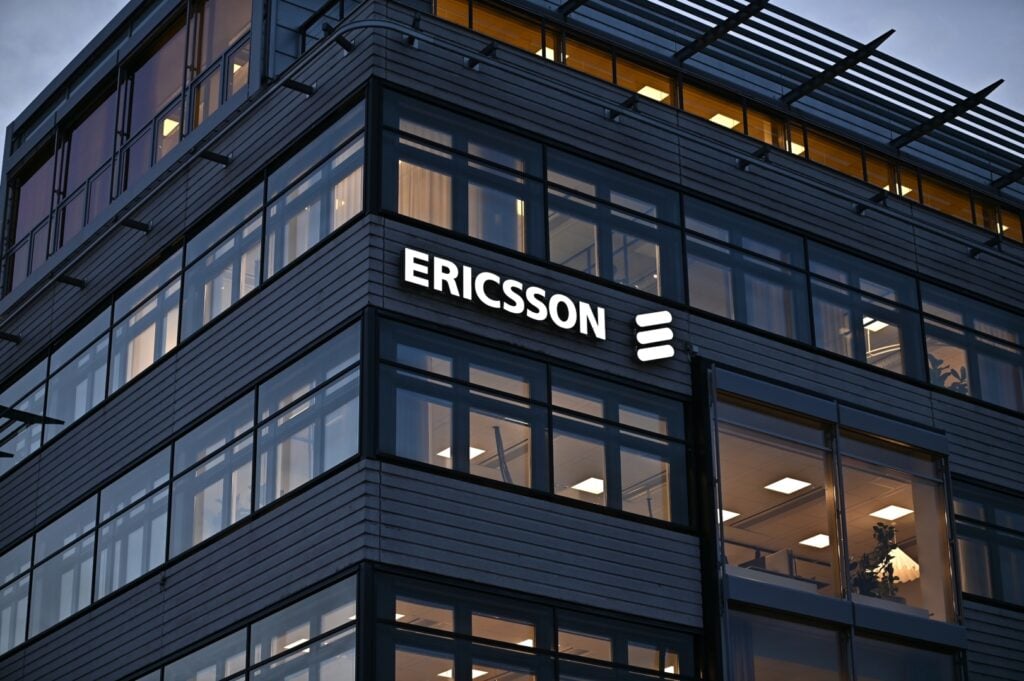
Ericsson (NASDAQ:ERIC) stock jumped nearly 10% Thursday after the telecom equipment maker reported better-than-expected third-quarter earnings and revenue, driven by stronger mobile network demand and tighter cost controls.
However, management warned that a flat radio access network (RAN) market and rising component costs could weigh on performance through 2027.
Ericsson Beats Earnings and Revenue Estimates
Ericsson reported third-quarter revenue of 59.5 billion Swedish kronor ($6.17 billion), up 6% year over year. Revenue topped Wall Street’s estimate of $5.79 billion.
Organic sales increased 7%, according to the company’s investor update.
Earnings of 18 cents per share beat the analyst consensus estimate of 14 cents.
Chief Financial Officer Lars Sandström said sales increased across all regions except the Americas. Japan, India, Vietnam and the Middle East led growth.
Networks revenue rose 9% to 38.7 billion kronor, while Cloud Software and Services sales increased 3% to 15.8 billion kronor.
Enterprise revenue fell 10% on a reported basis, reflecting the previous year’s sale of iconectiv. However, organic sales rose 1%.
Adjusted earnings before interest, taxes and amortization (EBITA) reached 10.1 billion kronor, beating analysts’ expectations of 7.93 billion kronor, Bloomberg reported Thursday.
Ericsson shares climbed as much as 11% in Stockholm, marking their largest intraday gain since January.
Higher Margins Help Offset Rising Costs
Ericsson’s adjusted gross margin remained largely stable at 47.7%, compared with 48.1% a year earlier. Its adjusted EBITA margin stood at 17%, excluding the prior-year divestment gain.
The Networks division maintained an adjusted gross margin of 50.3%, while its EBITA margin reached 23.1%.
Higher equipment sales drove much of the earnings improvement. Meanwhile, a favorable product mix and retroactive intellectual property rights revenue helped offset rising component costs.
Operating expenses, excluding restructuring charges, fell by about 700 million kronor to 18.4 billion kronor.
CEO Per Narvinger told Bloomberg that some customers accelerated orders ahead of expected price increases.
See More:
Top Value Stocks
Ericsson Warns of Pressure Through 2027
Despite stronger quarterly results, Ericsson faces continued pressure from a largely flat radio access network (RAN) market and rising component costs.
During the earnings call, Narvinger warned that the AI boom is driving up equipment costs, which Ericsson cannot absorb indefinitely without hurting profitability.
The company is raising prices in new tenders and negotiating increases with existing customers. However, long-term contracts could delay these adjustments, putting pressure on profit margins through 2027.
Narvinger also cautioned that telecom operators may eventually pass the higher costs on to consumers.
AI Technology and Rivalry Shape Ericsson’s Strategy
Ericsson continues to prioritize custom-designed chips for telecommunications networks as artificial intelligence reshapes the industry.
Narvinger said Ericsson’s AI-Native Link Adaptation technology improves spectrum efficiency by 10%. The technology is already deployed across more than 60,000 base stations operated by three customers.
Meanwhile, rival Nokia Corp. (NYSE:NOK) is expanding into AI data center networking and integrating chips from NVIDIA Corp. (NASDAQ:NVDA) into radio access networks, Bloomberg reported.
Ericsson, however, remains focused on purpose-built telecommunications equipment.
The company also plans to combine its two Asian market areas into a single Asia-Pacific division. In addition, it will reorganize its enterprise wireless business to sharpen its focus on indoor connectivity.
Narvinger told Bloomberg that the changes should strengthen Ericsson’s position in Asia and help mobile operators compete with satellite internet provider Starlink.
AT&T Agreements Strengthen U.S. Business
Ericsson’s U.S. business continues to benefit from its five-year, $14 billion network modernization agreement with AT&T Inc. (NYSE:T).
Bloomberg also highlighted a separate radio equipment agreement linked to wireless spectrum that AT&T acquired from EchoStar.
Narvinger said satellite services complement traditional mobile networks rather than replace them. He identified indoor coverage as a key advantage for terrestrial networks.
ERIC Price Action: Ericsson shares were trading up 9.81% at $10.52 at the time of publication on Thursday, according to Benzinga Pro data.
Photo via Shutterstock