On April 14, 1912, the Titanic’s wireless room took a series of ice warnings from other ships. The liner kept steaming at about 22 knots.
It struck an iceberg shortly before midnight and sank in under three hours. A British inquiry later ruled the speed excessive.
Wall Street received a warning of its own this month. It came with a number: 6%.
Global fund managers told Bank of America that a 10-year Treasury yield of about 6% is the level at which they would move money out of stocks and into bonds.
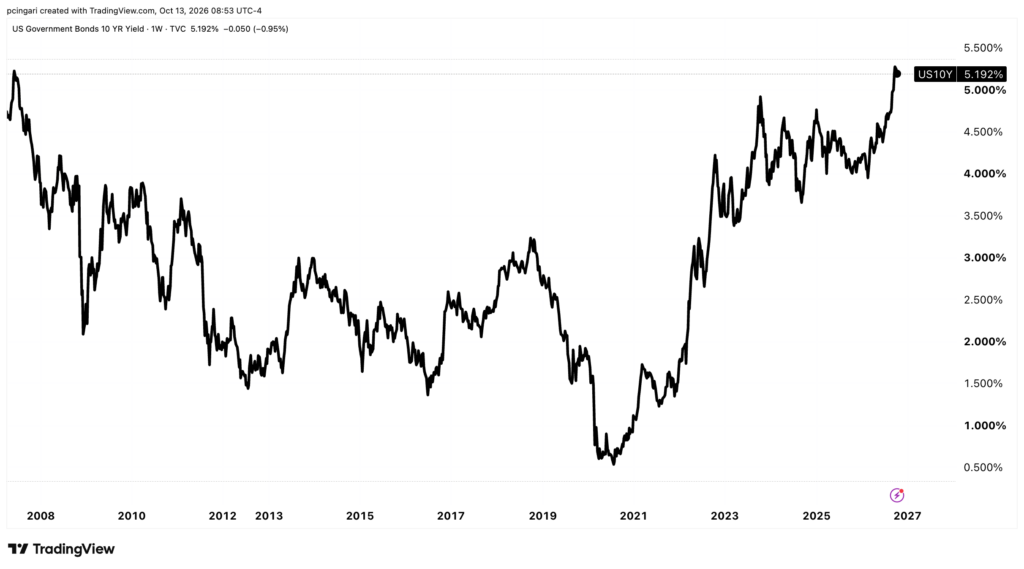
The 10-year yield traded at 5.19% on Tuesday, after touching a 24-year high of 5.36% last week.
But the same survey holds a second number. One in five managers said they do not need 6%. For them, yields are already high enough to sell stocks for bonds.
So far, the market has barely slowed.
Where Fund Managers See the Iceberg
Strategists at Bank of America, led by chief investment strategist Michael Hartnett, surveyed 185 fund managers overseeing $512 billion between Oct. 2 and Oct. 8.
One question asked at what 10-year Treasury yield they would consider shifting their allocation from stocks to bonds.
The most common answer was 6.0%, chosen by 37% of respondents.
Another 14% said 6.5%, and 8% said 7% or higher.
The rest of the answers are closer. Some 12% set their trigger at 5.5%, and 19% said yields are already there.
The weighted average of all answers is 5.9%, according to Bank of America.
Added together, 68% of respondents would have reached their trigger by the time the 10-year yield hits 6%.
Investors are “waiting for ~6% yields before flipping from stocks to bonds,” Hartnett’s team said.
Why a 6% Treasury Yield Matters for Stocks
A common way to compare stocks and bonds is the earnings yield. It is the profit that S&P 500 companies are expected to earn over the next 12 months, divided by the price of the index.
The S&P 500 trades at 19.1 times expected earnings, according to FactSet.
That equals an earnings yield of about 5.2%.
The 10-year Treasury yields 5.19%. As a result, stocks and government bonds now pay almost the same.
At 6%, the bond would pay clearly more.
For the earnings yield to match it, the S&P 500 would have to trade at about 16.7 times expected earnings. With profit forecasts unchanged, that implies an index roughly 13% lower.
Chart: 10-Year Treasury Yields Have Recently Hit The Highest Level Since 2007
Fund Managers Have Barely Slowed Down
The 6% level matters because of how investors are positioned ahead of it.
Managers named a disorderly rise in bond yields as the biggest tail risk for markets, at 31%. In August it ranked second. An artificial intelligence bubble is now second at 23%.
Yet portfolios have changed little. Fund managers are net 44% overweight stocks, down only slightly from net 49% in September, and net 37% underweight bonds.
Net overweight is the share of managers holding more of an asset than their benchmark, minus the share holding less.
Cash was unchanged at 3.9% of portfolios. Bank of America treats a cash level at or below 4% as a contrarian sell signal for stocks.
| Asset | Fund manager positioning | ETF | 2026 price change |
|---|---|---|---|
| Technology stocks | Net 37% overweight, highest since August 2020 | State Street Technology Select Sector SPDR ETF (NYSE:XLK) | +34.8% |
| Bank stocks | Net 13% overweight, biggest monthly cut since March 2023 | State Street SPDR S&P Bank ETF (NYSE:KBE) | +4.4% |
| Real estate | Net 22% underweight, lowest since August 2024 | State Street Real Estate Select Sector SPDR ETF (NYSE:XLRE) | +3.9% |
| Consumer discretionary stocks | Net 34% underweight, lowest since July 2008 | State Street Consumer Discretionary Select Sector SPDR ETF (NYSE:XLY) | -6.5% |
| Bonds | Net 37% underweight | iShares 20+ Year Treasury Bond ETF (NASDAQ:TLT) | -10.7% |
Is the S&P 500 About to Hit the Iceberg?
Most managers do not expect yields to get there.
Only a net 1% see long-term rates higher in 12 months, down from a net 15% in September and the lowest since May 2025.
Betting against Treasuries is also the second most crowded trade in the survey, named by 27% of managers, up from 18% in September. A crowded bet can reverse quickly, which would pull yields lower.
Prediction markets agree.
Polymarket traders assign a 7% probability that the 10-year yield reaches 6% before the end of 2026, up from about 3% a month ago.
Earnings are the other defense. S&P 500 profits are expected to grow 29.6% in the third quarter from a year earlier, according to FactSet.
The Titanic had its warnings on paper hours before the ice came into view. The speed stayed the same.
Fund managers have now put theirs in writing. It reads 6%, and the S&P 500 is still within 0.2% of its record.
Photo: Shutterstock