The gap between the cost of using and producing artificial intelligence is widening. Inference-token costs have been falling roughly 47% a quarter—about 13x a year—faster than technologies like compute, lithium batteries, or electricity ever managed.
Meanwhile, inputs run the other way. Hyperscalers—Alphabet Inc. (NASDAQ:GOOG), Microsoft Corporation (NASDAQ:MSFT), Amazon.com, Inc. (NASDAQ:AMZN), Meta Platforms, Inc. (NASDAQ:META) and Oracle Corporation (NYSE:ORCL)—will spend about $750 billion on data centers this year, more than $1 trillion next year and over $5 trillion across four years.
Jessica Watcher, a Wharton finance professor and former SEC chief economist, says the AI companies must achieve 2.7 times productivity gains to cover depreciation, the cost of capital, and a standard 15% hurdle rate by 2030.
Without that cash flow explosion, Wachter warns, “the current buildout will be the largest misallocation of capital in history.”
Financial Engineering and Macro Collision
Silicon Valley has long insisted that balance-sheet cash reserves would self-fund this physical revolution, but that premise no longer holds.
Infrastructure spending devoured Alphabet’s nearly $120 billion in quarterly revenue, leaving a $5.9 billion free-cash deficit—its first since the 2004 IPO. Morgan Stanley calculates that more than half of the $2.9 trillion hyperscalers will spend through 2028 will be financed with “external capital.”
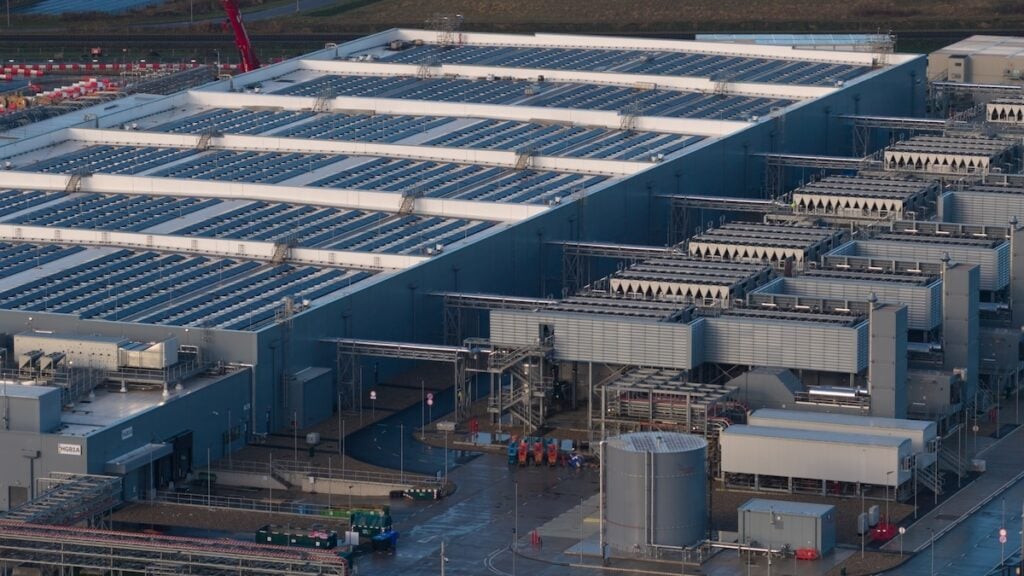
The structures are getting baroque. Meta handed 80% of its $30 billion Hyperion campus in Louisiana to Blue Owl Capital through a joint venture whose subsidiary leases the buildings back to Meta on four-year terms—matching the expected life of the GPUs inside.
If Meta walks, Columbia’s finance professor Stijn Van Nieuwerburgh said, investors are left “with an empty building and no cash flow.”
The corporate appetite for capital collides directly with the broader macro reality. In the latest memo, Oaktree co-founder Howard Marks warned that multi-trillion-dollar AI capital requirements don’t exist in isolation – they’re crashing into structural U.S. federal deficits running near 6% of GDP.
“The simplest rule of economics is that increased demand for something causes its price to rise,” he noted, pointing to the pressure on the cost of money.
See More:
Top Value Stocks
The Enterprise Disconnect
Economists see little or no economy-wide productivity gain from AI. In a Stanford survey of about 6,000 senior executives, about 90% reported no productivity increase over three years.
“If you don’t get the productivity gains, at some point people are going to sour on AI,” said the 2024 Nobel laureate Daron Acemoglu.
Meanwhile, Bain’s calculation puts $4.7 trillion in corporate profits in play by 2035—but only $1.1 trillion, or 24%, comes from productivity gains companies actually keep. The remaining 76% is innovation and competitive redistribution, including $1.3 trillion of existing profit changing hands.
“You’re more likely to lose share to the competitor that makes the best use of AI,” Bain points out.
The Parlay Bet
MIT Sloan professor and former SEC Chair Gary Gensler observes that the entire AI buildout currently functions as “a parlay bet by the capital markets and the economy.”
To deliver on these valuations, hyperscalers must simultaneously tick three boxes: extract trillions in direct software revenue, achieve widespread macro productivity, and successfully defend frontier model pricing against low-cost alternatives.
If a single leg fails, the financial structure collapses.
AI is rapidly changing the world, but when a technology’s price drops faster than the cost of capital used to build it, value inevitably flows to the user, leaving those who develop it holding the bag.
Image via Shutterstock