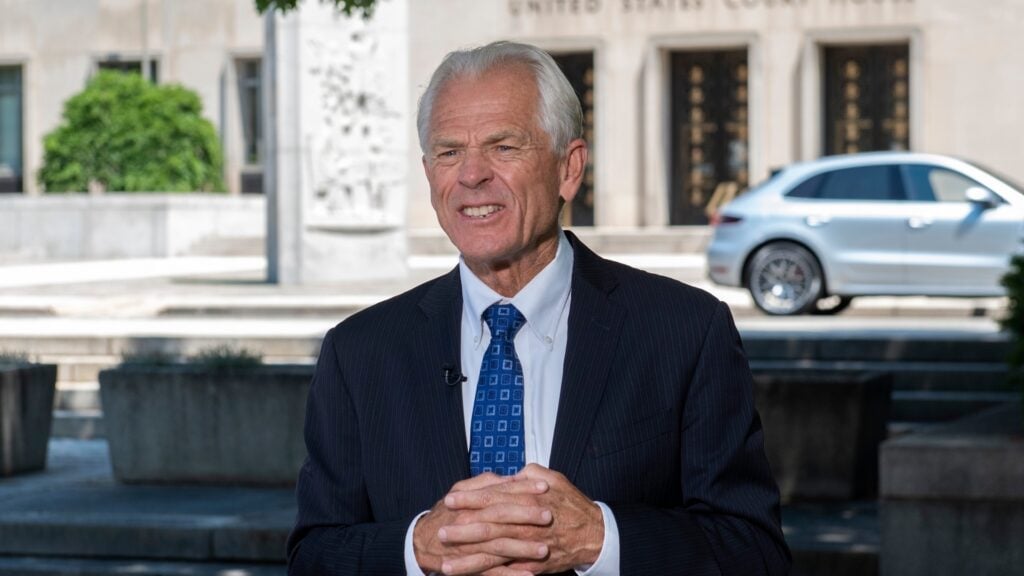
President Donald Trump‘s Trade Adviser, Peter Navarro, on Wednesday, criticized the Federal Reserve’s decision to hike interest rates to tackle inflation amid oil shocks.
Kevin Warsh Made a ‘Foolish’ Decision
Sharing a clip of his appearance on News Nation on the social media platform X, Navarro criticized Federal Reserve Chair Kevin Warsh‘s decision to hike interest rates by 25 basis points to 3.75% to 4.00%.
Navarro hailed economists and former Fed Chairs Alan Greenspan and Ben Bernanke. “What those two share in common… you never raise rates at the Fed into the teeth of an energy price shock,” Navarro said.
He added that Greenspan “did not raise rates” despite the energy woes following Iraq’s invasion of Kuwait in the early 1990s. Navarro added that Bernanke also did not hike Fed rates in 2006-07 when “Iran was doing its mischief again” and oil prices surged.
“Right now, oil prices are up, diesel prices are up,” Navarro said, adding that people were already paying more for fuel, which leaves them with less money to spend on the economy. “Effectively, an oil price shock does the work that a Fed rate hike would otherwise do, so you don’t need it as well. It’s like a double-tap on the economy,” Navarro said.
He also criticized Warsh, calling it a “foolish decision” by someone who is supposed to “be a smart guy.” Navarro warned that the Fed rate hike “would hurt” the U.S.
What is the Fed Rate?
The federal funds rate is the interest rate at which depository institutions lend balances held at the Federal Reserve to one another, typically overnight. The Fed sets a target range for the rate as its primary monetary-policy tool. The reserve balance refers to the voluntary amount of funds banks hold in their regional Federal Reserve Banks.
Changes in the federal funds rate can influence borrowing costs across the economy, including some credit cards, auto loans and mortgages, while also affecting yields on savings products.
Iran’s Parliament Speaker Mocks Fed Rate Hike
Following the Fed’s decision, Iran’s Parliament Speaker Mohammad Bagher Ghalibaf mocked the rate hikes, saying that Iran was in control of the Strait of Hormuz, and that uncertainty of ship movement through it was the real driver of inflation as oil prices rise.
Meanwhile, fuel costs continue to rise in the U.S., with the national average price of gas on Wednesday at $4.3672/gallon on Wednesday, while the national average price of diesel surged to $6.3103, according to data from the American Automobile Association (AAA).
Check out more of Benzinga’s Future Of Mobility coverage by following this link.
Photo courtesy: Consolidated News Photos / Shutterstock.com