
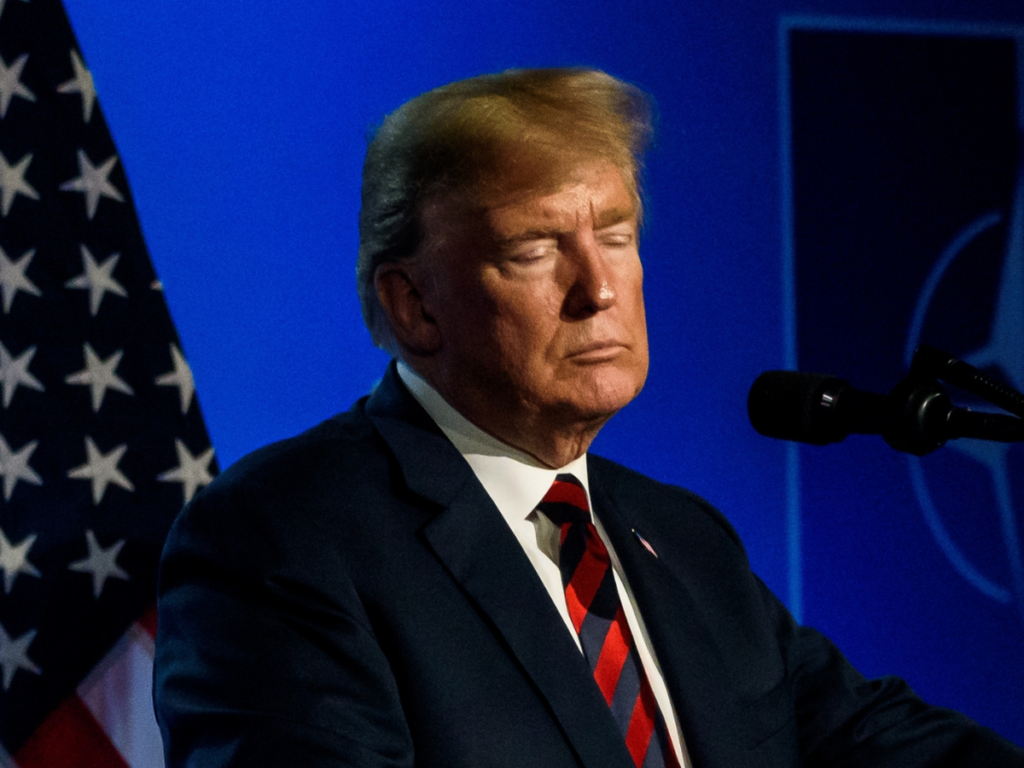
The AI trade may be about to grow far beyond GPUs. At the All-In Summit, President Donald Trump called data centers “the oil of the next 20–25 years,” arguing that they are making states and communities wealthy. Data proves otherwise.
Nvidia Corp. (NASDAQ:NVDA) CEO Jensen Huang agreed with the broader thesis, tying the surge in AI infrastructure to America’s industrial resurgence. Huang said roughly $400 billion in venture financing has flowed into AI companies over the past six months, creating jobs and enormous demand for computing power — which is, in turn, driving demand for data centers.
But that buildout is also creating a backlash in communities.
Costs Become Hard to Ignore
Trump said communities that were once struggling are now benefiting from data-center investment and warned that America cannot afford to slow the AI buildout.
But consider the facts: A single large AI data center can consume as much electricity as 100,000 homes, while the World Resources Institute estimates data centers could account for as much as 12% of U.S. electricity consumption by 2028.
Last year alone saw over $60 billion in rate increases, and the Energy Efficiency and Sustainable Infrastructure group says utilities are passing the cost of new generation, transmission and other infrastructure onto consumers, while electricity prices rose 11.5% in 2025.
Also, data centers reportedly create few lasting jobs — often fewer than 150 people, sometimes just 25 — once construction ends. Generous state tax breaks mean the touted economic gains (like the $162 billion in government revenue by 2023) look smaller once abatements are netted out, while local governments can still be stuck covering water and grid upgrades long after.
AI Infrastructure Goes Beyond GPUs
Huang, whose net worth is currently estimated at about $183 billion, describes AI as a “new industrial revolution.” It requires not just chips but manufacturing, electricity, and physical infrastructure to produce intelligence at scale. The catch is that all three are becoming sources of friction for the communities hosting the boom.
That broadens the investor opportunity beyond Nvidia. Power generators such as Vistra Corp. (NYSE:VST) and Constellation Energy Corporation (NASDAQ:CEG), electrical-equipment makers GE Vernova Inc. (NYSE:GEV) and Eaton Corporation, PLC (NYSE:ETN), and data-center REITs Digital Realty Trust, Inc. (NYSE:DLR) and Equinix, Inc. (NASDAQ:EQIX) could all sit along the AI infrastructure chain.
While these companies benefit from Trump’s oil comparison, that boom comes at a cost.
Beyond rising electricity demand, water consumption, and infrastructure spending, there’s also the environmental toll. Elon Musk‘s xAI and other tech companies, for example, currently face major federal and local lawsuits over air pollution, noise, and unpermitted power equipment at AI data center sites.
And new builds in states like California have clustered near lower-income communities.
Shutterstock