
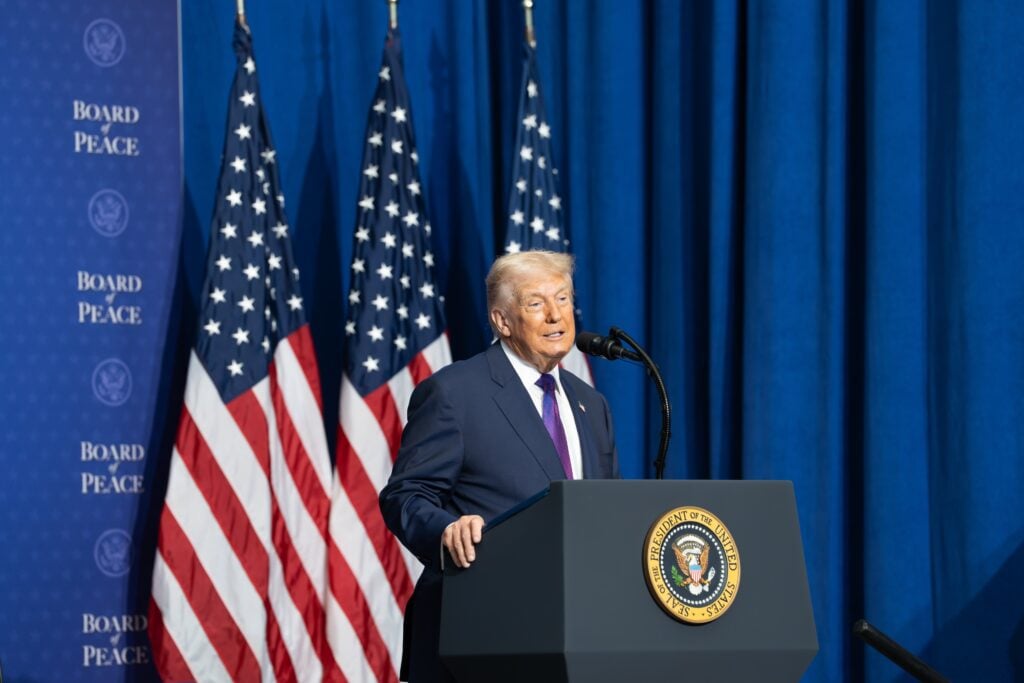
President Donald Trump‘s second-term “Peace Through Strength” foreign policy could lead to net taxpayer savings of nearly $326 billion over four years, according to a report by the GOP-associated group Polaris National Security.
The comprehensive 72-page analysis compares these projected savings to a hypothetical second term under Biden-Harris, which the report suggests would have cost American taxpayers an estimated $512 billion.
The report stated that the Trump administration required about $186 billion in investments to reestablish “deterrence,” including military operations overseas and robust border enforcement, which led to about $326 billion in net taxpayer savings over the president’s term, or $2,500 per American household.
Significant savings are also expected from the joint U.S. and NATO Prioritised Ukraine Requirements List (PURL), projected to save taxpayers $258 billion, and the administration’s initiatives to secure the U.S.-Mexico border, preventing an estimated $158 billion in projected costs, the report noted.
The report further credits savings to the administration’s restructuring of the U.S. Agency for International Development (USAID), projected to save nearly $47 billion.
In addition, the report suggests that by brokering an end to the war in Gaza, securing a U.S.-Houthi ceasefire, and ending Iran’s projected containment burden, the Trump Administration is forecast to save about $49 billion in taxpayer costs that a second Biden-Harris term would have incurred.
Polaris added that the figures exclude several unquantified costs that Trump’s foreign policy may have avoided, including prolonged indefinite counter-drug expenditures of leaving former Venezuelan President Nicolas Maduro in power, Red Sea shipping disruptions and risks from a nuclear-armed Iran.
Iran War Cost Escalates
The report comes on the heels of the estimate that the U.S. war with Iran has cost consumers over $100 billion through higher energy prices, according to Brown’s Watson School’s Iran War Energy Cost Tracker.
In July, the Pentagon estimated the U.S.-Israel war against Iran has cost $37.5 billion, up $8.5 billion from its May estimate. Defense Secretary Pete Hegseth defended nearly $70 billion in supplemental funding during a Senate hearing, with the request forming part of Trump’s proposed $1.5 trillion defense budget.
Sen. Bernie Sanders (I-VT) criticized Trump’s Iran war, arguing that the conflict was causing higher fuel prices and adding economic pressure on American households. Sanders stated, “We must end this war NOW.”
Oil Markets Face Fresh Pressure
Obsidian Risk Advisors’ Brett Erickson said Trump may have lost influence over oil markets as Iran tensions intensify. At the same time, Goldman Sachs raised its oil-price forecasts, warning that crude could surpass $120 a barrel if supply disruptions in the Persian Gulf persist.
At the time of writing, Brent crude oil futures expiring in October were trading 2.75% higher at $100.61 per barrel, while WTI crude futures expiring in October were trading 2.30% higher at $95.17per barrel.
Disclaimer: This content was partially produced with the help of AI tools and was reviewed and published by Benzinga editors.
Image via Shutterstock