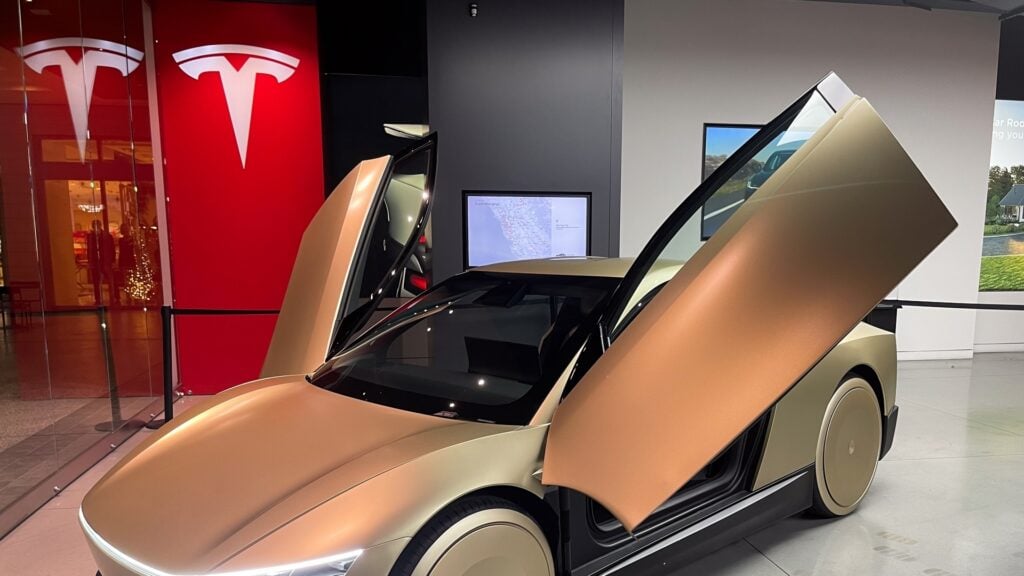
Tesla Inc‘s (NASDAQ:TSLA) Cybercab rollout in Austin, Texas, is producing two completely different stories. On some trips, riders have paid less than half of what Uber Technologies, Inc (NYSE:UBER) charged for the same route. On others, Cybercab fares have surged well above Uber’s prices. The contrast offers an early look at the economics behind Tesla’s robotaxi strategy—and the biggest challenge it still faces.
Tesla Cybercab Pricing
Early fare comparisons suggest Tesla’s autonomous ride-hailing model can deliver a meaningful cost advantage when demand is under control.
Several riders shared side-by-side screenshots showing Cybercab fares undercutting Uber on identical routes. In one comparison, a 15-minute trip cost $9.65 in a Cybercab versus $21.00 on Uber—a discount of more than 50%. Another comparison showed Tesla charging $19.35 for a route where Uber quoted $34.98, while a shorter 3.3-mile journey cost just $4.31 on Tesla’s network compared with $10.96 for UberX.
Those early comparisons support Elon Musk‘s long-held thesis that removing the human driver could eventually make autonomous rides cheaper than traditional ride-hailing.
Uber Price Advantage
Cybercab wait times stretched beyond an hour in Austin, and prices climbed sharply. For one 1.3-mile trip, Cybercab charged $15.24, while Uber listed the same route for $7.95, with its Wait & Save option falling to $6.41.
Perhaps the clearest sign of the supply crunch was that Cybercab briefly became more expensive than Tesla’s own four-seat Model Y Robotaxi on comparable trips.
The fluctuations do not necessarily undermine Tesla’s long-term economics. Instead, they reflect a familiar marketplace dynamic: when demand outpaces supply, prices rise.
Replying to a post about the increase in registration numbers for the Cybercab in Texas, Musk said “The degree to which Cybercab is optimized for lowest possible cost per mile (fully loaded) is understood by very few.”
With only a limited Cybercab fleet operating in Austin, surge pricing appears to be doing exactly what it is designed to do—balance demand until more vehicles become available.
What Investors Should Watch
The most important takeaway from Austin’s early fare data is not whether Tesla or Uber was cheaper on a particular day. It is that Tesla’s robotaxi economics appear capable of delivering lower prices—assuming enough vehicles are available.
That shifts the investment question from pricing to production. If Tesla can rapidly expand its Cybercab fleet, lower operating costs could become a durable competitive advantage over traditional ride-hailing. If fleet growth lags demand, however, frequent surge pricing could narrow that advantage and give platforms like Uber more room to compete, even in an autonomous future.
Photo courtesy: Shutterstock