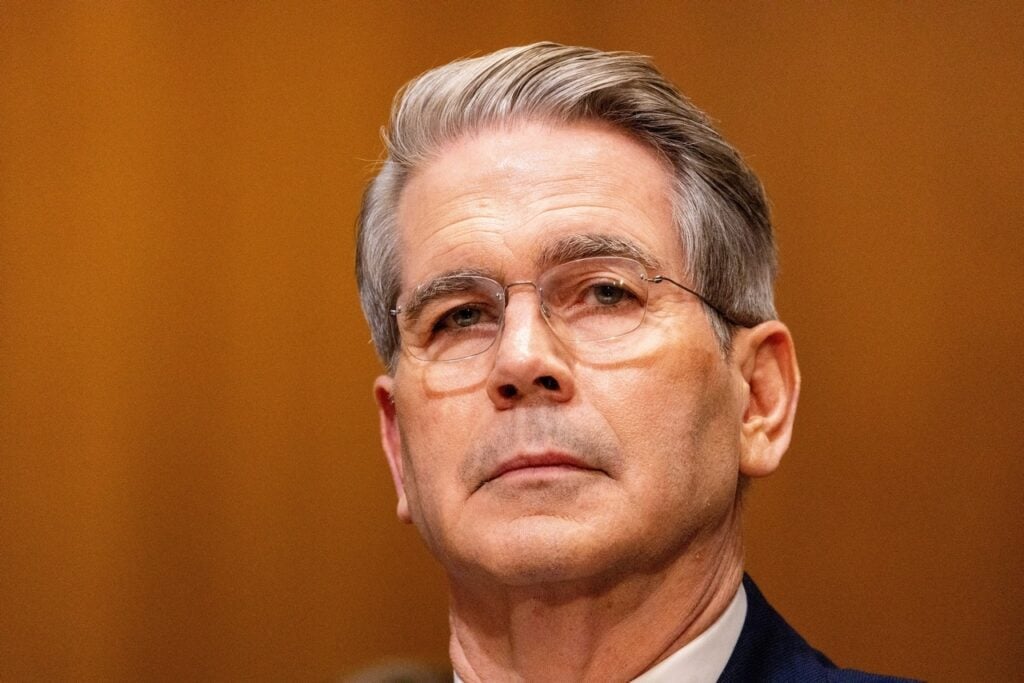
Treasury Secretary Scott Bessent on Thursday accused Iran’s government of funneling billions of dollars to terrorist proxies abroad, while its own citizens struggle to afford basic necessities, part of Washington’s escalating economic pressure campaign against Tehran.
‘The Regime Should Spend That Money For Its People’
“Instead of funneling billions of dollars to its terrorist proxies, the regime should spend that money for its people,” Bessent said in a post on X, calling the country’s regime “corrupt.”
The Iranian rial fell to a record low this month, with roughly 1.37 million rials needed to buy a single dollar at the time of writing.
Part of a Broader ‘Economic D-Day’ Campaign
Bessent declared “economic D-Day” on Iran last week, calling it “the single greatest financial offensive ever marshaled against an adversary” and added that the goal was to “sever every economic lifeline” sustaining the regime.
Bessent’s warning followed Trump’s threat on Iran with “the most crushing economic operation ever taken against any country”, warning that nations maintaining financial ties to Tehran would face severe consequences
The Treasury separately sanctions nearly 60 entities, individuals and vessels tied to Iran’s nuclear, missile, cyber and oil networks under a campaign dubbed “economic outcast.”
Iran Pushes Back As Tensions Continue
Iran’s Foreign Ministry spokesperson Esmaeil Baqaei accused the U.S. of “annihilating” international law and called the campaign “systemic bullying.”
Iranian oil loadings have fallen to just 248,000 barrels a day in August, down sharply from 1.85 million barrels a day in March and April, according to Kpler.
Iran and Oman have separately discussed a framework for a temporary navigational corridor through the Strait of Hormuz and agreed to work on clearing mines from the waterway, Reuters reported, while Trump said on Tuesday that all mines in the strait’s international waters had already been removed or detonated.
Earlier this week, Trump told Al Jazeera he has “no time schedule” for Iran to return to talks, saying “we are winning very big.”
Disclaimer: This content was partially produced with the help of AI tools and was reviewed and published by Benzinga editors.
Image via Shutterstock/ Maxim Elramsisy