

Elastic N.V.‘s (NYSE:ESTC) blowout fiscal first-quarter earnings didn’t just reward shareholders—it also put a spotlight on a split among prominent hedge funds.
While Paul Tudor Jones‘ firm initiated a new position ahead of the quarter, Steven Cohen‘s Point72 reduced its exposure before shares surged nearly 30% in pre-market trading on Friday, after the results.
The contrasting moves emerged as Elastic delivered a stronger-than-expected fiscal first-quarter report, raised full-year guidance, and highlighted accelerating adoption of its AI-powered search platform, sending the stock to fresh 52-week highs in pre-market trading.
Paul Tudor Jones And Steve Cohen Took Different Approaches To Elastic
Quarterly institutional filings show Tudor Investment, led by Paul Tudor Jones, established a new position in Elastic during the second quarter, purchasing roughly 204,000 shares.
Meanwhile, Point72 Asset Management, Steve Cohen’s hedge fund, reduced its holding by about 42%, trimming roughly 474,000 shares during the same period. Other notable managers were similarly divided. DE Shaw and Gotham Asset Management added to their positions, while AQR Capital Management, Millennium Management and Goldentree Asset Management pared theirs.
Those filings capture positioning ahead of Elastic’s earnings report—meaning investors were expressing differing views on the company’s AI trajectory before management delivered its latest update.
Elastic Gave Investors Plenty to Like
The company reported adjusted earnings of 70 cents per share on $478 million in revenue, comfortably ahead of Wall Street expectations. Management also raised its full-year outlook after describing record additions of large enterprise customers and growing momentum across Search & AI, Security and Observability.
Chief Executive Ash Kulkarni said the company is benefiting from a shift in how enterprises are adopting artificial intelligence. “AI is reshaping the enterprise technology stack.”
Elastic also disclosed that more than 37% of customers generating over $100,000 in annual contract value now use the platform for AI workloads, up from about 21% a year earlier. The company completed its acquisition of Deductive AI earlier this week, strengthening its AI-powered observability capabilities.
Beyond the Earnings: Elastic’s Technical Picture Strengthens
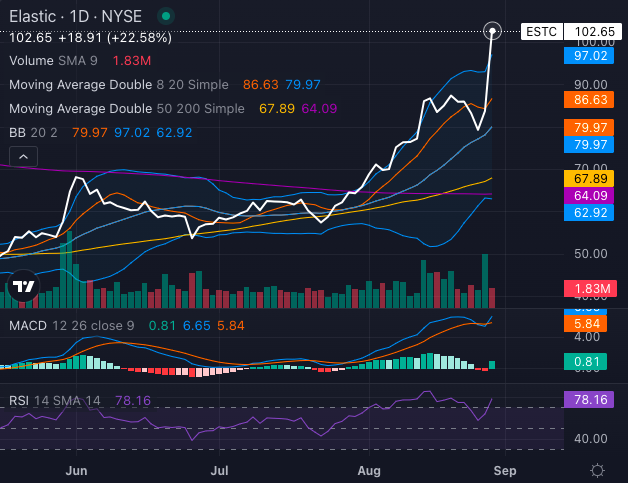
Chart created using Benzinga Pro
The stock recently formed a Golden Cross, a widely watched bullish signal that occurs when the 50-day moving average rises above the 200-day moving average, often indicating improving long-term momentum. Friday’s earnings-driven rally pushed the shares decisively above that crossover, while trading volume expanded sharply as the stock broke out to new 52-week highs.
Momentum indicators also remain elevated. The Relative Strength Index (RSI) has climbed toward overbought territory, reflecting the intensity of the post-earnings buying, while the stock is trading above its upper Bollinger Band—a sign of strong momentum that can sometimes precede increased volatility.
Institutional Investors Were Far From Unanimous
Tudor Jones’ decision to establish a position contrasts with Point72’s reduction, but the quarter ultimately reinforced management’s argument that AI is becoming a durable growth driver rather than a short-lived catalyst.
For investors, the next question is whether Elastic can sustain that momentum. Record additions of large enterprise customers, rising AI adoption across its installed base and a higher full-year outlook suggest demand remains healthy.
After a nearly 30% post-earnings rally, however, the focus will shift from beating expectations to proving that AI-led growth can continue at this pace.
Image via Shutterstock