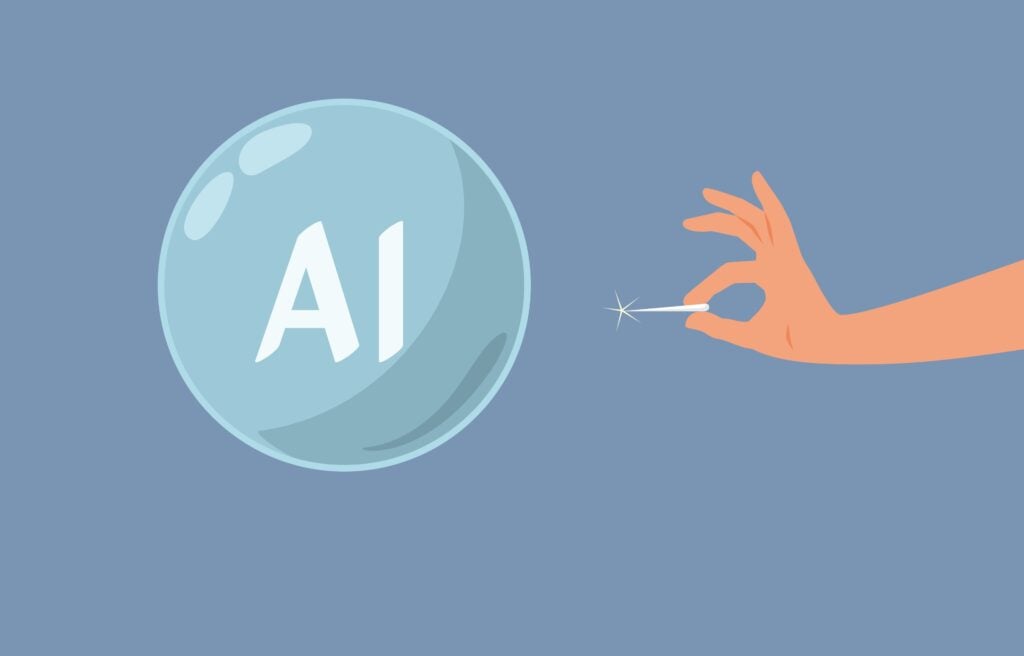
The debate over the artificial-intelligence boom has mostly been framed as a market question: whether NVIDIA Corp.’s (NASDAQ:NVDA) valuation is stretched, whether hyperscalers are overbuilding data centers, whether the capital-expenditure cycle can eventually be justified by revenue.
According to Scott Ortkiese, CEO & President of Faulkner Capital Holdings, that’s the wrong question. “The important story is not whether the bubble pops; the important story is who pays when it does,” he wrote for Throughline Synthesis.
His argument is that the risk has already been routed away from venture investors and chip buyers into a machinery of private credit, life-insurance reserves and state guaranty funds.
The apparent equity bubble, in Ortkiese’s telling, is really a credit structure — one that connects NVIDIA’s AI infrastructure ambitions to annuity holders and, eventually, state taxpayers.
The scale became explicit on Aug. 10, 2026, when NVIDIA announced memoranda of understanding with Apollo Global Management Inc., BlackRock Inc., Blackstone Inc., Brookfield Corp., Goldman Sachs Group Inc. and KKR & Co. Inc. to mobilize more than $500 billion of third-party capital for AI compute infrastructure. Jensen Huang, Ortkiese notes, also disclosed NVIDIA could backstop as much as $125 billion, or a quarter of the potential deals.
That announcement, he argues, didn’t create the risk. It revealed the transmission channel.
From Bank Lending to Unregulated Shadow Debt
In the financial crisis aftermath, private credit expanded into the space banks vacated. Regulations like Basel III, Dodd-Frank, and the Volcker Rule made leveraged, illiquid lending more expensive for regulated banks to hold. The markets that private funds built there, Ortkiese believes, exceeded $1.8 trillion by 2024 and could reach $3 trillion by 2028.
Its appeal was simple – higher yields without the visible volatility of public bonds. But for Ortkiese – the absence of volatility wasn’t because the risks were lower, but rather owing to discretionary marks.
Unlike banks, private credit funds don’t hold bank-level regulatory capital, don’t fail into FDIC receivership, nor are they examined under the same supervisory regime.
Their assets are typically marked quarterly using manager-selected models, and ratings may come from agencies retained by the borrower’s sponsor.
“Every discretionary handle in that sentence sits with the party that has the most to lose if the truth comes out,” Ortkiese writes.
The Life Insurance Pipeline
The next step was funding. Private equity firms didn’t merely raise credit funds – they acquired or partnered with life insurers and annuity providers, gaining access to long-duration reserves that don’t redeem like hedge-fund capital.
Apollo seeded Athene and now controls it. KKR bought Global Atlantic. Blackstone partnered with Corebridge and controls Fortitude Re. Brookfield bought American National and American Equity Investment Life. Ares Management Corp. owns Aspida.
Traditional life insurers, Ortkiese says, hold roughly 13% of portfolios in alternatives such as private placements, private credit and structured products. Private-equity-owned insurers hold closer to 50%, often including loans originated or sponsored by the parent asset manager.
The closed loop is the point. Policyholder premiums can be deployed into private credit vehicles financing data-center SPVs and neoclouds such as CoreWeave Inc. or Lambda Inc., which buy NVIDIA hardware and rely on compute commitments from AI labs and hyperscalers.
“That is not a life insurance company,” Ortkiese writes. “It is a private credit fund wearing a life insurance company as a costume.”
The Unwinding Mechanism
The fragility lies in the frequently criticized promised AI spending and actual cash generation. Ortkiese cites roughly $1.1 trillion of compute commitments by OpenAI and Anthropic through 2030 against around $17 billion in combined 2025 revenue.
If end-user revenue fails to service the debt, the cascade begins with neocloud and data-center SPVs. Defaults force impairments at private credit funds and vendor backstops move from footnotes to the income statement. Collateral once marked near par like chips, leases, and compute contracts, gets revalued lower.
The next pressure point is the insurer balance sheet. If policyholders seek surrenders as asset values fall, PE-owned insurers could face an old-fashioned insurance run backed by a very modern asset – depreciating AI infrastructure.
The Automatic State Backstop
However, unlike banks, insurers don’t fail into the FDIC. State guaranty associations handle insolvent life insurers, which assess surviving insurers to protect policyholders up to statutory limits.
Ortkiese’s central claim is that this mechanism quietly socializes the losses. Drawing on work by Andrew Granato at the University of Texas at Austin and Pranjal Drall at Yale, he notes that 44 states allow assessed insurers to claim a 100% premium-tax credit over five to 10 years.
In plain terms, surviving insurers pay first. State general funds absorb the cost later through forgone premium-tax revenue. Taxpayers pay through tighter municipal budgets, reduced services, higher taxes or borrowing — without a congressional vote, a TARP debate or a Federal Reserve facility.
“The bailout has already been legislated,” Ortkiese states. “It runs automatically, jurisdiction by jurisdiction, the moment the receiver’s assessment goes out.”
Image via Shutterstock